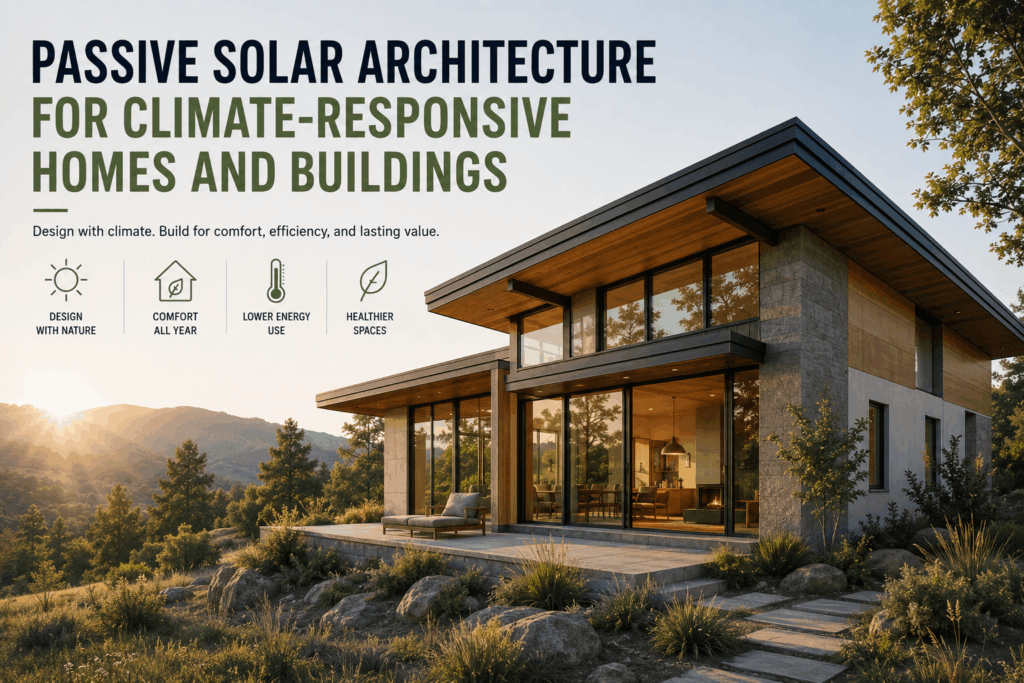
Passive Solar Architecture for Climate-Responsive Homes and Buildings
Passive Solar Architecture helps homeowners, architects, self-builders, students, and investors understand how to design buildings that work with the sun, climate, site, and materials.
Here you can learn how passive solar design uses orientation, windows, shading,
thermal mass, insulation, airtightness, ventilation, daylighting, and building form to improve comfort and reduce unnecessary heating and cooling demand.
Passive solar design is not the same as adding solar panels. It is not automatically the same as Passive House certification. It is an architectural approach that starts with climate, site, and building design before mechanical systems or renewable energy are added.
Start Here |
Learn Passive Solar Design |
Use the Design Tools
Start With the Fundamentals
New to passive solar architecture? Start with the core ideas before choosing materials, windows, overhangs, or calculators.
| Page |
What You Will Learn |
Best For |
| What Is Passive Solar Architecture? |
A clear definition of passive solar architecture and how it differs from solar panels and Passive House. |
Beginners, homeowners, students |
| Passive Solar Fundamentals |
The basic principles behind sun, heat, windows, mass, shading, insulation, and ventilation. |
Self-builders, students, early-stage clients |
| Passive Solar Design Principles |
The main design rules and trade-offs that shape successful passive solar buildings. |
Architects, designers, builders |
| Passive Solar House Design |
How to apply passive solar ideas to a real home design, from site planning to room layout. |
Homeowners, architects, self-builders |
What Passive Solar Design Really Means
Passive solar design means using the building itself to manage heat and light. It works by coordinating several design decisions rather than relying on one feature.
A passive solar building usually considers:
- Climate: whether the main design challenge is heating, cooling, humidity, or seasonal balance.
- Orientation: how the building faces the sun, especially equator-facing glazing.
- Windows: how much glass is used, where it is placed, and what type of glazing is selected.
- Shading: how unwanted sun is blocked before it enters the building.
- Thermal mass: how dense materials store and release heat.
- Envelope: how insulation, airtightness, and thermal bridge control reduce unwanted heat flow.
- Ventilation: how fresh air, moisture control, and passive cooling are managed.
- Daylighting: how natural light improves comfort without glare or overheating.
The strongest passive solar buildings are designed as systems. A large window, a concrete floor, or a deep overhang is not enough by itself.
Explore Passive Solar Design by Topic
| Topic |
Recommended Page |
Why It Matters |
| Climate |
Passive Solar Design by Climate |
Passive solar strategy changes in cold, temperate, hot-dry, hot-humid, and mixed climates. |
| Site Analysis |
Site & Climate Analysis |
The site determines solar access, shade, wind, slope, views, and design constraints. |
| Orientation |
Passive Solar Orientation |
Orientation affects solar gain, shading, daylight, room layout, and overheating risk. |
| Building Form |
Orientation & Building Form |
Shape, depth, layout, and compactness affect heat loss, daylight, and comfort. |
| Windows |
Passive Solar Windows |
Windows can provide useful sun and daylight, but also heat loss, glare, and overheating. |
| Window Placement |
Passive Solar Window Placement |
Window position affects sun penetration, thermal mass, views, privacy, and ventilation. |
| Shading |
Passive Solar Shading & Overhangs |
Shading controls unwanted heat before it enters the building. |
| Thermal Mass |
Thermal Mass |
Dense materials can store useful heat, but must be climate-appropriate and shaded correctly. |
| Materials |
Passive Solar Materials |
Materials affect heat storage, insulation, moisture, durability, and environmental impact. |
| Passive Systems |
Passive Solar Systems |
Direct gain, indirect gain, isolated gain, Trombe walls, and sunspaces work differently. |
Use the Passive Solar Design Tools
Our calculators and tools help you test early passive solar ideas before a design becomes fixed. They are educational tools and do not replace professional design, local climate data, energy modeling, or code review.
Explore all Passive Solar Design Tools
Passive Solar Design Depends on Climate
A passive solar home in a cold climate should not be designed the same way as a home in a hot-humid climate. Climate affects every decision: window size, shading, thermal mass, insulation, ventilation, materials, and passive cooling strategy.
For a broader overview, visit
Climate Guides.
Choose Your Path
PassiveSolarArchitecture.com is designed for different readers. Choose the path that best matches your role.
| Reader |
What You Need |
Recommended Path |
| Architects and Designers |
Clear technical guidance, design workflows, climate logic, and tools for early-stage review. |
For Architects |
| Self-Builders and Homeowners |
Plain-English explanations before buying land, choosing a plan, or approving a design. |
For Self-Builders |
| Investors and Developers |
Ways to evaluate comfort, performance risk, long-term value, and design quality. |
For Investors |
| Students |
Structured learning about climate-responsive architecture, sun path, heat flow, and building science. |
Learn |
Passive Solar Is Not Just Passive Heating
Passive solar architecture is often associated with winter sun and passive heating, but good design also includes passive cooling.
A complete passive solar strategy should ask:
- How will useful winter sun be admitted where heating is needed?
- How will unwanted summer sun be blocked?
- How will east and west windows be controlled?
- How will thermal mass avoid storing unwanted heat?
- How will the building remain comfortable during hot periods?
- How will ventilation, humidity, and indoor air quality be managed?
Learn more in
Shading & Passive Cooling.
Passive Solar vs Solar Panels vs Passive House
These terms are related to sustainable building, but they do not mean the same thing.
| Term |
What It Means |
Key Difference |
| Passive Solar Design |
Uses building design to manage sun, heat, shade, light, and comfort. |
Architectural strategy. |
| Solar Panels |
Use active technology to generate electricity or hot water. |
Energy production system. |
| Passive House |
A performance standard focused on very low energy demand, airtightness, insulation, windows, and ventilation. |
Certification/performance standard. |
A building can use passive solar principles, solar panels, and Passive House strategies together, but each one has a different purpose.
Read Passive Solar vs Passive House
Featured Learning Path
Not sure where to begin? Follow this sequence:
- Start Here
- What Is Passive Solar Architecture?
- Passive Solar Fundamentals
- Passive Solar Design Principles
- Passive Solar House Design
- Passive Solar Design by Climate
- Passive Solar Design Tools
- Passive Solar Design Checklist
Case Studies and Practical Examples
Passive solar design becomes easier to understand when you see how principles apply to real or realistic projects.
Visit
Passive Solar Case Studies to explore examples by climate, budget, building type, construction system, and before-after analysis.
Popular Topics
Our Approach
PassiveSolarArchitecture.com focuses on practical, climate-aware, technically reliable education.
Our content is designed to be:
- Clear: complex building science explained in plain English.
- Practical: focused on design decisions that affect real homes and buildings.
- Climate-aware: no one-size-fits-all recommendations.
- Balanced: benefits, limits, trade-offs, and risks are explained.
- Useful: includes guides, checklists, calculators, examples, and internal learning paths.
For more information, read
About Passive Solar Architecture and
Editorial Policy.
Frequently Asked Questions
What is passive solar architecture?
Passive solar architecture is a design approach that uses building orientation, windows, shading, thermal mass, insulation, airtightness, ventilation, daylighting, and climate response to improve comfort and reduce unnecessary heating and cooling demand.
Is passive solar design the same as solar panels?
No. Passive solar design uses the building itself to manage heat and light. Solar panels are active systems that generate electricity or hot water. A building can use both, but they are different strategies.
Does passive solar design work in every climate?
Passive solar principles can be useful in many climates, but the strategy changes. Cold climates may focus on useful winter sun and heat retention. Hot climates may focus on shade, airflow, passive cooling, and moisture control.
Can passive solar design eliminate heating and cooling?
Not automatically. Passive solar design can reduce heating and cooling demand when done well, but mechanical systems may still be needed depending on climate, comfort expectations, construction quality, and user behavior.
What is the most important passive solar design principle?
Climate-aware design is the foundation. Orientation, windows, shading, thermal mass, insulation, airtightness, and ventilation must all respond to the local climate and site conditions.
Should passive solar windows always face south?
No. For a global audience, the better term is equator-facing glazing. In the Northern Hemisphere, this usually means south-facing. In the Southern Hemisphere, it usually means north-facing.
Is passive solar design the same as Passive House?
No. Passive solar design is an architectural strategy. Passive House is a performance standard with specific requirements for energy demand, airtightness, insulation, windows, thermal bridges, and ventilation.
Where should I start learning?
Start with
Start Here, then read
What Is Passive Solar Architecture? and
Passive Solar Fundamentals.
Start Learning Passive Solar Architecture
Passive solar design works best when it starts early. Site, climate, orientation, windows, shading, thermal mass, insulation, airtightness, ventilation, and room layout should be considered together before key decisions become fixed.
Start Here |
Browse the Learning Hub |
Use the Tools |
Open the Checklist