
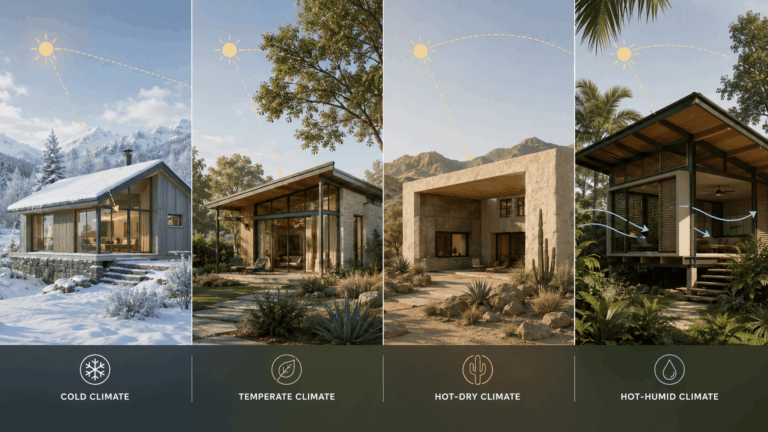
Climate Guides for Passive Solar Design
Passive solar design by climate helps you choose the right orientation, glazing, shading, thermal mass, insulation, and ventilation strategy for your region. Use these climate guides to understand how passive solar homes should respond to cold, temperate, hot-dry, hot-humid, mixed, and Southern Hemisphere conditions.
Passive solar design depends on climate. A strategy that works well in a cold mountain region may perform poorly in a hot-humid coastal climate. A house designed for northern Europe needs different priorities than a house in Australia, California, Serbia, Spain, Brazil, or Southeast Asia.
This Climate Guides section helps you understand how passive solar architecture changes across different climates. Use it to choose the right design priorities for heating, cooling, daylighting, shading, ventilation, thermal mass, insulation, and comfort.
The goal is not to copy one universal rule. The goal is to design a building that responds intelligently to its site, sun path, local weather, seasonal patterns, and occupant needs.
Start Here: Passive Solar Design by Climate
If you are new to climate-responsive design, begin with the main guide:
Read Passive Solar Design by Climate
This guide explains how passive solar strategies change between cold, temperate, hot-dry, hot-humid, mixed, and Southern Hemisphere locations.
You may also want to review:
- Site & Climate Analysis
- Passive Solar Orientation
- Passive Solar Design Principles
- Passive Solar Shading & Overhangs
- Thermal Mass
Why Climate Matters in Passive Solar Architecture
Passive solar architecture uses the building itself to work with the sun and climate. That means the best design strategy depends on local conditions.
Important climate factors include:
- Winter temperatures and heating demand
- Summer temperatures and cooling demand
- Humidity and moisture risk
- Cloud cover and solar availability
- Daily temperature swings between day and night
- Prevailing winds and natural ventilation potential
- Sun angle, latitude, and seasonal solar path
- Risk of overheating during summer and shoulder seasons
- Local building codes, construction methods, and material availability
A passive solar home in a cold climate may need to collect and store winter sun. A passive solar home in a hot climate may need to block most direct sun, encourage ventilation, reduce internal heat gain, and protect the building envelope from overheating.
Choose Your Climate Guide
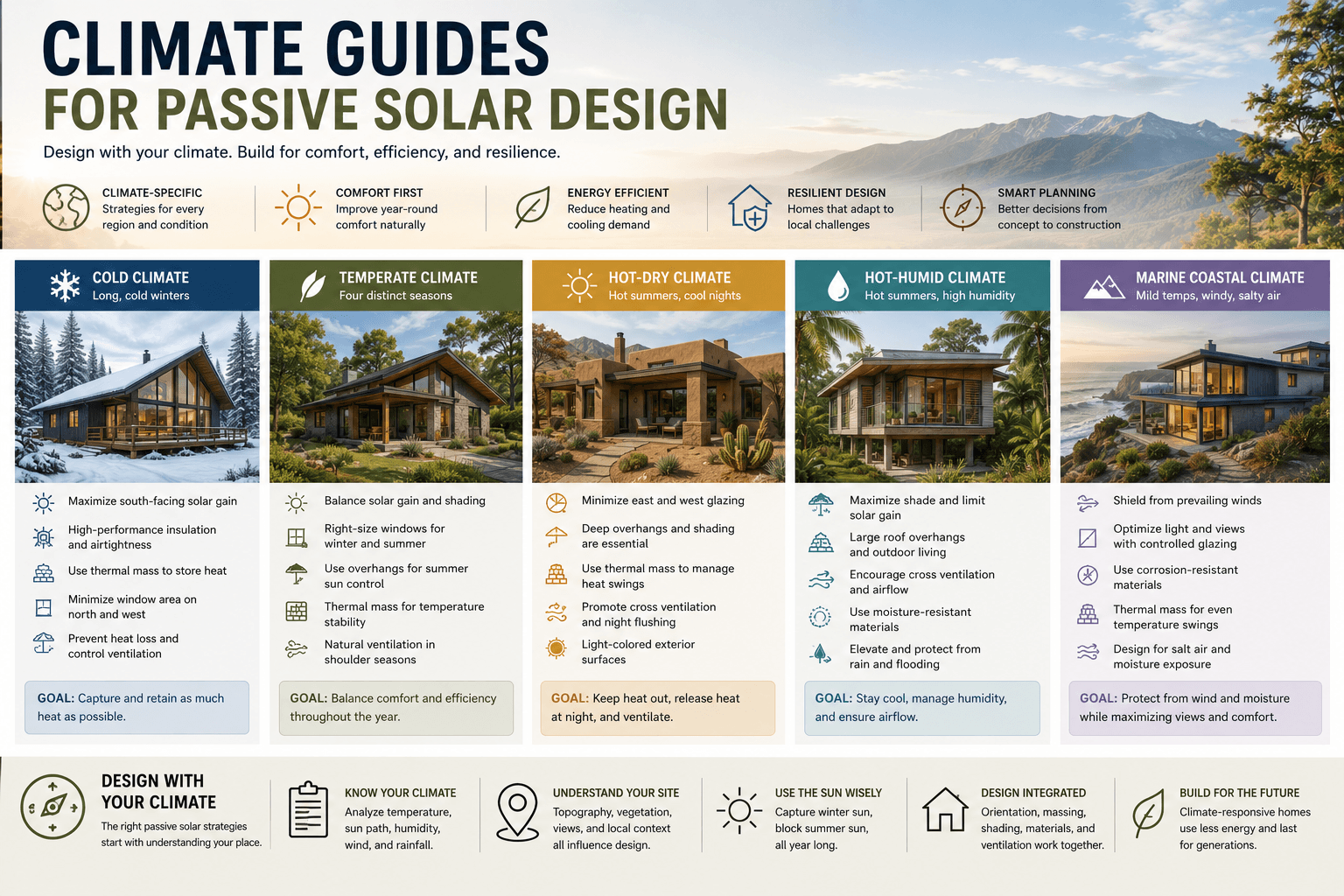
Select the climate type that best matches your project location. If your region has both strong heating and cooling seasons, start with the mixed climate guide.
| Climate Type | Main Design Priority | Recommended Guide |
|---|---|---|
| Cold Climates | Capture winter sun, reduce heat loss, and store useful solar heat | Passive Solar Design for Cold Climates |
| Temperate Climates | Balance winter solar gain, summer shading, daylight, and comfort | Passive Solar Design for Temperate Climates |
| Hot-Dry Climates | Control daytime heat, use thermal mass carefully, and support night cooling | Passive Solar Design for Hot-Dry Climates |
| Hot-Humid Climates | Block solar heat, encourage airflow, manage humidity, and avoid heat storage | Passive Solar Design for Hot-Humid Climates |
| Mixed Climates | Balance heating and cooling needs across different seasons | Passive Solar Design for Mixed Climates |
| Southern Hemisphere | Apply passive solar principles with reversed solar orientation | Passive Solar Design in the Southern Hemisphere |
Cold Climate Passive Solar Design
In cold climates, passive solar design usually focuses on collecting useful winter sun, reducing heat loss, and storing heat so indoor temperatures stay more stable.
The main challenge is not only getting solar gain into the building. The building also needs a high-performance envelope so that collected heat is not quickly lost through poorly insulated walls, roofs, floors, windows, air leaks, or thermal bridges.
Key priorities in cold climates
- Orient main glazing toward the equator-facing side of the building
- Use high-performance windows to reduce heat loss
- Limit excessive glazing on the east, west, and pole-facing sides
- Use thermal mass where winter sun can reach it
- Design roof overhangs to admit low winter sun and block high summer sun
- Prioritize insulation, airtightness, and thermal bridge reduction
- Check overheating risk during sunny winter days and shoulder seasons
Best starting links:
- Passive Solar Design for Cold Climates
- Passive Solar Orientation
- Thermal Mass
- Insulation, Airtightness & Ventilation
Temperate Climate Passive Solar Design
Temperate climates often need a balanced approach. Winter solar gain can be useful, but overheating may still be a problem in summer or during mild sunny seasons.
The best passive solar strategy in a temperate climate usually combines moderate equator-facing glazing, good shading, reliable ventilation, insulation, airtightness, and carefully placed thermal mass.
Key priorities in temperate climates
- Balance solar gain with overheating control
- Use moderate glazing rather than excessive glass
- Provide external shading for summer and shoulder seasons
- Use thermal mass to moderate indoor temperature swings
- Design for daylight without glare
- Use natural ventilation when outdoor conditions are suitable
- Adapt window performance to local heating and cooling demand
Best starting links:
- Passive Solar Design for Temperate Climates
- Windows, Glazing & Daylighting
- Passive Solar Shading & Overhangs
- Window-to-Wall Ratio Calculator
Hot-Dry Climate Passive Solar Design
Hot-dry climates often have strong sun, high daytime temperatures, and cooler nights. Passive design in these regions is usually more about cooling than heating.
Thermal mass can be useful in hot-dry climates when it is paired with night ventilation or other cooling strategies. Without night cooling, mass can store unwanted heat and make interiors uncomfortable.
Key priorities in hot-dry climates
- Reduce direct solar gain during hot periods
- Use deep shading, courtyards, verandas, screens, or recessed openings
- Control east and west sun carefully
- Use thermal mass only with a clear night-cooling strategy
- Encourage night ventilation when outdoor temperatures drop
- Protect roofs and walls from intense solar exposure
- Use daylight strategies that avoid glare and heat gain
Best starting links:
- Passive Solar Design for Hot-Dry Climates
- Shading & Passive Cooling
- Roof Overhang Calculator
- Thermal Mass Calculator
Hot-Humid Climate Passive Solar Design
Hot-humid climates require a different approach from hot-dry climates. Because nights often remain warm and humidity is high, thermal mass and night cooling may be less effective.
The main priorities are shading, airflow, moisture control, lightweight construction where appropriate, solar protection, and reducing unwanted heat gain.
Key priorities in hot-humid climates
- Prioritize shade before solar heat enters the building
- Use large roof overhangs, verandas, screens, and shaded outdoor spaces
- Encourage cross ventilation where climate and air quality allow
- Reduce east and west exposure
- Avoid unnecessary thermal mass that stores unwanted heat
- Protect walls and roofs from solar radiation and moisture
- Consider mechanical dehumidification or controlled ventilation where needed
Best starting links:
- Passive Solar Design for Hot-Humid Climates
- Shading & Passive Cooling
- Insulation, Airtightness & Ventilation
- Passive Solar Window Placement
Mixed Climate Passive Solar Design
Mixed climates are among the most challenging for passive solar architecture because buildings must perform well in both heating and cooling seasons.
A mixed-climate design may need useful winter sun, strong summer shading, good insulation, airtightness, controlled ventilation, and flexible strategies that change with the season.
Key priorities in mixed climates
- Balance winter solar gain with summer overheating prevention
- Use adjustable or seasonal shading when fixed shading is not enough
- Design windows by orientation, not only by view
- Use insulation and airtightness to reduce both heating and cooling loads
- Use thermal mass carefully and test overheating risk
- Plan for natural ventilation when outdoor conditions are favorable
- Use early-stage calculations before fixing glazing and overhang dimensions
Best starting links:
- Passive Solar Design for Mixed Climates
- Passive Solar Calculations
- Solar Angle Calculator
- Passive Solar Design Checklist
Southern Hemisphere Passive Solar Design
Passive solar design principles are global, but orientation changes by hemisphere.
In the Northern Hemisphere, useful winter solar gain usually comes from the south. In the Southern Hemisphere, useful winter solar gain usually comes from the north. That is why this website often uses the term equator-facing glazing instead of only saying “south-facing windows.”
Key priorities in the Southern Hemisphere
- Use north-facing glazing for winter solar gain in most Southern Hemisphere locations
- Control east and west sun carefully
- Design shading based on local sun angles and latitude
- Adapt thermal mass to the local climate type
- Check whether the project is cold, temperate, hot-dry, hot-humid, or mixed
- Avoid copying Northern Hemisphere diagrams without reversing orientation
Best starting links:
- Passive Solar Design in the Southern Hemisphere
- Passive Solar Orientation
- Solar Angle Calculator
- Passive Solar Orientation Calculator
Climate Strategy Comparison
The table below gives a simplified comparison of passive solar priorities by climate. Use it as a starting point, not as a final design rule.
| Climate | Solar Gain | Shading | Thermal Mass | Ventilation | Main Risk |
|---|---|---|---|---|---|
| Cold | Important in winter | Needed for summer and shoulder seasons | Useful when sun-exposed | Controlled fresh air needed | Heat loss and winter discomfort |
| Temperate | Useful but should be balanced | Important for seasonal comfort | Often useful in moderation | Useful when outdoor conditions allow | Overheating from too much glass |
| Hot-Dry | Usually minimized in hot periods | Very important | Useful with night cooling | Night ventilation can be valuable | Stored heat without cooling release |
| Hot-Humid | Usually minimized | Essential | Often limited or used cautiously | Air movement and moisture control are critical | Humidity, heat gain, and poor airflow |
| Mixed | Useful in winter but risky in summer | Seasonal or adjustable shading often helps | Useful when carefully designed | Useful during suitable seasons | Design that works in one season but fails in another |
How to Analyze Your Climate Before Designing
Before choosing window sizes, roof overhangs, thermal mass, or ventilation strategies, study the climate and site.
- Identify your climate type. Is the project in a cold, temperate, hot-dry, hot-humid, or mixed climate?
- Check heating and cooling seasons. Determine whether the building needs more help with heating, cooling, or both.
- Study the sun path. Understand winter and summer sun angles for your latitude.
- Map solar access. Look for shading from trees, hills, neighboring buildings, and future development.
- Review wind and ventilation potential. Consider prevailing winds, air quality, noise, humidity, and security.
- Evaluate humidity and moisture risk. This is especially important in hot-humid, coastal, and mixed climates.
- Use early design tools. Test orientation, overhangs, window ratios, and thermal mass before finalizing the design.
Helpful tools and guides:
- Site & Climate Analysis
- Solar Angle Calculator
- Roof Overhang Calculator
- Window-to-Wall Ratio Calculator
- Thermal Mass Calculator
- Passive Solar Design Checklist
Common Climate Design Mistakes
Many passive solar problems happen because a design rule is copied from one climate and used in another.
- Using large areas of glass in a hot climate without exterior shading
- Adding thermal mass in a humid climate without understanding heat release and moisture behavior
- Assuming south-facing windows are always correct, even in the Southern Hemisphere
- Ignoring east and west sun, which can be difficult to shade
- Designing for winter comfort while forgetting summer overheating
- Using roof overhang rules without checking local sun angles
- Ignoring cloud cover and assuming all climates have strong winter sun
- Depending on natural ventilation where humidity, air quality, noise, or security make it unreliable
- Using passive solar heating ideas without enough insulation or airtightness
To avoid these mistakes, start with Site & Climate Analysis and then use the Passive Solar Design Checklist.
For Architects, Self-Builders, and Investors
For Architects
Use the climate guides to improve early design decisions, explain climate-responsive strategies to clients, and test assumptions before developing detailed drawings.
For Self-Builders
Use the climate guides before buying land, choosing a floor plan, selecting windows, or asking an architect to design your home.
For Investors and Developers
Use the climate guides to evaluate site potential, reduce design risk, and understand which passive solar strategies may support long-term comfort and energy performance.
Frequently Asked Questions
What climate is best for passive solar design?
Passive solar design can be useful in many climates, but the strategy changes. Cold climates often focus on winter solar gain and heat retention, while hot climates often focus on shading, ventilation, and reducing unwanted heat gain.
Is passive solar design only for cold climates?
No. Passive solar architecture includes passive heating, passive cooling, daylighting, shading, ventilation, and climate-responsive building design. In warm climates, passive solar design often means controlling sun rather than collecting it.
What is equator-facing glazing?
Equator-facing glazing means windows oriented toward the equator. In the Northern Hemisphere, this usually means south-facing glazing. In the Southern Hemisphere, this usually means north-facing glazing.
Can the same passive solar house plan work in every climate?
No. A house plan should be adapted to the local climate, site orientation, sun path, humidity, wind, window performance, insulation levels, shading needs, and local building codes.
Which climate needs the most shading?
Hot-humid, hot-dry, and mixed climates often need strong shading strategies. However, even cold and temperate climates may need shading to prevent summer and shoulder-season overheating.
Is thermal mass always good in passive solar design?
No. Thermal mass can help when it is correctly placed and matched to the climate. In some hot or humid climates, poorly designed thermal mass can store unwanted heat and reduce comfort.
Continue Learning
Climate is the foundation of good passive solar architecture. Before choosing windows, materials, overhangs, or ventilation strategies, understand the local climate and site conditions.
Recommended next step: Read Passive Solar Design by Climate
Next step: check your own project
Try the ideas on your own project with the free passive solar design tools. It is free and runs in your browser.
Keep your results in one place
The free Passive Solar Design Checklist & Project Brief is a printable PDF with pages for your site’s sun angles, orientation, glazing per facade, shading and thermal mass, plus 12 questions to take to your architect or designer.