

Passive Solar Design by Climate
Passive solar design by climate means adapting orientation, windows, shading, thermal mass, insulation, airtightness, ventilation, and building form to the specific conditions of a place. A passive solar strategy that works well in one climate can fail in another.
Good passive solar architecture does not use one universal formula. A cold-climate home may need winter solar gain and strong heat retention. A hot-humid home may need deep shade, airflow, moisture control, and reduced heat storage. A mixed-climate home must balance both heating and cooling seasons.
This guide explains how passive solar design changes across cold, temperate, hot-dry, hot-humid, mixed, and Southern Hemisphere design contexts.
Why Climate Matters in Passive Solar Design
Passive solar architecture works by managing sun, heat, shade, air movement, thermal storage, and heat loss. Climate determines which of these matters most.
Before designing a passive solar building, ask:
- Does the building need more help with heating, cooling, or both?
- Is the climate dry or humid?
- Are nights cool enough for night ventilation?
- Is winter sun reliable or often blocked by cloud cover?
- Is overheating a bigger risk than heat loss?
- How important are insulation, airtightness, and moisture control?
- Can the site receive useful solar access without excessive summer heat?
Passive solar design should always begin with Site & Climate Analysis, then continue into orientation, windows, shading, thermal mass, insulation, and ventilation.
Passive Solar Design by Climate at a Glance
| Climate Type | Main Priority | Useful Strategies | Common Mistake |
|---|---|---|---|
| Cold | Capture useful winter sun and reduce heat loss | Equator-facing glazing, high insulation, airtightness, thermal mass, high-performance windows | Using too much glass without enough envelope performance |
| Temperate | Balance winter gain, summer shading, daylight, and ventilation | Moderate glazing, seasonal shading, thermal mass, cross ventilation | Designing only for winter and ignoring summer comfort |
| Hot-Dry | Block daytime heat and release heat when nights are cooler | Deep shade, courtyards, controlled thermal mass, night ventilation | Using mass without night cooling or adequate shading |
| Hot-Humid | Reduce solar gain, increase shade, support airflow, and manage moisture | Large overhangs, raised or ventilated forms, cross ventilation, low heat storage | Trapping heat and humidity inside heavy construction |
| Mixed | Design for both heating and cooling seasons | Adjustable shading, balanced glazing, insulation, ventilation, careful thermal mass | A design that works in one season but fails in another |
Cold Climate Passive Solar Design
In cold climates, passive solar design usually focuses on collecting useful winter sun, reducing heat loss, storing heat carefully, and maintaining comfort during long heating seasons.
The building should be designed to keep useful heat inside. This means passive solar gain must work together with a strong building envelope.
Main design priorities
- Maximize useful winter solar access where available
- Use equator-facing glazing carefully
- Reduce heat loss through walls, roof, floor, windows, and air leakage
- Use thermal mass where it can receive useful sun
- Control glare and overheating during sunny shoulder seasons
- Use high-performance windows and good installation details
- Plan ventilation without excessive heat loss
Cold climate orientation
In the Northern Hemisphere, main passive solar glazing often faces south or near south. In the Southern Hemisphere, it often faces north or near north. More generally, the goal is equator-facing glazing.
Orientation should be checked against winter solar access, local shading, slope, wind exposure, and room layout.
Cold climate windows
Windows can bring useful solar heat, but they can also lose heat. In cold climates, window quality matters. Glazing should be selected for both heat loss and useful solar gain.
Design considerations include:
- Lower U-values for reduced heat loss
- Appropriate SHGC for useful solar gain where needed
- Careful sizing of equator-facing windows
- Limited or high-performance pole-facing glazing
- Controlled east and west windows
- Airtight installation
Cold climate thermal mass
Thermal mass can help store useful daytime solar heat and release it later. It should be exposed to indoor air and placed where it can receive sun. Common materials include concrete, brick, stone, tile, masonry, adobe, and rammed earth.
Thermal mass should not be used as a substitute for insulation. A cold-climate passive solar house usually needs both thermal storage and a strong envelope.
Common cold climate mistakes
- Oversizing glass and increasing heat loss
- Using weak windows in a heating-dominated climate
- Ignoring airtightness
- Adding thermal mass where it receives little useful sun
- Forgetting summer or shoulder-season overheating
- Assuming passive solar gain can replace a heating system
Helpful links: Passive Solar Orientation, Passive Solar Windows, Thermal Mass, Insulation, Airtightness & Ventilation
Temperate Climate Passive Solar Design
Temperate climates often require balance. The building may need useful winter sun, but it also needs summer shading, ventilation, and overheating control.
In temperate climates, the best passive solar design is usually moderate rather than extreme. Too much glass can cause overheating. Too little solar access can reduce winter comfort.
Main design priorities
- Balance winter solar gain with summer shading
- Use moderate equator-facing glazing
- Control east and west windows
- Use roof overhangs or adjustable shading
- Include thermal mass where it supports comfort
- Plan natural ventilation where outdoor conditions allow
- Use good insulation and airtightness
Temperate climate orientation
Equator-facing orientation is often useful in temperate climates, but it should not dominate every design decision. Views, privacy, daylight, summer comfort, and outdoor living areas also matter.
Temperate climate shading
Shading is especially important because the building may need sun in winter and protection in summer. Roof overhangs, pergolas, shutters, exterior blinds, deciduous planting, and adjustable shading can all be useful depending on the site.
Temperate climate thermal mass
Moderate thermal mass can help smooth temperature swings, especially when paired with useful winter sun and night cooling. It should be protected from excessive summer solar gain.
Common temperate climate mistakes
- Designing only for winter heating
- Adding too much equator-facing glass
- Ignoring west-facing windows
- Using fixed shading that blocks useful winter sun
- Forgetting ventilation and cooling strategies
Helpful links: Passive Solar Shading & Overhangs, Roof Overhang Calculator, Window-to-Wall Ratio Calculator
Hot-Dry Climate Passive Solar Design
Hot-dry climates often have strong sun, high daytime temperatures, low humidity, and cooler nights. In these climates, passive solar design usually focuses on reducing daytime heat gain and using night cooling where conditions allow.
The goal is often not to collect sun, but to control it.
Main design priorities
- Provide deep shade for walls, windows, and outdoor spaces
- Reduce unwanted daytime solar gain
- Use thermal mass carefully to slow heat swings
- Use night ventilation where nights are cool enough
- Limit east and west glazing
- Create shaded courtyards or protected outdoor rooms
- Use roof and wall assemblies that reduce heat transfer
Hot-dry climate orientation
Orientation should reduce exposure to harsh low-angle sun and support shade. Equator-facing glazing may be limited, shaded, or used selectively. East and west exposure should be controlled carefully.
Hot-dry climate thermal mass
Thermal mass can be useful in hot-dry climates when nights are cool enough to release stored heat. Heavy materials can absorb heat during the day and cool down at night through ventilation.
However, thermal mass can become a problem if it stores heat but cannot release it. Night ventilation, shading, and climate conditions must be checked.
Hot-dry climate passive cooling
Useful strategies may include:
- Night ventilation
- Courtyards
- Thick shaded walls
- Exterior shutters or screens
- Light-colored exterior surfaces where appropriate
- Ventilated roof spaces
- Shaded outdoor transitions
Common hot-dry climate mistakes
- Using too much unshaded glass
- Adding thermal mass without night cooling
- Exposing west facades to low afternoon sun
- Ignoring roof heat gain
- Designing outdoor spaces without shade
Helpful links: Shading & Passive Cooling, Passive Solar Shading & Overhangs, Thermal Mass Calculator
Hot-Humid Climate Passive Solar Design
Hot-humid climates require a different approach. The main issue is often not storing heat, but avoiding heat gain and managing humidity.
In hot-humid climates, passive solar design usually prioritizes shade, airflow, moisture control, lightweight or ventilated construction where appropriate, and reduced heat storage.
Main design priorities
- Maximize shade on windows, walls, roofs, and outdoor areas
- Reduce solar heat gain
- Promote airflow where outdoor conditions allow
- Control humidity and condensation risk
- Limit thermal mass that stores unwanted heat
- Use roof design to reduce heat transfer
- Protect openings from rain while allowing ventilation
Hot-humid climate orientation
Orientation should reduce direct sun and support breezes where possible. East and west glazing can be especially problematic because low-angle sun adds heat while being hard to shade.
Equator-facing glazing is not automatically desirable in hot-humid climates. Shade and ventilation may be more important than solar collection.
Hot-humid climate windows
Windows should support airflow, daylight, and rain protection without creating excessive heat gain. Operable windows, shaded openings, louvers, screens, verandas, and deep overhangs may be useful depending on site and security needs.
Hot-humid climate thermal mass
Thermal mass should be used cautiously. Heavy materials can store unwanted heat, especially when nights remain warm and humid. In some hot-humid contexts, lightweight, shaded, and well-ventilated design may be more comfortable.
Common hot-humid climate mistakes
- Copying cold-climate passive solar strategies
- Using large unshaded windows
- Adding heavy thermal mass that stores heat
- Ignoring humidity and moisture control
- Relying on natural ventilation when outdoor air is too humid, polluted, or hot
- Designing roofs and walls without enough heat protection
Helpful links: Shading & Passive Cooling, Insulation, Airtightness & Ventilation, Passive Solar Windows
Mixed Climate Passive Solar Design
Mixed climates have both heating and cooling needs. They are often the most challenging because a strategy that helps in winter can create problems in summer.
In mixed climates, passive solar design must be flexible. The building should admit useful winter sun where appropriate while blocking unwanted summer sun and supporting ventilation or cooling.
Main design priorities
- Balance heating and cooling seasons
- Use carefully sized equator-facing glazing
- Design adjustable or seasonally effective shading
- Control east and west solar gain
- Use thermal mass only where it supports both seasons
- Use insulation and airtightness to stabilize comfort
- Plan ventilation and moisture control
Mixed climate shading
Mixed climates often benefit from shading that changes by season. Options include adjustable exterior blinds, shutters, operable screens, pergolas, deciduous vegetation, or overhangs designed carefully for local sun angles.
Mixed climate thermal mass
Thermal mass can help, but it must be protected from unwanted summer sun. It should work with night ventilation or mechanical cooling strategy where needed.
Common mixed climate mistakes
- Designing the house only for winter solar gain
- Ignoring shoulder-season overheating
- Using fixed shading that blocks too much winter sun or too little summer sun
- Oversizing glazing
- Forgetting humidity control
Helpful links: Passive Solar Design Principles, Passive Solar Design Checklist, Passive Solar Design Tools
Passive Solar Design in the Southern Hemisphere
Passive solar design must be adjusted by hemisphere. Many passive solar resources are written from a Northern Hemisphere perspective, where “south-facing windows” are often recommended. That advice must be reversed in the Southern Hemisphere.
For global clarity, use equator-facing glazing:
- In the Northern Hemisphere, equator-facing usually means south-facing.
- In the Southern Hemisphere, equator-facing usually means north-facing.
This affects:
- Window placement
- Room layout
- Roof overhang design
- Solar angle calculations
- Thermal mass placement
- Shading strategy
A Southern Hemisphere passive solar home should not simply copy a Northern Hemisphere plan. The sun path, seasonal shading, facade exposure, and room layout must be reviewed for the actual location.
Helpful links: Passive Solar Orientation, Solar Angle Calculator, Roof Overhang Calculator
Passive Solar Window Strategy by Climate
Windows must be designed differently for each climate. The right amount of glass depends on heating demand, cooling demand, orientation, glazing performance, shading, and thermal mass.
| Climate | Window Strategy | Key Caution |
|---|---|---|
| Cold | Use high-performance windows and carefully sized equator-facing glazing. | Avoid excessive heat loss through poor glazing. |
| Temperate | Use moderate glazing with seasonal shading. | Avoid too much glass without overheating control. |
| Hot-Dry | Limit direct solar gain and shade openings deeply. | Avoid unshaded east and west glass. |
| Hot-Humid | Use shaded, ventilated openings with moisture-aware design. | Avoid large unshaded windows and trapped humidity. |
| Mixed | Balance winter gain with summer protection. | Avoid one-season design thinking. |
For more detail, read Passive Solar Windows, Passive Solar Window Placement, and use the Window-to-Wall Ratio Calculator.
Passive Solar Shading Strategy by Climate
Shading is essential in almost every climate, but the purpose changes.
| Climate | Shading Role | Useful Options |
|---|---|---|
| Cold | Prevent summer and shoulder-season overheating while allowing winter sun. | Calculated overhangs, seasonal shading, deciduous planting where suitable |
| Temperate | Balance winter access with summer protection. | Overhangs, adjustable shading, pergolas, shutters |
| Hot-Dry | Keep direct sun off walls, windows, and outdoor spaces. | Deep overhangs, courtyards, screens, verandas, exterior shutters |
| Hot-Humid | Reduce heat gain while allowing airflow and rain protection. | Wide overhangs, verandas, louvers, ventilated screens, shaded openings |
| Mixed | Adjust to seasonal differences. | Adjustable exterior blinds, shutters, overhangs, deciduous vegetation |
For early shading checks, use the Roof Overhang Calculator and Solar Angle Calculator.
In cold, sunny and hot-dry climates, the soil itself can act as a seasonal buffer. See Earth-Sheltered Homes: Types, Pros and Cons, and Design Basics.
Thermal Mass by Climate
Thermal mass can be helpful, neutral, or harmful depending on climate and design. It is not automatically good passive solar design.
| Climate | Thermal Mass Potential | Design Warning |
|---|---|---|
| Cold | Can store useful winter solar heat. | Must be paired with insulation and high-performance windows. |
| Temperate | Can smooth daily temperature swings. | Needs summer shading and ventilation. |
| Hot-Dry | Can help if nights are cool enough for heat release. | Can overheat if night cooling is unavailable. |
| Hot-Humid | Often needs caution because heat may be stored indoors. | Can worsen comfort if nights remain warm and humid. |
| Mixed | Can help if protected from summer sun. | Must serve both heating and cooling seasons. |
For more detail, read Thermal Mass and use the Thermal Mass Calculator.
Insulation, Airtightness, and Ventilation by Climate
Passive solar design does not replace a good building envelope. Insulation, airtightness, and ventilation should be adapted to climate.
| Climate | Envelope Priority | Ventilation Priority |
|---|---|---|
| Cold | High insulation, airtightness, thermal bridge reduction | Fresh air with heat loss control where appropriate |
| Temperate | Balanced insulation and airtightness | Natural or hybrid ventilation where conditions allow |
| Hot-Dry | Reduce daytime heat transfer through roof and walls | Night ventilation if nights are cool enough |
| Hot-Humid | Control heat and moisture movement | Airflow, humidity control, and reliable indoor air quality |
| Mixed | Envelope designed for both heat loss and heat gain | Seasonal ventilation strategy |
For more detail, read Insulation, Airtightness & Ventilation.
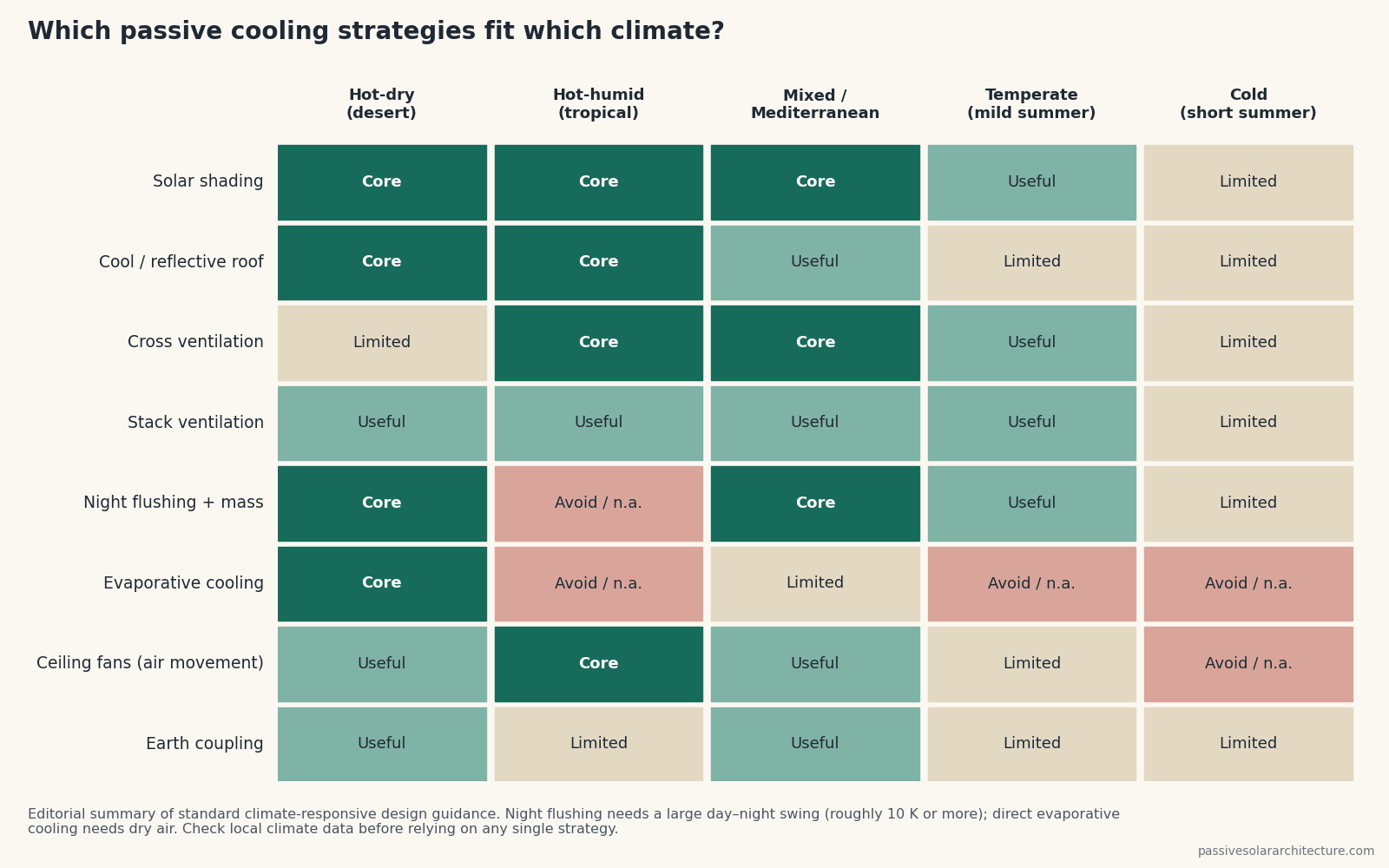
Cooling needs the same climate logic as heating. The matrix summarises which passive cooling strategies suit each climate: night flushing needs cool nights, evaporative cooling needs dry air, and shading is valuable almost everywhere.
How to Choose a Passive Solar Strategy for Your Climate
Use this simple process before choosing windows, overhangs, thermal mass, or materials.
- Identify the climate type. Decide whether the project is cold, temperate, hot-dry, hot-humid, mixed, or near-equatorial.
- Define the main comfort problem. Is the biggest issue winter heat loss, summer overheating, humidity, glare, or daily temperature swing?
- Study the sun path. Check seasonal sun angles and solar access.
- Analyze the site. Look at shade, slope, wind, views, access, privacy, and neighboring buildings.
- Choose the orientation strategy. Use equator-facing glazing only where it supports the climate goal.
- Size windows carefully. Match window area to climate, facade direction, glazing performance, shading, and thermal mass.
- Design shading early. Prevent unwanted heat before it enters the building.
- Use thermal mass only where appropriate. Make sure it supports comfort rather than storing unwanted heat.
- Strengthen the envelope. Use climate-appropriate insulation, airtightness, and moisture control.
- Plan ventilation. Provide fresh air, cooling potential, and humidity control where needed.
- Check the whole system. Review heating season, cooling season, shoulder seasons, and occupant behavior.
Common Climate-Based Passive Solar Mistakes
- Copying a design from another climate: Passive solar design must be adapted to local conditions.
- Assuming south-facing windows always work: Use equator-facing logic and climate-specific design.
- Ignoring the Southern Hemisphere: Northern Hemisphere orientation rules must be reversed.
- Adding too much glass: More glazing can mean more heat loss, glare, and overheating.
- Using thermal mass everywhere: Thermal mass must be climate-appropriate.
- Forgetting humidity: Hot-humid climates need moisture-aware design.
- Ignoring west sun: Low-angle afternoon sun can cause serious overheating.
- Designing only for winter: Summer and shoulder-season comfort matter.
- Relying on natural ventilation without checking conditions: Outdoor air may be hot, humid, polluted, smoky, noisy, or unsafe.
- Skipping professional review: Real projects need local climate data, codes, energy analysis, and qualified design input.
Passive Solar Design by Climate Checklist
Use this checklist when reviewing a passive solar design for a specific climate.
- The climate type has been identified.
- Heating and cooling priorities are clear.
- Humidity and moisture risks have been reviewed.
- Sun path has been checked for winter, summer, and shoulder seasons.
- The hemisphere has been considered.
- Equator-facing glazing is used only where it supports the design goal.
- East and west windows are controlled.
- Window size is matched to climate and orientation.
- Shading is designed before overheating occurs.
- Thermal mass is appropriate for the climate.
- Insulation and airtightness match local conditions.
- Ventilation supports comfort and indoor air quality.
- Passive cooling has been considered, not only passive heating.
- Overheating risk has been checked.
- Local building codes and professional review are included.
Useful Tools for Climate-Based Passive Solar Design
These tools can help with early-stage design thinking. They do not replace professional design, energy modeling, HVAC calculations, local climate analysis, or building code review.
- Solar Angle Calculator
- Roof Overhang Calculator
- Passive Solar Orientation Calculator
- Window-to-Wall Ratio Calculator
- Thermal Mass Calculator
- Passive Solar Design Tools
- Passive Solar Design Checklist
Passive Solar Design by Climate for Different Readers
| Reader | How to Use This Guide | Recommended Page |
|---|---|---|
| Architects | Use climate logic to structure site analysis, concept design, client decisions, and performance review. | For Architects |
| Self-Builders | Use this guide before buying land, choosing a plan, or approving window and shading decisions. | For Self-Builders |
| Investors and Developers | Use climate-based review to evaluate site potential, comfort risk, and long-term building quality. | For Investors |
| Students | Use this guide to understand why passive solar architecture changes across climates. | Learn |
Frequently Asked Questions
Does passive solar design work in every climate?
Passive solar design can be useful in many climates, but the strategy changes. Cold climates may prioritize winter solar gain, while hot climates may prioritize shading, passive cooling, airflow, and moisture control.
What is the best climate for passive solar design?
There is no single best climate. Passive solar design is easiest when the site has useful solar access and clear seasonal needs, but every climate requires a different balance of sun, shade, insulation, ventilation, and thermal mass.
Is passive solar design only for cold climates?
No. Passive solar design includes passive cooling, daylighting, shading, ventilation, and climate-responsive design. In hot climates, the main goal is often to block unwanted heat rather than collect sun.
Should all passive solar homes have south-facing windows?
No. For global passive solar design, the correct principle is not simply “south-facing glazing,” but “equator-facing glazing.” This means south-facing glazing in the Northern Hemisphere and north-facing glazing in the Southern Hemisphere. In hot climates, even equator-facing windows may need to be reduced, carefully sized, or protected with effective shading to prevent overheating.
How does passive solar design change in hot-humid climates?
Hot-humid passive solar design usually prioritizes shade, airflow, moisture control, reduced solar gain, and limited heat storage. Thermal mass must be used carefully because nights may remain warm and humid.
Is thermal mass always good for passive solar design?
No. Thermal mass can help in cold, temperate, mixed, and some hot-dry climates, but it can store unwanted heat if poorly designed. It must be matched to climate, shading, solar gain, and ventilation.
Can one house plan work in every climate?
No. A house plan should be adapted to climate, site, orientation, local codes, materials, construction quality, and occupant needs. Copying a passive solar plan from another region can create comfort and performance problems.
What should I study after climate-based passive solar design?
Continue with Site & Climate Analysis, Passive Solar Orientation, Passive Solar Windows, and Passive Solar Shading & Overhangs.
Recommended Learning Path
After reading this guide, continue with these related pages:
- Site & Climate Analysis
- Passive Solar Orientation
- Orientation & Building Form
- Passive Solar Window Placement
- Passive Solar Windows
- Passive Solar Shading & Overhangs
- Thermal Mass
- Insulation, Airtightness & Ventilation
- Passive Solar Design Checklist
Continue Learning
Passive solar design by climate is the foundation of good passive solar architecture. Once climate priorities are clear, decisions about orientation, windows, shading, thermal mass, insulation, airtightness, ventilation, and passive cooling become more logical and reliable.
Recommended next step: Read Site & Climate Analysis
Next step: check your own project
Try the ideas on your own project with the free passive solar design tools. It is free and runs in your browser.
Keep your results in one place
The free Passive Solar Design Checklist & Project Brief is a printable PDF with pages for your site’s sun angles, orientation, glazing per facade, shading and thermal mass, plus 12 questions to take to your architect or designer.