
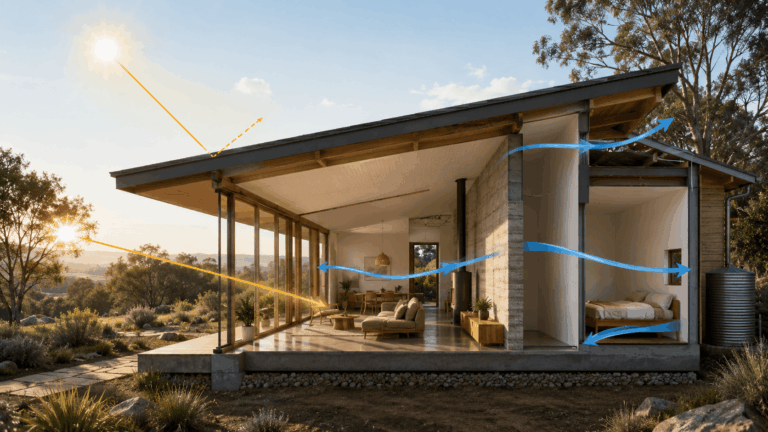
What Is Passive Solar Architecture?
Passive solar architecture is a design approach that uses the building itself to work with the sun, climate, and site. Instead of depending only on mechanical heating, cooling, or active solar technology, passive solar design uses orientation, windows, shading, thermal mass, insulation, airtightness, ventilation, and building form to improve comfort and reduce unnecessary energy demand.
A passive solar building is not simply a house with solar panels. It is a building designed from the beginning to collect useful sunlight when heat is needed, block unwanted sun when cooling is needed, store heat where appropriate, and maintain comfortable indoor conditions through smart architectural decisions.
Passive solar architecture can be used in homes, renovations, small buildings, and climate-responsive residential projects. But it is not one universal formula. The best strategy depends on climate, latitude, site conditions, window placement, materials, shading, construction quality, and occupant behavior.
Choose your next step: plan a passive solar house · compare passive solar system types · try the free calculators.
Passive Solar Architecture in Simple Terms
Passive solar architecture means designing a building so it can naturally use the sun’s energy and local climate conditions.
In a well-designed passive solar building:
- The building is oriented to make useful solar gain possible.
- Windows are placed and sized according to climate and orientation.
- Shading blocks unwanted summer sun and reduces overheating.
- Thermal mass stores and releases heat where appropriate.
- Insulation and airtightness reduce unwanted heat loss or heat gain.
- Ventilation supports fresh air, cooling, and moisture control.
- The whole building works as a connected system.
The goal is not to create a building that never needs heating or cooling. The goal is to reduce unnecessary loads and improve comfort before mechanical systems are selected.
How Passive Solar Architecture Works
Passive solar architecture works by controlling how sunlight, heat, air, and materials interact inside a building.
The basic process is simple:
- Collect useful sun during colder periods through well-oriented glazing.
- Store heat in thermal mass such as concrete, brick, stone, tile, adobe, or masonry where appropriate.
- Reduce heat loss through insulation, airtightness, and better windows.
- Block unwanted sun during hot periods with overhangs, screens, shutters, vegetation, or other shading devices.
- Release heat or cool the building through ventilation, night cooling, shading, and climate-appropriate design.
These steps must be adapted to the local climate. A cold-climate passive solar home may focus on winter solar gain and heat retention. A hot-humid passive solar home may focus more on shading, airflow, moisture control, and reducing heat gain.
Passive Solar Architecture Is Not the Same as Solar Panels
This is one of the most common misunderstandings.
Passive solar architecture uses the building itself. It works through orientation, windows, materials, shading, insulation, airtightness, and ventilation.
Solar panels are active solar technology. They use equipment to generate electricity or heat water.
A building can use both passive solar design and solar panels, but they are different strategies.
| Passive Solar Architecture | Solar Panels |
|---|---|
| Uses building design | Uses active technology |
| Depends on orientation, windows, shading, thermal mass, and envelope design | Depends on panels, inverters, wiring, mounting, and electrical systems |
| Can reduce heating and cooling demand | Can generate electricity or hot water |
| Should be considered early in design | Can often be added later if the roof and electrical system allow |
To learn more about system types, read Passive Solar Systems.
Passive Solar Architecture Is Not the Same as Passive House
Passive solar design and Passive House are also different.
Passive solar architecture is a design approach based on solar orientation, seasonal heat gain, shading, thermal mass, daylighting, passive cooling, and climate response.
Passive House is a performance standard focused on very low energy demand, airtightness, high insulation, high-performance windows, thermal bridge reduction, and controlled ventilation.
A building can use passive solar principles without being a certified Passive House. A Passive House can also include passive solar design, but it must meet specific performance criteria.
For a detailed comparison, read Passive Solar vs Passive House.
The Main Principles of Passive Solar Architecture
Passive solar architecture is based on several connected principles. None of them works well in isolation. A good design balances them together.
| Principle | What It Means | Why It Matters |
|---|---|---|
| Site and Climate Analysis | Understanding sun path, climate, wind, humidity, shading, and local conditions | Passive solar design must be adapted to location |
| Orientation | Placing the building and windows in relation to the sun | Orientation affects solar gain, daylight, comfort, and overheating |
| Glazing | Designing window size, placement, and performance | Windows control light, heat gain, heat loss, views, and glare |
| Thermal Mass | Using materials that absorb, store, and release heat | Thermal mass can stabilize indoor temperatures when used correctly |
| Shading | Blocking unwanted sun during hot periods | Shading helps prevent overheating and improves summer comfort |
| Insulation and Airtightness | Reducing unwanted heat flow and air leakage | A strong envelope helps passive strategies perform better |
| Ventilation | Providing fresh air and supporting cooling where suitable | Ventilation affects comfort, indoor air quality, and moisture control |
For a deeper explanation, read Passive Solar Design Principles.
Site and Climate Come First
Passive solar architecture begins with the site. Before choosing a floor plan, window layout, roof overhang, or material strategy, you need to understand the local climate and solar conditions.
Important questions include:
- Is the climate mainly cold, temperate, hot-dry, hot-humid, or mixed?
- Does the building need more help with heating, cooling, or both?
- What is the local sun path during winter and summer?
- Are there trees, hills, nearby buildings, or future developments that may block sunlight?
- Are nights cool enough for night ventilation?
- Is humidity a major design issue?
- Are strong winds, storms, or wildfire risks relevant?
- What do local building codes require?
A passive solar strategy that works in one region may not work in another. For global design, climate-specific thinking is essential.
Helpful links:
Orientation and Equator-Facing Glazing
Orientation is one of the most important early decisions in passive solar architecture.
For a global audience, it is more accurate to use the term equator-facing glazing. In the Northern Hemisphere, this usually means south-facing windows. In the Southern Hemisphere, this usually means north-facing windows.
Equator-facing glazing can help collect useful winter sun in climates where passive heating is desirable. However, it must be sized carefully and paired with shading, thermal mass, insulation, and ventilation.
Good orientation can support:
- Useful winter solar gain
- Better daylight
- More comfortable living spaces
- Reduced heating demand in suitable climates
- More effective roof overhang design
- More logical room layout
But orientation is not the only priority. Views, access, slope, privacy, wind, local planning rules, and construction cost also matter.
Helpful links:
Windows and Glazing in Passive Solar Architecture
Windows are powerful passive solar design elements. They bring daylight, views, fresh air, and solar gain. They can also create heat loss, overheating, glare, and comfort problems.
Good passive solar glazing is not simply “more glass.” It is the right glass, in the right place, with the right shading, for the right climate.
Window design should consider:
- Orientation of each facade
- Window-to-wall ratio
- Glazing type
- U-value or U-factor
- Solar Heat Gain Coefficient, or SHGC
- Visible transmittance
- Frame performance
- External shading
- Thermal mass
- Daylight, glare, privacy, and views
Large unshaded windows can create serious overheating in warm or mixed climates. In cold climates, windows can help collect sun, but they can also lose heat if they are poorly specified.
Helpful links:
- Passive Solar Windows
- Passive Solar Window Placement
- Windows, Glazing & Daylighting
- Window-to-Wall Ratio Calculator
Thermal Mass: Storing Heat Carefully
Thermal mass refers to materials that absorb, store, and release heat. Common thermal mass materials include concrete, brick, stone, tile, adobe, masonry, and rammed earth.
In passive solar architecture, thermal mass can help moderate indoor temperature swings. For example, a sunlit concrete floor may absorb heat during the day and release it later when indoor temperatures fall.
Thermal mass works best when:
- It is exposed to indoor air
- It receives useful solar gain where appropriate
- It is balanced with window area
- It is protected from excessive summer heat
- It is matched to the local climate
- Ventilation can remove stored heat when needed
Thermal mass is not always beneficial. In some hot or humid climates, poorly designed mass can store unwanted heat and make indoor comfort worse.
Helpful links:
Shading and Passive Cooling
Passive solar architecture is not only about heating. In many climates, the most important passive solar strategy is preventing overheating.
Shading can block unwanted solar heat before it enters the building. This is usually more effective than relying only on interior blinds after the heat has already passed through the glass.
Common shading strategies include:
- Roof overhangs
- External blinds
- Shutters
- Solar screens
- Pergolas
- Balconies
- Deep window reveals
- Vegetation and deciduous trees where suitable
- Verandas and shaded outdoor spaces
Shading should be designed by climate and orientation. Equator-facing windows may work well with horizontal overhangs in some climates. East- and west-facing windows often need stronger protection because low-angle morning and afternoon sun is harder to block.
Helpful links:
- Passive Solar Shading & Overhangs
- Shading & Passive Cooling
- Roof Overhang Calculator
- Solar Angle Calculator
Insulation, Airtightness, and Ventilation
Passive solar design does not replace the need for a good building envelope.
A building that collects winter sun but leaks heat through poor insulation, weak windows, air leakage, or thermal bridges will not perform well. A building that is airtight but poorly ventilated may have moisture or indoor air quality problems.
Modern passive solar architecture should include:
- Climate-appropriate insulation
- Good airtightness
- Reduced thermal bridges
- High-quality window installation
- Fresh air ventilation
- Moisture control
- Passive cooling strategies where suitable
Ventilation may be natural, mechanical, or hybrid. The best strategy depends on climate, outdoor air quality, humidity, noise, security, and comfort expectations.
Helpful links:
Types of Passive Solar Systems
Passive solar buildings can use different design approaches depending on climate, building type, and design goals.
| System Type | How It Works | Design Consideration |
|---|---|---|
| Direct Gain | Sunlight enters directly through windows and warms interior surfaces. | Requires careful glazing, shading, and thermal mass balance. |
| Indirect Gain | Solar heat is collected in a thermal mass element before moving into the occupied space. | Must be designed to avoid overheating and heat loss. |
| Isolated Gain | Solar heat is collected in a separate space such as a sunspace. | Needs good control of heat transfer, ventilation, and moisture. |
| Hybrid Passive Solar | Combines passive design with mechanical systems or active solar technology. | Requires coordination between architecture and systems. |
To explore these systems in detail, read Passive Solar Systems.
Passive Solar Architecture by Climate
Passive solar architecture must be adapted to climate. The same design strategy should not be copied from one region to another without analysis.
| Climate | Main Passive Solar Priority | Common Risk |
|---|---|---|
| Cold | Collect useful winter sun, reduce heat loss, and store heat carefully. | Weak insulation, poor airtightness, or excessive heat loss through windows. |
| Temperate | Balance winter gain, summer shading, daylight, and ventilation. | Overheating from too much glass. |
| Hot-Dry | Block unwanted sun, use shade, and support night cooling where suitable. | Thermal mass storing heat without a way to release it. |
| Hot-Humid | Prioritize shade, airflow, moisture control, and reduced heat storage. | Heat and humidity trapped inside the building. |
| Mixed | Design for both heating and cooling seasons. | A design that works in winter but overheats in summer. |
Helpful links:
Benefits of Passive Solar Architecture
When designed well, passive solar architecture can support better building performance and comfort.
Potential benefits include:
- Improved indoor comfort
- Better daylight and connection to the outdoors
- Reduced heating demand in suitable climates
- Reduced cooling demand when shading and ventilation are designed well
- Lower reliance on mechanical systems
- More climate-responsive building design
- Better early-stage design decisions
- Improved resilience during seasonal temperature changes
These benefits are not automatic. They depend on climate, site, design quality, construction quality, systems, and user behavior.
Limitations of Passive Solar Architecture
Passive solar design has limits. It should not be presented as a magic solution or a substitute for professional design.
Important limitations include:
- It depends strongly on local climate and site conditions.
- Poorly designed glazing can cause overheating or heat loss.
- Thermal mass can store unwanted heat if used incorrectly.
- Shading must be designed carefully for sun angles and seasons.
- Insulation, airtightness, and ventilation are still necessary.
- Dense urban sites may have limited solar access.
- Existing buildings may limit orientation and layout options.
- Detailed projects may require energy modeling and professional review.
A good passive solar design is not based on one rule. It is based on the relationship between building, site, climate, and people.
Common Passive Solar Design Mistakes
Many passive solar problems happen when one principle is applied without understanding the whole system.
- Adding too much glass: Large windows can cause overheating, glare, heat loss, or high cooling demand.
- Ignoring climate: A cold-climate strategy may not work in a hot-humid or mixed climate.
- Forgetting shading: Solar gain must be controlled during hot periods.
- Misplacing thermal mass: Mass must be exposed and connected to useful heat flow.
- Ignoring east and west sun: Low-angle morning and afternoon sun can be difficult to shade.
- Neglecting the envelope: Passive solar design still needs insulation, airtightness, and thermal bridge control.
- Confusing terms: Passive solar design is not the same as solar panels or Passive House certification.
Use the Passive Solar Design Checklist to review a project before major decisions become fixed.
Who Uses Passive Solar Architecture?
Passive solar architecture is useful for several types of readers and projects.
| Audience | How Passive Solar Design Helps | Start Here |
|---|---|---|
| Architects | Supports better site planning, orientation, facade design, shading, and comfort strategy. | For Architects |
| Self-Builders | Helps with land evaluation, house planning, window decisions, and design questions. | For Self-Builders |
| Investors | Helps evaluate project risk, site potential, climate response, and long-term comfort. | For Investors |
| Students | Explains the relationship between architecture, climate, energy, and comfort. | Learn |
Simple Passive Solar Architecture Checklist
Use this quick checklist when reviewing a passive solar concept.
- Has the local climate been studied?
- Has the sun path been checked for winter and summer?
- Does the site have useful solar access?
- Is the building orientation appropriate for the hemisphere?
- Are windows sized by orientation and climate?
- Is there a shading strategy for hot periods?
- Is thermal mass used only where it supports comfort?
- Are insulation and airtightness part of the design?
- Is ventilation planned for fresh air, cooling, and moisture control?
- Has overheating risk been considered?
- Are local codes and professional design requirements being followed?
For a full review, use the Passive Solar Design Checklist.
Useful Passive Solar Tools
Simple tools can help test early design assumptions before decisions become difficult or expensive to change.
- Solar Angle Calculator
- Roof Overhang Calculator
- Window-to-Wall Ratio Calculator
- Thermal Mass Calculator
- Passive Solar Orientation Calculator
- Passive Solar Design Tools
These tools are for education and early-stage design thinking. They do not replace professional calculations, detailed energy modeling, building code review, or project-specific design.
Frequently Asked Questions
What is passive solar architecture?
Passive solar architecture is a building design approach that uses orientation, windows, shading, thermal mass, insulation, airtightness, ventilation, and building form to work with the sun and climate.
Is passive solar architecture the same as solar panels?
No. Solar panels are active technology that generate electricity or hot water. Passive solar architecture uses the building itself to manage sun, heat, shade, and comfort.
Does a passive solar home need heating and cooling?
Often, yes. Passive solar design can reduce heating and cooling demand, but it does not automatically eliminate mechanical systems. Climate, construction quality, comfort expectations, and occupant behavior all matter.
What is the most important passive solar design principle?
There is no single principle that works alone. Site analysis, climate, orientation, glazing, shading, thermal mass, insulation, airtightness, and ventilation must work together.
Can passive solar architecture work in hot climates?
Yes, but the priority is often passive cooling rather than passive heating. Hot climates usually need shading, airflow, reduced solar gain, moisture control, and careful material choices.
Is thermal mass always required?
No. Thermal mass can help in some climates and designs, but it must be correctly placed and matched to solar gain, shading, ventilation, and climate conditions.
Is passive solar design the same as Passive House?
No. Passive solar design is an architectural design approach. Passive House is a performance standard with specific requirements for energy demand, airtightness, insulation, windows, and ventilation.
Where should I start learning passive solar design?
Start with Passive Solar Fundamentals, then continue to Passive Solar Design Principles and Passive Solar Design by Climate.
Continue Learning
Passive solar architecture is most effective when it is considered early in the design process. Orientation, windows, shading, thermal mass, insulation, ventilation, and climate response all need to work together.
Recommended next step: Read Passive Solar Fundamentals
Next step: check your own project
Try the ideas on your own project with the free passive solar design tools. It is free and runs in your browser.
Keep your results in one place
The free Passive Solar Design Checklist & Project Brief is a printable PDF with pages for your site’s sun angles, orientation, glazing per facade, shading and thermal mass, plus 12 questions to take to your architect or designer.