
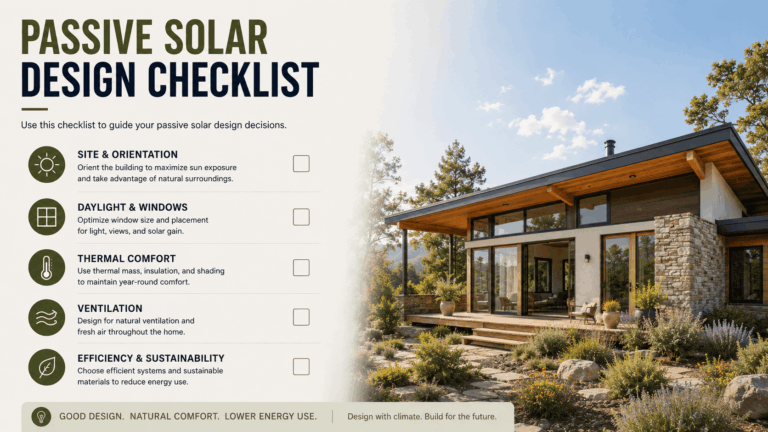
Passive Solar Design Checklist
This passive solar design checklist helps homeowners, architects, designers, builders, and students review the most important decisions in passive solar architecture before a home is built or renovated. It covers site planning, orientation, windows, thermal mass, insulation, shading, ventilation, climate strategy, and long-term comfort. Passive solar design works best when it is considered early. Once the house orientation, floor plan, roof shape, window placement, and building envelope are fixed, many passive solar opportunities become harder or more expensive to improve. Use this checklist as an educational planning tool. It does not replace architectural design, engineering, energy modeling, local code review, or professional advice. Passive solar performance depends on climate, site conditions, construction quality, window specifications, thermal mass, insulation, shading, ventilation, and occupant behavior. If you are new to the topic, first read what passive solar architecture is, then review passive solar design principles and passive solar house design before using this checklist.How to Use This Checklist
This passive solar design checklist is organized by design stage. You can use it before buying a house plan, during early schematic design, before construction documents, or before a renovation. For each section, ask whether the design has addressed the issue clearly. If the answer is “no,” “not sure,” or “we will decide later,” the item may need more attention. This checklist is most useful when used together with:- Passive solar design by climate
- Passive solar calculations
- Passive solar materials
- Types of passive solar systems
1. Site and Climate Checklist
Passive solar design starts with the site and climate. Before choosing window sizes, floor materials, or roof overhangs, the design team should understand the environmental conditions.- Has the local climate been studied before major design decisions?
- Is the site in a cold, hot, dry, humid, temperate, or mixed climate?
- Are heating needs more important than cooling needs, or are both significant?
- Has winter solar access been evaluated?
- Has summer overheating risk been evaluated?
- Are there trees, hills, fences, or nearby buildings that block useful sun?
- Are prevailing winds understood?
- Is humidity a major comfort or durability concern?
- Is there a large daily temperature swing that could make thermal mass useful?
- Are local building codes, setbacks, fire rules, and energy requirements understood?
- Has the site slope been considered?
- Are views, privacy, and access balanced with solar performance?
2. Orientation Checklist
Orientation determines how the building receives sunlight during different seasons. It affects solar gain, daylight, room layout, shading, and overheating risk.- Has true south or true north been identified correctly?
- Has magnetic declination been considered if using a compass?
- Is the main solar-facing facade oriented appropriately for the hemisphere?
- Are the most-used rooms placed where useful solar exposure is available?
- Has the design avoided excessive west-facing glass?
- Are east-facing windows used intentionally rather than accidentally?
- Is the roof form compatible with passive solar goals and possible future solar panels?
- Has the sun path been reviewed for winter and summer?
- Has shading from neighboring structures been checked?
- Does the orientation still support views, privacy, and everyday living?
3. Floor Plan Checklist
A passive solar floor plan should place rooms according to comfort, daylight, heat gain, ventilation, and daily use.- Are living rooms placed on the best solar-facing side where climate supports it?
- Are dining areas, kitchens, studios, or home offices located where daylight is useful?
- Are garages, storage rooms, utility rooms, and bathrooms used as buffer spaces where appropriate?
- Does the floor plan allow winter sun to reach useful thermal mass?
- Does the layout avoid overheating bedrooms or frequently occupied spaces?
- Is the plan compact enough to reduce unnecessary heat loss or heat gain?
- Can warm air move naturally through important living areas?
- Does the plan support cross ventilation or stack ventilation?
- Are furniture placement and thermal mass exposure compatible?
- Does the design balance performance with privacy, views, storage, and circulation?
4. Window and Glazing Checklist
Windows are one of the most important and risky parts of passive solar design. They can collect heat, provide daylight, support ventilation, and frame views, but they can also cause heat loss, glare, and overheating.- Are windows sized by orientation rather than treated the same on every facade?
- Is solar-facing glass balanced with available thermal mass?
- Are west-facing windows limited or well shaded?
- Are east-facing windows designed for morning light without overheating?
- Are north-facing windows used appropriately for daylight and heat loss control?
- Has the window-to-wall ratio been reviewed?
- Has the window-to-floor ratio been considered in major solar rooms?
- Are U-factor and solar heat gain coefficient appropriate for the climate?
- Is visible transmittance suitable for daylight without excessive glare?
- Are window frames insulated and durable?
- Are operable windows placed to support ventilation?
- Is nighttime heat loss through windows addressed in cold climates?
- Are windows shaded from unwanted summer sun?
5. Thermal Mass Checklist
Thermal mass stores heat and helps reduce temperature swings. It is especially important in direct gain passive solar design.- Is thermal mass included where solar gain is part of the strategy?
- Is the thermal mass located inside the insulated building envelope?
- Does winter sunlight reach the thermal mass?
- Is the mass exposed to indoor air?
- Is the mass covered by carpet, rugs, cabinets, or insulating finishes?
- Is the amount of mass appropriate for the amount of solar-facing glass?
- Is the material suitable for the climate?
- Can the mass release stored heat when needed?
- Can the mass be cooled at night in climates where night flushing is used?
- Has the comfort effect of floor temperature been considered?
- Are material choices coordinated with structure, cost, and durability?
6. Insulation and Airtightness Checklist
Passive solar design does not work well if useful heat is lost quickly. Insulation and airtightness help retain comfort and reduce heating and cooling loads.- Are walls insulated appropriately for the climate?
- Is the roof or attic insulation sufficient?
- Are floors and foundations insulated where needed?
- Are windows and doors thermally appropriate?
- Is the air barrier continuous?
- Are penetrations, joints, and transitions sealed carefully?
- Are thermal bridges reduced?
- Is moisture control addressed?
- Is ventilation intentional rather than dependent on leaks?
- Does the envelope support both winter and summer comfort?
- Are insulation materials suitable for local climate and wall assemblies?
7. Shading and Overhang Checklist
Shading controls unwanted solar gain. It is essential for preventing overheating and maintaining year-round comfort.- Are solar-facing windows shaded during the warm season?
- Do roof overhangs allow winter sun where it is useful?
- Are overhangs sized with sun angles rather than guesswork?
- Are east and west windows protected from low-angle sun?
- Is exterior shading used where heat control is important?
- Are awnings, shutters, louvers, or pergolas considered where appropriate?
- Can shading devices be adjusted seasonally if needed?
- Do trees or landscape elements support the shading strategy?
- Could future tree growth block useful winter sun?
- Does shading reduce glare as well as heat?
- Is summer comfort addressed in every major occupied space?
8. Ventilation and Passive Cooling Checklist
Passive solar design must address cooling as well as heating. Ventilation and passive cooling strategies should be planned early.- Does the home have a clear passive cooling strategy?
- Are cross ventilation paths possible?
- Are high and low openings used for stack ventilation where appropriate?
- Are operable windows placed where they can actually move air?
- Is night flushing appropriate for the climate?
- Will humidity make natural ventilation difficult?
- Are ceiling fans or air movement strategies considered?
- Are hot roof spaces or attic areas controlled?
- Are exterior walls and windows shaded where needed?
- Does the design avoid excessive west-facing heat gain?
- Is mechanical ventilation included where airtightness requires it?
- Is indoor air quality considered?
9. Materials Checklist
Materials determine how the building absorbs, stores, reflects, blocks, and releases heat. They also affect durability, moisture performance, and comfort.- Are thermal mass materials selected for performance, not appearance only?
- Are materials appropriate for the climate?
- Are moisture-sensitive materials protected?
- Are exterior materials durable under local weather conditions?
- Are surface colors chosen with heat absorption and glare in mind?
- Are floor finishes compatible with thermal mass performance?
- Are insulation materials suitable for the wall and roof assemblies?
- Are shading materials durable and maintainable?
- Are embodied carbon and environmental impacts considered where relevant?
- Are materials locally available and buildable by the project team?
10. Passive Solar Systems Checklist
Passive solar systems describe how the building collects, stores, and distributes solar heat. The right system depends on climate, site, design goals, and user behavior.- Has the project selected a passive solar system intentionally?
- Is direct gain appropriate for the main living spaces?
- Is indirect gain useful, or would it reduce views and daylight too much?
- Would a Trombe wall fit the climate and design goals?
- Would a sunspace be useful, or would it create overheating and heat loss?
- Is a simpler sun-tempered design more realistic?
- Is the system matched to the climate?
- Is there enough thermal mass for the chosen system?
- Are controls simple for occupants?
- Is backup heating and cooling included?
- Does the system work with the floor plan rather than against it?
11. Comfort and Operation Checklist
Passive solar homes must be comfortable to live in. A technically interesting design is not successful if it is difficult to operate or uncomfortable in daily use.- Will the home remain comfortable during cloudy winter periods?
- Will the home avoid overheating during sunny winter days?
- Will summer comfort be acceptable?
- Are backup heating and cooling systems included where needed?
- Are shades, vents, windows, and doors easy to operate?
- Does the design require daily occupant actions?
- Are those actions realistic for the people living there?
- Is glare controlled in major living spaces?
- Are bedrooms protected from unwanted heat?
- Is humidity managed in humid climates?
- Is indoor air quality maintained?
12. Retrofit Checklist
Existing homes can sometimes be improved with passive solar strategies, but retrofits have limits. Orientation and structure are difficult to change after construction.- Does the existing home have useful solar access?
- Are the main living spaces located near useful solar exposure?
- Can insulation be improved?
- Can air leakage be reduced?
- Can windows be upgraded or shaded?
- Can west-facing overheating be reduced?
- Can existing thermal mass be exposed?
- Can a sunspace be added without creating heat loss or overheating?
- Can ventilation be improved?
- Can room use be adjusted based on daylight and comfort?
- Are retrofit costs reasonable compared with expected benefits?
13. Professional Review Checklist
This checklist can guide planning, but real projects should be reviewed by qualified professionals.- Has an architect or designer reviewed the passive solar strategy?
- Has a builder reviewed constructability?
- Has an engineer reviewed structural issues where needed?
- Has an energy consultant reviewed performance where appropriate?
- Have local building codes been checked?
- Have fire, safety, and egress requirements been reviewed?
- Have moisture risks been evaluated?
- Have window specifications been confirmed?
- Have insulation and air sealing details been documented?
- Has HVAC sizing been coordinated with passive strategies?
- Has the owner been taught how to operate passive features?
Quick Review Table
| Checklist Area | Main Question | Why It Matters | Common Risk |
|---|---|---|---|
| Site and climate | Does the design respond to local conditions? | Climate determines heating, cooling, shading, and ventilation needs | Copying a design from another region |
| Orientation | Is the house aligned with useful sun? | Orientation affects solar gain, daylight, and overheating | Using the wrong solar direction |
| Floor plan | Are rooms placed according to sun and use? | Room layout affects comfort and energy performance | Putting garages on the best solar side |
| Windows | Are windows sized by orientation and climate? | Windows control heat, light, views, and heat loss | Too much glass |
| Thermal mass | Is useful mass exposed where sun reaches? | Thermal mass stores heat and reduces swings | Mass covered by carpet or finishes |
| Envelope | Can the building retain comfort? | Insulation and airtightness support passive performance | Solar heat lost through weak envelope |
| Shading | Is unwanted sun blocked? | Shading prevents overheating | No summer solar control |
| Ventilation | Is cooling and air quality planned? | Ventilation supports comfort when climate allows | Confusing leaks with ventilation |
Common Mistakes This Checklist Helps Prevent
1. Starting Passive Solar Design Too Late
Passive solar design should begin before the house orientation, floor plan, roof geometry, and windows are finalized.2. Choosing a House Plan Before Studying the Site
A generic plan may not match the sun, wind, shade, slope, and climate of the property.3. Adding Too Much Glass
Large windows can cause overheating, glare, and heat loss if not balanced with thermal mass, insulation, and shading.4. Forgetting Thermal Mass
Solar gain without thermal mass can create uncomfortable temperature swings.5. Ignoring Summer Comfort
A home designed only for winter sun can become too hot in summer.6. Treating Insulation as Secondary
Solar heat is useful only if the home can retain it. A weak envelope reduces passive solar benefits.7. Using the Wrong Strategy for the Climate
Cold, hot, dry, humid, temperate, and mixed climates require different passive solar priorities.FAQ About the Passive Solar Design Checklist
What is a passive solar design checklist?
A passive solar design checklist is a planning tool that helps review site conditions, orientation, windows, thermal mass, insulation, shading, ventilation, materials, and climate strategy before building or renovating.When should I use this checklist?
Use it as early as possible, ideally before choosing a house plan or finalizing the floor plan. It is also useful before construction documents, renovations, or design reviews.Can this checklist replace an architect?
No. This checklist is educational. It can help you ask better questions, but real projects should be reviewed by qualified architects, engineers, builders, energy consultants, and code officials where appropriate.What is the most important item on the checklist?
Climate and orientation are among the most important early items because they affect room layout, windows, solar gain, shading, and comfort. However, they must work together with thermal mass, insulation, ventilation, and materials.Does every passive solar home need thermal mass?
Thermal mass is strongly recommended when direct solar gain is used for heating. It helps store heat and reduce temperature swings. The amount and type of mass depend on climate, glazing, and design goals.How do I know if my windows are too large?
Windows may be too large if they cause glare, overheating, excessive heat loss, or comfort problems. Window sizing should be checked against climate, orientation, glazing performance, shading, and available thermal mass.Should passive solar design include backup heating and cooling?
Usually, yes. Passive solar design can reduce heating and cooling demand, but most homes still need backup systems for extreme weather, cloudy periods, humidity control, and comfort.Can this checklist be used for renovations?
Yes. It can help evaluate passive solar retrofit options such as added shading, improved insulation, window upgrades, exposed thermal mass, ventilation improvements, and changes in room use.Does passive solar design work in hot climates?
Yes, but the checklist priorities change. In hot climates, shading, reduced solar heat gain, roof insulation, ventilation, air movement, and moisture control may be more important than winter heat collection.What should I do after completing the checklist?
Use the results to identify weak points in the design. Then review related guides, refine the plan, and consult qualified professionals before finalizing construction or renovation decisions.Conclusion
This passive solar design checklist helps organize the most important decisions in passive solar architecture. It guides you through site analysis, orientation, floor planning, window design, thermal mass, insulation, shading, ventilation, materials, system selection, comfort, retrofits, and professional review. The checklist’s most important lesson is integration. Passive solar design does not work because of one feature. It works when the site, climate, windows, mass, envelope, shading, and ventilation support each other. For homeowners, this checklist can help you ask better questions before building or renovating. For architects and designers, it can support early-stage review and client communication. For students, it provides a practical framework for understanding how passive solar principles become real design decisions. After using this checklist, continue with passive solar calculations, roof overhang calculator, and passive solar house design to refine the most important parts of your project.Quick Takeaways
- Start with climate, orientation, and envelope performance before choosing products.
- Use passive solar principles to reduce heating and cooling demand before adding active systems.
- Cross-check design choices with calculations, case studies, and trusted building science references.
- When the question becomes financial, use MySolarROI calculators for solar cost, savings, and payback estimates.
Related Passive Solar Guides
- Passive Solar Fundamentals
- Passive Solar Design Principles
- Passive Solar House Design Guide
- Passive Solar Design by Climate
- Passive Solar Materials Guide
- Passive Solar Design Checklist
Trusted External Resources
- U.S. Department of Energy: Passive Solar Homes
- Energy Saver passive solar home design fact sheet
- NREL Passive Solar Design for the Home
Compare Passive Design With Solar ROI
Passive solar design can lower the energy a home needs. If you also want to evaluate photovoltaic solar, use the Solar Payback Calculator at MySolarROI to estimate how long it may take for a solar investment to break even.
Frequently Asked Questions
What is the main goal of passive solar design checklist?
The goal is to use orientation, glazing, shading, insulation, thermal mass, and climate-specific design choices to reduce heating and cooling loads before adding mechanical systems.
Does passive solar design work in every climate?
Yes, but the strategy changes by climate. Cold climates usually prioritize winter solar gain and thermal mass, while hot climates need shading, low solar heat gain, ventilation, and cooling-load control.
Should passive solar design be combined with rooftop solar?
It can be. Passive design first reduces the home energy load, while photovoltaic solar can then offset remaining electricity use. This is where ROI and savings calculators become useful.
What should homeowners check before finalizing a design?
Review site orientation, seasonal sun angles, window placement, insulation, air sealing, thermal mass, shading, local climate, and comfort goals before construction or renovation.
