
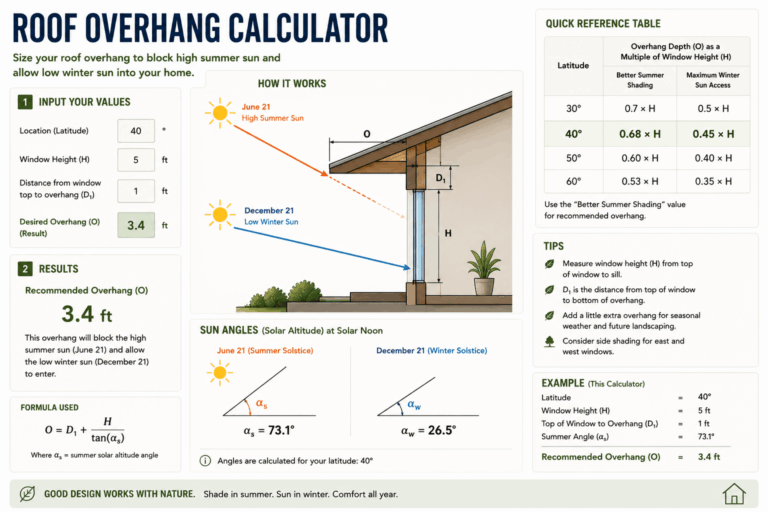
Roof Overhang Calculator
Use this roof overhang calculator to estimate the horizontal projection needed to shade a window at a selected solar altitude angle. This is useful for passive solar design, especially when designing roof overhangs for equator-facing windows.
Example inputs are pre-filled. Replace them with your project values. Reset restores this example.
Passive solar calculator
Roof Overhang Calculator
Estimate the horizontal roof overhang depth needed to shade a window at a selected solar altitude angle,
then compare summer shading with winter solar access.
overhang depth = vertical shading distance ÷ tan(solar altitude angle)Results
Enter window geometry and solar angles to calculate overhang depth.
A well-designed overhang can help block high summer sun while allowing lower winter sun to enter where passive solar heating is useful. However, overhang design depends on latitude, hemisphere, window height, facade orientation, sun angle, climate, shading goals, and site conditions.
This calculator is intended for early-stage design and education. It does not replace professional architectural design, local climate analysis, detailed solar modeling, structural design, or building code review.
Note: This calculator requires JavaScript. If the calculator does not run, enable JavaScript or use the formula explained below.
How to Use the Roof Overhang Calculator
- Choose a unit. Use meters or feet. Keep all length inputs in the same unit.
- Enter the vertical distance from the overhang shading edge to the top of glass. This is the gap between the underside or outer shadow line of the overhang and the top of the window glass.
- Enter the window glass height. Use the height of the glass area you want to shade, not necessarily the full frame size.
- Enter the summer solar altitude angle. Use the sun angle for the date and time when you want the window shaded.
- Enter the winter solar altitude angle. Use the sun angle for the date and time when you want to check winter solar access.
- Optional: enter a proposed overhang depth. If you leave it blank, the calculator evaluates the depth needed for full summer shading based on your inputs.
Use the Solar Angle Calculator to find the solar altitude angles for your project location, dates, and times.
What the Results Mean
| Result | Meaning | Design Use |
|---|---|---|
| Depth to begin shading top of glass | The approximate overhang depth needed for the shadow to reach the top of the glass. | Useful for understanding when shading begins. |
| Depth for full glass shading | The approximate overhang depth needed for the shadow to reach the bottom of the glass. | Useful for summer overheating control. |
| Evaluated overhang depth | The overhang depth used in the shading calculation. | Use this to compare a proposed design with the calculated target. |
| Summer shaded glass | The approximate percentage of glass shaded at the summer solar altitude. | Helps evaluate hot-season solar control. |
| Winter sunlit glass | The approximate percentage of glass that remains sunlit at the winter solar altitude. | Helps evaluate winter solar access where passive heating is useful. |
Roof Overhang Formula
The simplified overhang formula used in this calculator is based on right-triangle geometry:
Overhang depth = vertical shading distance ÷ tan(solar altitude angle)
Where:
- Overhang depth is the horizontal projection from the wall to the outer shading edge.
- Vertical shading distance is the vertical distance from the overhang shading edge to the point on the window you want to shade.
- Solar altitude angle is the height of the sun above the horizon.
For full window shading, the vertical shading distance is usually:
vertical distance from overhang edge to top of glass + window glass height
This formula is useful for early design, but real overhang performance also depends on solar azimuth, facade orientation, window recess, side shading, climate, and local site obstructions.
Worked example: calculate overhang depth
Take a window 1.50 m high with its top 0.30 m below the overhang edge. At a chosen summer solar altitude of 70°, the vertical distance to shade is 1.80 m:
Depth = (0.30 + 1.50) ÷ tan(70°) = 0.655 m ≈ 0.66 m
The same geometry in feet uses a 4.92 ft window and a 0.98 ft gap, giving a projection of about 2.15 ft. The angle stays in degrees.
This is a simplified vertical-section example, with the sun directly in front of the facade. When the sun is to one side, solar altitude alone does not describe the shadow: facade direction, solar azimuth and side coverage also matter. The 70° input is an example, not a default for your site. Use the solar angle calculator for your location and dates, and read the overhang design guide for the wider design context.
If you do not know the solar altitudes, the overhang calculator by latitude and date finds them from your location, date, time and facade direction, and tests a chosen projection.
Why Roof Overhangs Matter in Passive Solar Design
Roof overhangs are one of the most common passive solar shading strategies. They can help reduce unwanted solar heat gain before it enters through the glass.
A well-designed overhang can help:
- Block high summer sun
- Allow lower winter sun where passive heating is useful
- Reduce overheating risk
- Improve comfort near windows
- Protect thermal mass from unwanted summer heat
- Reduce glare
- Protect windows and doors from rain exposure
- Create comfortable outdoor transition spaces
Overhangs should be designed early, together with orientation, window placement, glazing, shading, thermal mass, insulation, airtightness, ventilation, and climate response.
For the full guide, read Passive Solar Shading & Overhangs.
Best Use: Equator-Facing Windows
Roof overhangs are often most useful on equator-facing windows.
- In the Northern Hemisphere, equator-facing usually means south-facing.
- In the Southern Hemisphere, equator-facing usually means north-facing.
Equator-facing windows often receive higher-angle sun in summer and lower-angle sun in winter. This seasonal difference makes horizontal overhangs useful in many passive solar designs.
However, climate still matters. In hot climates, stronger shading may be needed for more of the year. In cold climates, overhangs should avoid blocking too much useful winter sun.
For orientation guidance, read Passive Solar Orientation.
Why East and West Windows Need Different Shading
Horizontal roof overhangs are usually less effective for east- and west-facing windows because the sun is lower in the sky and comes from the side.
West-facing windows are often especially difficult because afternoon sun can arrive when outdoor temperatures are already high. This can cause glare, overheating, and late-day discomfort.
East and west windows may need:
- Reduced glass area
- Vertical fins
- Exterior shutters
- Exterior blinds
- Solar screens (affiliate link)
- Deep vegetation where suitable
- Lower solar heat gain glazing
- Careful room placement
Use overhang calculations mainly for equator-facing shading. For east and west facades, consider additional shading strategies.
Choosing Summer and Winter Solar Angles
The calculator requires two solar altitude angles: one for summer shading and one for winter access.
Summer shading angle
Choose a solar altitude angle for the time when overheating risk is important. This may be near solar noon or another critical hot period, depending on climate and facade orientation.
Winter access angle
Choose a solar altitude angle for the time when useful winter sun is desired. This is often lower than the summer angle.
Do not check only one date. Passive solar design should review:
- Summer conditions
- Winter conditions
- Shoulder seasons
- Morning and afternoon sun
- Cloudy and sunny climate patterns
- Local shading from trees, hills, and buildings
Use the Solar Angle Calculator to estimate these angles.
Overhang Design by Climate
The right overhang depth depends on climate. A cold-climate overhang strategy may not work in a hot-humid or hot-dry climate.
| Climate | Overhang Priority | Main Caution |
|---|---|---|
| Cold | Allow useful winter sun while preventing summer and shoulder-season overheating. | A deep overhang may block too much winter solar gain. |
| Temperate | Balance winter solar access with summer shading. | Too much glass can still overheat even with an overhang. |
| Hot-Dry | Provide strong shade and protect thermal mass from daytime heat. | Thermal mass can store unwanted heat if shading is weak. |
| Hot-Humid | Provide deep shade, rain protection, and support airflow. | Shading devices should not trap heat or moisture. |
| Mixed | Use balanced or adjustable shading for both heating and cooling seasons. | A winter-focused design may overheat in summer. |
For climate-specific design, read Passive Solar Design by Climate.
Overhangs and Thermal Mass
Roof overhangs and thermal mass must be designed together. Thermal mass can store useful winter heat, but it can also store unwanted summer heat.
A good overhang can:
- Allow winter sun to reach thermal mass where heating is useful
- Block summer sun from reaching thermal mass
- Reduce overheating risk
- Improve comfort in rooms with large windows
- Support passive cooling strategies
If a concrete floor, brick wall, tile surface, or stone element receives strong summer sun, it may store heat and release it later when the building needs cooling.
For more guidance, read Thermal Mass and use the Thermal Mass Calculator.
Overhangs and Window Design
Overhang depth should be coordinated with window size, placement, and glazing performance.
Important window factors include:
- Window orientation
- Window height
- Window head height
- Window-to-wall ratio
- U-value or U-factor
- Solar Heat Gain Coefficient, or SHGC
- Visible transmittance
- Frame performance
- Window recess and wall thickness
- Airtight installation
A roof overhang cannot fix every window problem. Oversized glazing, poor orientation, weak insulation, and unshaded west-facing glass can still create discomfort.
Helpful links:
Limitations of This Roof Overhang Calculator
This calculator uses simplified geometry. It is useful for understanding overhang depth, but it cannot fully predict real shading performance.
It does not fully account for:
- Solar azimuth
- Facade rotation away from true equator-facing direction
- East and west low-angle sun
- Window recess depth
- Wall thickness
- Side fins or side shading
- Balconies, pergolas, or complex shading devices
- Nearby buildings, trees, hills, or fences
- Cloud cover or local solar radiation
- Interior blinds or exterior screens
- Dynamic indoor temperature behavior
- Structural, drainage, wind, fire, or code requirements
Use this calculator for early design. For final overhang design, use site-specific solar analysis, climate data, drawings, energy modeling, and professional review.
Common Roof Overhang Mistakes
- Guessing overhang depth by appearance: Overhangs should be checked against solar angles and window geometry.
- Using one depth everywhere: Different facades and window heights need different review.
- Ignoring winter sun: A deep overhang can block useful passive solar gain in heating climates.
- Ignoring summer overheating: A shallow overhang may not shade enough of the glass.
- Using horizontal overhangs for west sun: West-facing windows often need vertical or adjustable shading.
- Forgetting thermal mass: Unshaded mass can store unwanted heat.
- Ignoring glazing performance: SHGC and U-value still matter.
- Ignoring site shade: Trees, hills, and neighboring buildings can change solar access.
- Designing for one date only: Check winter, summer, and shoulder seasons.
- Skipping professional review: Real overhangs also need structure, drainage, durability, and code compliance.
Roof Overhang Design Checklist
Use this checklist before finalizing overhang depth.
- The project climate type has been identified.
- The hemisphere and equator-facing direction are clear.
- True orientation has been checked.
- Summer solar altitude has been reviewed.
- Winter solar altitude has been reviewed.
- Shoulder-season sun has been considered.
- Window height and overhang height are measured accurately.
- Overhang depth has been checked with solar geometry.
- East and west windows have separate shading strategies.
- Thermal mass is protected from unwanted summer sun.
- Useful winter sun is not blocked unnecessarily where passive heating is desired.
- Daylight and glare have been reviewed.
- Window SHGC and U-value are considered.
- Ventilation and passive cooling strategy are considered.
- Site shading from trees and nearby buildings has been reviewed.
- Structural, drainage, wind, fire, and code issues are reviewed by professionals where needed.
Useful Related Tools
Use these tools together for better passive solar shading decisions:
- Solar Angle Calculator
- Passive Solar Orientation Calculator
- Window-to-Wall Ratio Calculator
- Thermal Mass Calculator
- Passive Solar Design Tools
- Passive Solar Design Checklist
Roof Overhang Calculator for Different Readers
| Reader | How to Use This Calculator | Recommended Next Page |
|---|---|---|
| Architects | Use it for early facade studies, overhang proportions, solar access checks, and client discussions. | Passive Solar Shading & Overhangs |
| Self-Builders | Use it to understand why overhang depth should be calculated before approving plans or window layouts. | Passive Solar Window Placement |
| Investors and Developers | Use it to review overheating risk, facade quality, and whether large windows have a realistic shading strategy. | Passive Solar Design Checklist |
| Students | Use it to connect solar altitude, geometry, shading, window design, and passive solar performance. | Passive Solar Calculations |
Frequently Asked Questions
What is a roof overhang calculator?
A roof overhang calculator estimates the horizontal overhang depth needed to shade a window based on solar altitude angle and window geometry.
How do you calculate roof overhang depth?
A simplified formula is overhang depth equals vertical shading distance divided by the tangent of the solar altitude angle. Real designs should also consider orientation, climate, window recess, site shade, and solar azimuth.
What is the best roof overhang depth for passive solar design?
There is no universal depth. The best depth depends on latitude, hemisphere, facade orientation, window height, desired shading dates, climate, and whether winter solar gain is useful.
Do roof overhangs work on all windows?
No. Horizontal roof overhangs usually work best on equator-facing windows. East and west windows often need vertical fins, exterior screens, shutters, vegetation, or reduced glazing.
Can a roof overhang block summer sun and allow winter sun?
Yes, in many locations and climates, especially on equator-facing facades. The overhang must be sized for local sun angles and window geometry.
Should hot climates use deeper overhangs?
Often, hot climates need stronger shading, but depth alone is not enough. Airflow, humidity, glazing, wall design, roof heat gain, and east-west exposure also matter.
Can an overhang cause a room to be too dark?
Yes. A very deep overhang may reduce daylight and winter solar gain. Overhang design should balance shade, daylight, views, and seasonal comfort.
Is this calculator accurate enough for construction?
It is useful for early design and education. Final construction decisions should use professional review, local climate data, structural design, detailed solar analysis, and building code compliance.
Recommended Learning Path
After using the roof overhang calculator, continue with these pages:
- Solar Angle Calculator
- Passive Solar Shading & Overhangs
- Passive Solar Window Placement
- Passive Solar Windows
- Thermal Mass
- Passive Solar Design by Climate
- Passive Solar Calculations
- Passive Solar Design Tools
Continue Learning
Roof overhangs are most effective when they are designed as part of the whole passive solar system. Overhang depth, window placement, glazing performance, thermal mass, daylight, insulation, ventilation, and climate response should all work together.
Recommended next step: Use the Window-to-Wall Ratio Calculator
Recommended books and tools
This section contains affiliate links. As an Amazon Associate we earn from qualifying purchases, at no extra cost to you. We only list items that relate to this page; we have not tested specific products.
- Sun, Wind & Light by G. Z. Brown and Mark DeKay: the architect's handbook of sun angles, shading, daylight and climate-responsive design strategies. View on Amazon
- Digital angle finders: useful for measuring roof pitch and checking the angles you use in the calculators. Browse on Amazon
- Laser distance measures: for quick, accurate measurements of window heights, gaps and overhang depths on site. Browse on Amazon