
Solar Angle Calculator
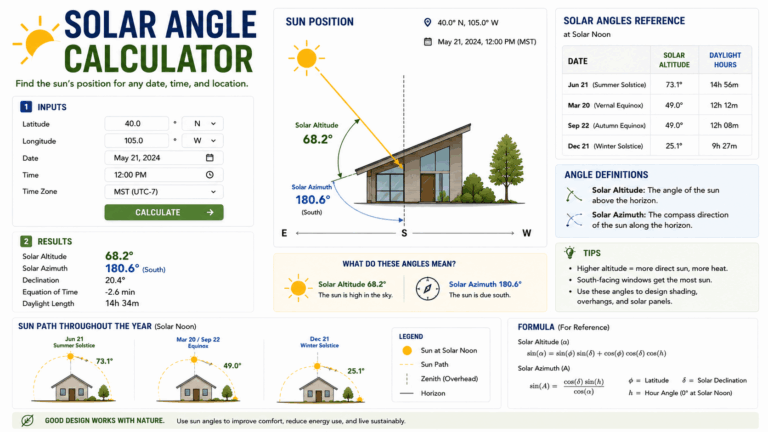
Use this solar angle calculator to estimate the sun’s altitude, azimuth, zenith angle, solar time, sunrise, sunset, and day length for a specific location, date, and time.
Example location: New York City. Replace its coordinates, date, clock time and UTC offset with your own. Reset restores the example.
Passive solar design tool
Solar Angle Calculator
Calculate the sun’s altitude, azimuth, zenith angle, true solar time, sunrise, sunset, and day length for a chosen location, date, and local clock time.
Results will appear hereEnter your project location and time, then calculate solar altitude, azimuth, sunrise, sunset, and day length.
Solar angle calculations are useful for passive solar design because they help you understand where the sun is in the sky. This affects window placement, roof overhangs, shading devices, daylighting, thermal mass exposure, passive heating, and passive cooling.
This calculator is intended for early-stage design and education. It uses simplified solar geometry and does not replace professional solar modeling, local climate analysis, energy modeling, or building code review.
Solar Angle Calculator
Enter latitude, longitude, date, time, and UTC offset. Use decimal degrees for latitude and longitude. Longitude is positive east and negative west.
Note: This calculator requires JavaScript. If the calculator does not run, enable JavaScript or use the formulas explained below.
How to Use the Solar Angle Calculator
- Enter latitude. Use decimal degrees. North is positive and south is negative.
- Enter longitude. Use decimal degrees. East is positive and west is negative.
- Select the date. Solar angle changes throughout the year.
- Enter local clock time. Use the time at the project location.
- Enter UTC offset. Include daylight saving time if it applies to the selected date.
- Calculate solar angles. Review solar altitude, azimuth, sunrise, sunset, and day length.
The calculator uses clock time and UTC offset to estimate true solar time. If the UTC offset is wrong, the azimuth and altitude results may be shifted.
Sun angles for your address or ZIP code
The calculator works from coordinates, not from an address or ZIP code: look up your site on any map, copy its latitude and longitude in decimal degrees, and enter them above. To compare summer shading with winter sun, keep the location fixed and change only the date and time. Solar noon and clock noon can differ by more than an hour.
Take the altitudes you find to the roof overhang calculator for a simple window-section check, and read the calculation assumptions and limits before relying on the output.
What the Results Mean
| Result | Meaning | Why It Matters for Passive Solar Design |
|---|---|---|
| Solar Altitude | The height of the sun above the horizon | Important for roof overhangs, shading, daylight penetration, and solar gain. |
| Solar Azimuth | The compass direction of the sun, measured from true north clockwise | Important for facade exposure, window placement, and east-west sun control. |
| Solar Zenith | The angle between the sun and the vertical direction overhead | Useful in solar geometry and advanced shading analysis. |
| Solar Declination | The seasonal angle of the sun relative to Earth’s equator | Explains why sun paths change between winter and summer. |
| Equation of Time | The difference between clock-based solar time and apparent solar time | Helps correct time calculations for solar position. |
| True Solar Time | Time based on the sun’s apparent position | Solar noon occurs when the sun is highest, not always at 12:00 clock time. |
| Hour Angle | The sun’s angular distance from solar noon | Used to calculate solar altitude and azimuth. |
| Sunrise and Sunset | Approximate local sunrise and sunset times | Useful for daylight, solar access, and seasonal design review. |
Why Solar Angles Matter in Passive Solar Design
Solar angle is one of the foundations of passive solar architecture. It helps explain when sun will enter a building, how deep it will penetrate, and whether it can be controlled with shading.
Solar angle affects:
- Building orientation
- Window placement
- Roof overhang depth
- External shading devices
- Clerestory windows
- Thermal mass exposure
- Daylighting quality
- Glare risk
- Passive heating potential
- Passive cooling strategy
- Overheating risk
For the broader design process, read Passive Solar Design Principles.
Solar Altitude
Solar altitude is the angle of the sun above the horizon. A solar altitude of 0° means the sun is at the horizon. A higher altitude means the sun is higher in the sky.
Solar altitude is important because it affects whether sunlight enters a window or is blocked by an overhang.
Passive solar design implications
- Low sun can penetrate deeper into rooms.
- Low sun can cause glare, especially in the morning or afternoon.
- High sun is often easier to block with horizontal roof overhangs.
- Winter sun is often lower than summer sun in many locations.
- Overhangs must be sized for local sun angles, not guessed visually.
Use solar altitude with the Roof Overhang Calculator to review shading geometry.
Solar Azimuth
Solar azimuth is the direction of the sun along the horizon. This calculator reports azimuth in degrees from true north, clockwise.
| Azimuth | Approximate Direction |
|---|---|
| 0° or 360° | North |
| 90° | East |
| 180° | South |
| 270° | West |
Azimuth helps you understand which facade receives sunlight at a specific time. This is especially important for east and west windows, which receive low-angle sun that can be difficult to shade.
For orientation guidance, read Passive Solar Orientation.
Solar Zenith
Solar zenith is the angle between the sun and the vertical direction overhead. It is the complement of solar altitude.
Solar zenith = 90° - solar altitude
Solar zenith is often used in more technical solar radiation calculations. For most early passive solar design work, solar altitude and azimuth are easier to interpret.
Solar Noon
Solar noon is the time when the sun reaches its highest point in the sky for that location and date. Solar noon is not always the same as 12:00 clock time.
Solar noon can differ from clock noon because of:
- Longitude within the time zone
- Time zone boundaries
- Daylight saving time
- The equation of time
For passive solar design, solar noon helps identify when the sun is highest and how shadows behave around the middle of the day.
Noon Sun Angle by Latitude
The table gives the height of the sun at solar noon on the solstices and equinoxes for latitudes from the equator to 60°. It works in both hemispheres: use your latitude without the N or S. In the Northern Hemisphere the summer solstice is around 21 June and the winter solstice around 21 December; in the Southern Hemisphere it is the other way round.
| Latitude (N or S) | Summer solstice | Equinoxes (about 20 March and 22 September) | Winter solstice |
|---|---|---|---|
| 0° (equator) | 66.6° (sun north of overhead in June, south in December) | 90.0° | 66.6° |
| 10° | 76.6° (sun on the pole side of overhead) | 80.0° | 56.6° |
| 20° | 86.6° (sun on the pole side of overhead) | 70.0° | 46.6° |
| 23.4° (Tropics of Cancer and Capricorn) | 90.0° | 66.6° | 43.1° |
| 30° | 83.4° | 60.0° | 36.6° |
| 35° | 78.4° | 55.0° | 31.6° |
| 40° | 73.4° | 50.0° | 26.6° |
| 45° | 68.4° | 45.0° | 21.6° |
| 50° | 63.4° | 40.0° | 16.6° |
| 55° | 58.4° | 35.0° | 11.6° |
| 60° | 53.4° | 30.0° | 6.6° |
Noon altitude = 90° − |latitude − solar declination|, with declination +23.44° and −23.44° at the solstices and about 0° at the equinoxes. Values are for solar noon, not clock noon; the calculator above gives exact values for any date and time.
Two quick uses: the winter-solstice value shows how low the sun gets when you want it to reach deep into a room, and the summer value is a starting point for sizing a roof overhang. In the tropics, the summer sun passes to the pole side of overhead, so shading is needed on more than one side of the building.
Solar Angles and Roof Overhangs
Roof overhangs are one of the most common reasons to calculate solar angles.
In many climates, the sun is higher in summer and lower in winter. A correctly designed overhang on an equator-facing facade can block high summer sun while allowing useful low winter sun.
However, this depends on:
- Latitude
- Hemisphere
- Window height
- Overhang depth
- Distance from overhang to glass
- Facade orientation
- Climate
- Desired shading dates
Horizontal overhangs are usually less effective on east and west facades because low-angle sun comes from the side. Those facades often need vertical fins, exterior blinds, shutters, screens, vegetation, or smaller windows.
For more detail, read Passive Solar Shading & Overhangs.
Solar Angles and Window Placement
Solar angle calculations help determine where windows should be placed and how they should be shaded.
They can help answer questions such as:
- Will winter sun reach the main living space?
- Will sunlight reach thermal mass?
- Will summer sun be blocked?
- Will low-angle sun create glare?
- Will west-facing windows overheat the room?
- Will a clerestory window admit useful light or too much heat?
For window strategy, read Passive Solar Window Placement and Passive Solar Windows.
Solar Angles and Thermal Mass
Thermal mass is most useful when it receives heat at the right time and is protected from unwanted heat at the wrong time.
Solar angle calculations help you understand where sunlight will land inside a room. This matters because a sunlit concrete floor, brick wall, tile surface, or stone element can store heat. But if summer sun reaches the same mass, it may store unwanted heat and contribute to overheating.
Good passive solar design should:
- Allow useful winter sun to reach thermal mass where heating is needed
- Block unwanted summer sun from thermal mass
- Use ventilation to release stored heat where needed
- Match mass, glazing, shading, and climate
For more detail, read Thermal Mass and use the Thermal Mass Calculator.
Solar Angles by Climate
Solar angles matter in every climate, but they are used differently depending on the design goal.
| Climate | How Solar Angles Are Used | Main Risk to Check |
|---|---|---|
| Cold | Identify useful winter sun and protect against unnecessary heat loss. | Blocking winter sun or oversizing glass without enough insulation. |
| Temperate | Balance winter solar access with summer shading. | Shoulder-season overheating from too much solar gain. |
| Hot-Dry | Design deep shade and protect thermal mass from daytime heat. | Storing unwanted heat without night cooling. |
| Hot-Humid | Reduce solar heat gain while supporting shade, airflow, and rain protection. | Large unshaded windows trapping heat and humidity. |
| Mixed | Test both heating and cooling seasons. | A winter-focused design that overheats in summer. |
For climate-specific guidance, read Passive Solar Design by Climate.
Simple Solar Angle Formula Concepts
The calculator uses simplified solar geometry. You do not need to perform these calculations manually to use the tool, but understanding the concepts helps you interpret the results.
Solar altitude concept
A simplified solar altitude relationship is:
sin(altitude) = sin(latitude) × sin(declination) + cos(latitude) × cos(declination) × cos(hour angle)
This shows that solar altitude depends on latitude, season, and time of day.
Solar zenith concept
solar zenith = 90° - solar altitude
Overhang geometry concept
A simplified overhang relationship is:
overhang depth ≈ vertical shading distance ÷ tan(solar altitude)
This simplified formula is useful for understanding geometry, but real overhang design should account for facade orientation, window height, latitude, desired shading dates, wall thickness, climate, and local site conditions.
For related formulas, read Passive Solar Calculations.
Limitations of This Solar Angle Calculator
This calculator provides useful early-stage estimates, but it has limits.
It does not fully account for:
- Local terrain
- Mountains or horizon obstructions
- Trees, fences, and neighboring buildings
- Detailed atmospheric refraction
- Cloud cover
- Local climate data
- Actual solar radiation intensity
- Window frame effects
- Detailed shading from architectural elements
- Dynamic indoor temperature behavior
- Occupant behavior
Use this tool to understand sun position and early design relationships. For final design, use local climate data, site-specific shade analysis, energy modeling, and professional guidance.
Common Solar Angle Mistakes
- Using magnetic north instead of true north: Solar geometry should be based on true orientation.
- Using the wrong UTC offset: Daylight saving time can shift results if the offset is incorrect.
- Ignoring the Southern Hemisphere: Equator-facing direction changes by hemisphere.
- Checking only one date: Passive solar design should review winter, summer, and shoulder seasons.
- Ignoring east and west sun: Low-angle morning and afternoon sun can be difficult to shade.
- Assuming overhangs work on every facade: Horizontal overhangs are usually most effective on equator-facing facades.
- Ignoring site shade: Trees and nearby buildings can block useful sun even when solar angles look favorable.
- Designing only for heating: Overheating and passive cooling must also be checked.
Solar Angle Design Checklist
Use this checklist when applying solar angle results to passive solar design.
- The project latitude and longitude are correct.
- The UTC offset matches the selected date and local time.
- True orientation has been used.
- The hemisphere and equator-facing direction are clear.
- Winter, summer, and shoulder-season dates have been checked.
- Morning, noon, and afternoon sun have been reviewed.
- East and west sun angles have been checked separately.
- Window placement has been reviewed against solar altitude and azimuth.
- Overhang depth has been checked against local sun angles.
- Thermal mass exposure has been reviewed.
- Summer overheating risk has been considered.
- Local shade from trees, buildings, and terrain has been reviewed.
- Calculator results are treated as early estimates, not final proof.
- Professional review is planned for real construction projects.
Useful Related Tools
Use these tools together for better passive solar design decisions:
- Roof Overhang Calculator
- Passive Solar Orientation Calculator
- Window-to-Wall Ratio Calculator
- Thermal Mass Calculator
- Passive Solar Design Tools
- Passive Solar Design Checklist
Solar Angle Calculator for Different Readers
| Reader | How to Use This Calculator | Recommended Next Page |
|---|---|---|
| Architects | Use solar angles to test facade design, overhangs, clerestories, daylighting, and early passive solar strategy. | Passive Solar Shading & Overhangs |
| Self-Builders | Use solar angles to understand why window placement, shading, and orientation matter before approving a plan. | Passive Solar Window Placement |
| Investors and Developers | Use solar angle review to identify overheating risks, solar access opportunities, and facade performance issues. | Passive Solar Design Checklist |
| Students | Use this calculator to connect sun path theory with real passive solar design decisions. | Passive Solar Calculations |
Frequently Asked Questions
What is a solar angle calculator?
A solar angle calculator estimates the sun’s position in the sky for a specific location, date, and time. It usually calculates solar altitude, azimuth, zenith angle, solar time, sunrise, sunset, and day length.
What is solar altitude?
Solar altitude is the angle of the sun above the horizon. A higher altitude means the sun is higher in the sky. Solar altitude is important for window shading, roof overhangs, and daylight penetration.
What is solar azimuth?
Solar azimuth is the compass direction of the sun. This calculator reports azimuth from true north, clockwise. For example, 90° is east, 180° is south, and 270° is west.
Why do solar angles matter for passive solar design?
Solar angles help determine where sunlight will enter a building, how deep it will reach, how much shading is needed, and whether thermal mass will receive useful or unwanted solar gain.
Can this calculator size a roof overhang?
This calculator provides the sun angles needed for overhang design. For overhang geometry, use the Roof Overhang Calculator.
Does the calculator work in both hemispheres?
Yes. The calculator can be used globally. For design interpretation, remember that equator-facing windows usually face south in the Northern Hemisphere and north in the Southern Hemisphere.
Why is my solar noon not at 12:00?
Solar noon depends on longitude, time zone, daylight saving time, and the equation of time. It often differs from clock noon.
Is this calculator accurate enough for construction?
It is useful for early design and education, but final construction decisions should use professional design review, local climate data, site-specific shading analysis, and code-compliant documentation.
Recommended Learning Path
After using the solar angle calculator, continue with these pages:
- Roof Overhang Calculator
- Passive Solar Shading & Overhangs
- Passive Solar Window Placement
- Passive Solar Windows
- Passive Solar Orientation
- Passive Solar Calculations
- Passive Solar Design Tools
Continue Learning
Solar angle is one of the most useful concepts in passive solar architecture. Once you understand solar altitude and azimuth, window placement, shading, overhang depth, daylighting, and thermal mass design become easier to evaluate.
Recommended next step: Use the Roof Overhang Calculator
Recommended books and tools
This section contains affiliate links. As an Amazon Associate we earn from qualifying purchases, at no extra cost to you. We only list items that relate to this page; we have not tested specific products.
- Sun, Wind & Light by G. Z. Brown and Mark DeKay: the architect's handbook of sun angles, shading, daylight and climate-responsive design strategies. View on Amazon
- Digital angle finders: useful for measuring roof pitch and checking the angles you use in the calculators. Browse on Amazon
- Solar power (irradiance) meters: measure how much sunlight actually reaches a window or wall, in W/m². Browse on Amazon