
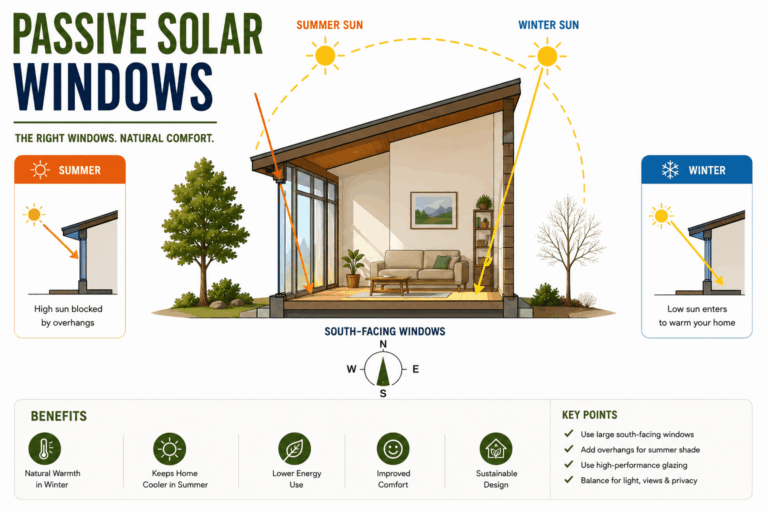
Passive Solar Windows
Passive solar windows are windows designed to manage sunlight, heat, daylight, views, ventilation, and comfort as part of a complete passive solar strategy. They are not simply large areas of glass. They must be sized, placed, shaded, and specified according to climate, orientation, thermal mass, insulation, airtightness, and room use.
Windows are one of the most powerful elements in passive solar architecture. They can bring useful winter sun, natural light, fresh air, and views. They can also cause heat loss, overheating, glare, drafts, and high cooling demand when poorly designed.
The goal of passive solar window design is to use the right amount of glazing in the right place, with the right performance, for the right climate.
Try it on your own design: Window-to-Wall Ratio Calculator (free, about a minute).
What Are Passive Solar Windows?
Passive solar windows are windows that support the building’s climate response. They are designed to admit, control, or block solar energy depending on the season and climate.
In a passive solar building, windows may help:
- Collect useful winter solar gain
- Provide daylight without excessive glare
- Frame views and connect indoor spaces to the outdoors
- Support natural ventilation where suitable
- Reduce unwanted heat gain through careful orientation and shading
- Limit heat loss through high-performance glazing and frames
- Work with thermal mass to stabilize indoor temperatures
Passive solar windows must be designed as part of the whole building. Window decisions should connect to orientation, building form, shading, thermal mass, insulation, airtightness, ventilation, and climate.
For the full design framework, read Passive Solar Design Principles.
In-depth guides: window sizing, placement and comfort · window design by climate · window placement by orientation and room · solar heat gain coefficient (SHGC) · clerestory windows
Passive Solar Windows at a Glance
| Window Factor | Why It Matters | Design Question |
|---|---|---|
| Orientation | Determines solar gain, glare, shading difficulty, and daylight quality | Which direction does each window face? |
| Window Size | Affects heat gain, heat loss, daylight, and overheating risk | Is the glazing area appropriate for the climate and room? |
| U-Value / U-Factor | Measures heat transfer through the window | Will the window reduce unwanted heat loss or heat gain? |
| SHGC | Measures how much solar heat passes through the glazing | Should this window admit or block solar heat? |
| Visible Transmittance | Measures how much visible light passes through | Will the room receive useful daylight without glare? |
| Shading | Blocks unwanted sun before it enters the building | How will the window be shaded in hot periods? |
| Installation | Affects airtightness, water control, thermal bridging, and durability | Is the window installed as part of a high-quality envelope? |
Passive Solar Windows Are Not Just Bigger Windows
A common passive solar mistake is assuming that more glass means better design. In reality, too much glass can create serious comfort and performance problems.
Oversized or poorly placed windows can cause:
- Summer overheating
- Shoulder-season overheating
- Glare and visual discomfort
- Heat loss in cold weather
- Drafts and cold interior surfaces
- Higher cooling demand
- Reduced privacy
- More expensive construction
Good passive solar window design is about balance. The right window area depends on climate, orientation, room function, glazing performance, shading, thermal mass, insulation, ventilation, and comfort goals.
Use the Window-to-Wall Ratio Calculator for early-stage glazing review.
Window Orientation in Passive Solar Design
Window orientation is one of the most important passive solar window decisions. Each facade receives sunlight differently throughout the day and year.
For global passive solar design, use the term equator-facing glazing. In the Northern Hemisphere, this usually means south-facing glazing. In the Southern Hemisphere, this usually means north-facing glazing.
| Window Orientation | Typical Solar Behavior | Passive Solar Strategy |
|---|---|---|
| Equator-facing | Often receives the most useful seasonal solar access | Use carefully sized glazing, shading, and thermal mass where passive heating is useful. |
| East-facing | Receives morning sun | Useful for morning light, but may need shading in warm climates. |
| West-facing | Receives low-angle afternoon sun | Often needs strong shading or reduced glass because overheating risk is high. |
| Pole-facing | Receives less direct solar gain in many locations | Can provide soft daylight, but may increase heat loss in cold climates if oversized. |
For a deeper explanation, read Passive Solar Orientation and Passive Solar Window Placement.
Equator-Facing Windows
Equator-facing windows are often the main passive solar windows in cold, temperate, and mixed climates. They can admit useful winter sun when heating is needed and can often be shaded more easily during summer with roof overhangs or horizontal shading.
Equator-facing glazing may support:
- Winter solar gain
- Daylight in main living spaces
- Connection to outdoor areas
- Thermal mass charging where appropriate
- Seasonal shading with roof overhangs
However, equator-facing windows still need careful design. Too much glass can cause overheating or heat loss. The glazing must be matched with shading, thermal mass, insulation, airtightness, and climate.
In hot climates, equator-facing windows may need to be smaller, better shaded, or specified with lower solar heat gain depending on the design goal.
East-Facing Windows
East-facing windows receive morning sun. This can be pleasant in bedrooms, kitchens, breakfast spaces, and some living areas.
In warm climates, east-facing windows can still add unwanted heat, especially during summer mornings. They may need external shading, careful size control, or glazing with lower solar heat gain.
East-facing windows are often easier to manage than west-facing windows, but they should not be ignored.
West-Facing Windows
West-facing windows are often the most difficult windows in passive solar design.
They receive low-angle afternoon sun, usually when outdoor temperatures are already higher. This can create glare, overheating, and late-day discomfort.
West-facing windows may need:
- Reduced glazing area
- Exterior shutters
- Vertical fins
- Exterior blinds
- Solar screens (affiliate link)
- Deciduous or evergreen planting where suitable
- Lower solar heat gain glazing
- Careful room placement
Interior blinds may reduce glare, but they are usually less effective at stopping heat because solar energy has already passed through the glass.
Pole-Facing Windows
Pole-facing windows face away from the equator. In the Northern Hemisphere, these are usually north-facing windows. In the Southern Hemisphere, they are usually south-facing windows.
These windows often provide softer daylight with less direct sun. They can be useful for studios, workspaces, circulation areas, and rooms where glare control matters.
In cold climates, pole-facing windows should be carefully sized and specified because they may lose more heat than they gain. In hot climates, they may provide useful daylight with lower solar gain, depending on local sun path and climate.
Understanding U-Value and U-Factor
U-value, sometimes called U-factor, measures how easily heat passes through a window. Lower U-values usually mean better insulation performance.
In passive solar design, U-value matters because windows are usually weaker thermal elements than insulated walls or roofs.
A lower U-value can help:
- Reduce winter heat loss
- Improve comfort near windows
- Reduce cold interior glass surfaces
- Improve building envelope performance
- Support low-energy design
Cold climates usually need stronger window insulation performance. Hot climates may also benefit from good window performance to reduce unwanted heat transfer, especially in air-conditioned buildings.
U-value should not be considered alone. It must be reviewed together with SHGC, visible transmittance, frame performance, airtightness, shading, and orientation.
Understanding SHGC
SHGC stands for Solar Heat Gain Coefficient. It describes how much solar heat passes through a window.
A higher SHGC allows more solar heat into the building. A lower SHGC blocks more solar heat.
The right SHGC depends on climate and orientation.
| Design Goal | Possible SHGC Strategy | Important Caution |
|---|---|---|
| Collect winter sun in a cold climate | Higher SHGC may be useful on equator-facing windows | Must still manage heat loss, glare, and summer overheating |
| Reduce cooling demand in a hot climate | Lower SHGC may be useful | Daylight, views, and ventilation still matter |
| Control difficult west sun | Lower SHGC or strong external shading may help | Exterior shading is often more effective than glass selection alone |
| Balance mixed-season comfort | SHGC should be selected by orientation | A single glazing specification may not be ideal for every facade |
SHGC is especially important for passive solar windows because the same glass can either help or hurt depending on climate and orientation.
For typical SHGC values by glass type, the difference between SHGC, g-value and shading coefficient, and starting values by climate and orientation, see Solar Heat Gain Coefficient (SHGC): What Is a Good Value for Your Windows?
Visible Transmittance and Daylighting
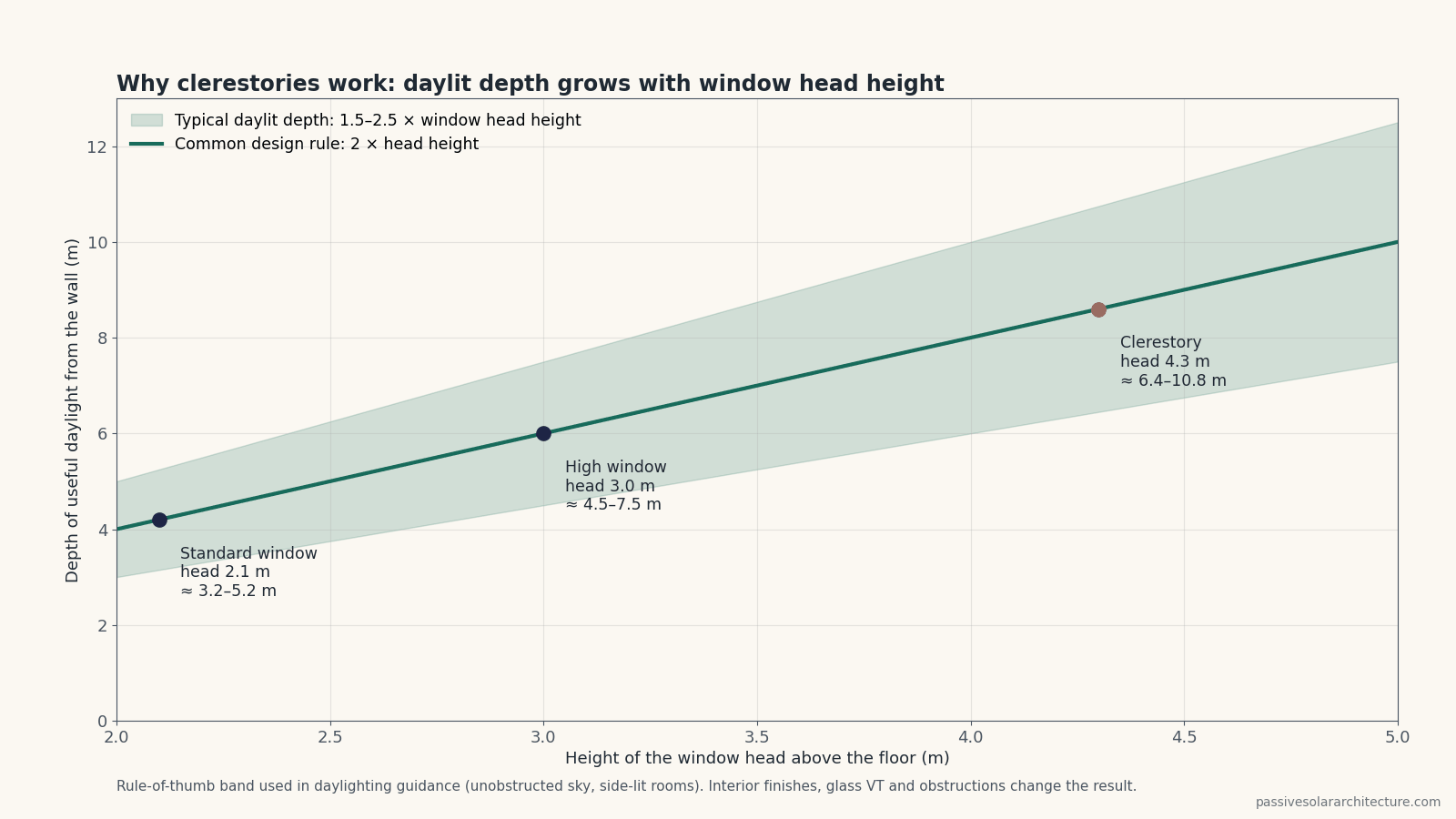
Window height matters as much as glass type for daylight: useful daylight from a side window reaches roughly 1.5–2.5 times the height of the window head. That is why high windows and clerestory windows light deep rooms so well.
Visible transmittance describes how much visible light passes through glazing. Higher visible transmittance allows more daylight into the room.
Good daylighting is not just about brightness. A passive solar window should provide useful light without glare, overheating, or excessive contrast.
Daylighting design should consider:
- Window height and position
- Room depth
- Interior surface colors
- Glare control
- Shading devices
- Window orientation
- Task areas and room use
- Visible transmittance of the glazing
A bright room that overheats or causes glare is not a successful passive solar design.
For more detail, read Windows, Glazing & Daylighting.
Window Frames and Installation
The glass is only one part of a passive solar window. Frames, spacers, seals, installation details, flashing, and airtightness all affect performance.
Window frames can create thermal bridges, air leakage, condensation risk, and comfort problems if they are poorly designed or installed.
Good window installation should consider:
- Airtight connection to the wall assembly
- Water management and flashing
- Thermal bridge reduction
- Correct placement within the wall depth
- Durable sealants and tapes
- Compatibility with exterior cladding and interior finishes
- Maintenance and long-term durability
A high-performance window can perform poorly if installed badly. Passive solar window design must include construction quality, not only product selection.
For related envelope design, read Insulation, Airtightness & Ventilation.
Passive Solar Windows and Thermal Mass
Windows and thermal mass must be designed together. Windows admit solar heat. Thermal mass stores and releases some of that heat.
If a room has too much solar glazing and not enough thermal mass, it may overheat quickly during the day and cool rapidly later. If a room has thermal mass but little useful solar gain, the mass may have limited passive solar benefit.
A good relationship between windows and thermal mass considers:
- How much sun enters the room
- Which surfaces receive direct sun
- Whether mass is exposed or covered
- Whether summer sun is blocked
- Whether stored heat can be released when needed
- Whether the climate supports heat storage
Thermal mass should not be used to justify excessive glazing. Shading, insulation, and ventilation are still necessary.
Helpful links:
Passive Solar Windows and Shading
Shading is essential for passive solar windows. Without shading, even well-oriented windows can cause overheating.
Exterior shading is usually more effective than interior shading because it blocks solar heat before it enters the building.
Common shading strategies include:
- Roof overhangs
- Exterior blinds
- Sliding shutters
- Fixed or adjustable louvers
- Vertical fins
- Solar screens
- Pergolas
- Balconies
- Deep window reveals
- Deciduous planting where suitable
Equator-facing windows can often work well with horizontal overhangs. East and west windows usually require different shading because the sun is lower in the sky.
Helpful links:
- Passive Solar Shading & Overhangs
- Shading & Passive Cooling
- Roof Overhang Calculator
- Solar Angle Calculator
Passive Solar Windows by Climate
Window design changes by climate. A window strategy that works in a cold region can cause overheating in a hot or mixed climate.
| Climate | Window Priority | Common Risk |
|---|---|---|
| Cold | Use high-performance windows, reduce heat loss, and admit useful winter sun where appropriate. | Too much glass or poor U-value increasing heat loss. |
| Temperate | Balance winter solar gain, summer shading, daylight, and ventilation. | Too much glazing without enough shading. |
| Hot-Dry | Reduce daytime solar gain and shade windows deeply. | Unshaded east and west glass causing overheating. |
| Hot-Humid | Prioritize shade, airflow, rain protection, and reduced heat gain. | Large unshaded windows trapping heat and humidity. |
| Mixed | Design for both heating and cooling seasons with flexible shading. | A winter-focused window strategy that overheats in summer. |
For detailed climate guidance, read Passive Solar Design by Climate.
Passive Solar Windows in Cold Climates
In cold climates, windows must balance solar gain and heat loss. Equator-facing windows can collect useful winter sun, but all windows lose heat compared with insulated walls.
Cold-climate window priorities include:
- Low U-value or strong insulating performance
- Appropriate SHGC on equator-facing glazing
- Airtight installation
- Reduced thermal bridges around frames
- Careful sizing of pole-facing windows
- Thermal mass where useful solar gain is expected
- Shading for summer and shoulder-season overheating
Cold-climate passive solar design should not rely on glass alone. Insulation, airtightness, and controlled ventilation are essential.
Passive Solar Windows in Temperate Climates
Temperate climates often need a balanced window strategy. The building may benefit from winter sun but also needs summer protection.
Temperate-climate window priorities include:
- Moderate equator-facing glazing
- Seasonal shading
- Controlled east and west windows
- Useful daylight without glare
- Ventilation potential
- Thermal mass where appropriate
- Good insulation and airtightness
The main risk is adding too much glass for winter comfort and then creating summer overheating.
Passive Solar Windows in Hot-Dry Climates
In hot-dry climates, windows should usually be designed to reduce unwanted daytime heat gain while supporting daylight, views, and ventilation.
Hot-dry window priorities include:
- Deep exterior shading
- Limited east and west glazing
- Openings that support night ventilation where nights are cool enough
- Careful use of thermal mass
- Protection from harsh sun and glare
- Durable shading materials
Thermal mass may work well in hot-dry climates if heat can be released at night. Without night cooling, windows and mass can contribute to overheating.
Passive Solar Windows in Hot-Humid Climates
Hot-humid climates usually prioritize shade, airflow, moisture control, and reduced heat gain.
Hot-humid window priorities include:
- Large exterior shading devices
- Rain-protected openings
- Cross ventilation where outdoor air quality and humidity allow
- Reduced direct solar gain
- Careful control of east and west glass
- Screens, louvers, shutters, or verandas where suitable
- Moisture-aware detailing around windows
In hot-humid climates, large areas of unshaded glass can quickly create heat and comfort problems. Thermal mass should also be used cautiously because stored heat may be difficult to release.
Passive Solar Windows in Mixed Climates
Mixed climates need windows that work across both heating and cooling seasons. A window that helps in winter may cause discomfort in summer if shading is weak.
Mixed-climate window priorities include:
- Balanced glazing area
- Adjustable or seasonally effective shading
- Orientation-specific glazing specifications
- Controlled west-facing glass
- Thermal mass protected from summer sun
- Good insulation and airtightness
- Ventilation and humidity control
In mixed climates, window design should always be checked for winter, summer, and shoulder seasons.
How Much Window Area Should a Passive Solar Home Have?
There is no universal window-to-wall ratio for every passive solar home. The right amount of glazing depends on climate, orientation, room size, shading, thermal mass, window performance, and comfort goals.
Before increasing window area, ask:
- What climate is the building in?
- Which direction does the window face?
- Does the room need solar gain, daylight, views, ventilation, or all of these?
- Can the window be shaded in hot periods?
- Is there enough thermal mass to absorb useful gain?
- Will the window cause glare?
- Will the window increase heat loss in cold weather?
- Is the glazing specification appropriate?
Use the Window-to-Wall Ratio Calculator for early-stage review. For final design, use local climate data, product specifications, energy modeling, and professional guidance where needed.
Passive Solar Windows and Natural Ventilation
Windows can support natural ventilation, but ventilation performance depends on more than opening size.
Natural ventilation depends on:
- Window placement
- Wind direction
- Cross ventilation paths
- Stack effect potential
- Indoor layout
- Outdoor temperature
- Humidity
- Air quality
- Noise and security
- Insects and rain protection
Operable windows can support passive cooling where outdoor conditions are suitable. In hot-humid, polluted, smoky, noisy, or high-security contexts, natural ventilation may be limited and mechanical ventilation or cooling may still be needed.
For related design, read Shading & Passive Cooling and Insulation, Airtightness & Ventilation.
Passive Solar Windows and Room Layout
Windows should be designed according to room use. A living room, bedroom, kitchen, bathroom, and home office do not need the same window strategy.
| Room Type | Window Design Priority | Design Caution |
|---|---|---|
| Living Room | Daylight, views, winter sun where useful, connection to outdoor space | Avoid overheating and glare from excessive glass. |
| Bedroom | Comfort, privacy, ventilation, morning light where desired | Avoid late-day overheating in warm climates. |
| Kitchen | Daylight, ventilation, task visibility | Remember that kitchens already generate internal heat. |
| Home Office | Stable daylight and glare control | Avoid direct sun on screens or work surfaces. |
| Bathroom | Privacy, ventilation, moisture control | Use appropriate glazing, ventilation, and waterproof detailing. |
| Circulation | Daylight and orientation | Avoid wasting the best solar access on spaces used briefly. |
For whole-house planning, read Passive Solar House Design.
Common Passive Solar Window Mistakes
Many passive solar comfort problems begin with poor window decisions.
- Adding too much glass: Oversized windows can cause overheating, glare, heat loss, and higher costs.
- Using one glazing type everywhere: Different orientations may need different SHGC, U-value, or shading strategies.
- Ignoring west-facing sun: Afternoon sun is often intense, low-angle, and difficult to shade.
- Relying only on interior blinds: Interior blinds may reduce glare but often do less to prevent heat gain.
- Forgetting thermal mass: Solar gain should be balanced with heat storage where appropriate.
- Using poor window installation: Air leaks, water leaks, and thermal bridges can reduce performance.
- Ignoring climate: Cold, hot-dry, hot-humid, temperate, and mixed climates need different window strategies.
- Designing for winter only: Summer and shoulder-season overheating must be considered.
- Confusing passive solar design with solar panels: Passive solar windows are architectural elements, not electricity-generating technology.
- Skipping professional review: Final window decisions should be checked against climate data, codes, product specifications, and energy performance goals.
Use the Passive Solar Design Checklist to review window design as part of the whole building.
Passive Solar Window Design Checklist
Use this checklist before finalizing window placement, size, and specifications.
- The local climate type has been identified.
- Heating, cooling, humidity, and daylight priorities are clear.
- Each window orientation has been reviewed separately.
- Equator-facing glazing is sized carefully.
- East and west glazing are controlled.
- Pole-facing glazing is not oversized in cold climates.
- Window-to-wall ratio has been reviewed.
- U-value or U-factor has been considered.
- SHGC has been selected according to climate and orientation.
- Visible transmittance supports useful daylight.
- Glare risk has been reviewed.
- Exterior shading is designed for hot periods.
- Thermal mass is balanced with solar gain where appropriate.
- Window installation supports airtightness and water control.
- Ventilation needs are considered.
- Overheating risk has been checked.
- Local codes, product data, and professional guidance are included.
Passive Solar Windows for Different Readers
| Reader | How to Use This Guide | Recommended Page |
|---|---|---|
| Architects | Use this guide to coordinate orientation, facade design, glazing performance, shading, daylight, and comfort. | For Architects |
| Self-Builders | Use this guide before approving window sizes, glazing types, room layouts, or large glass areas. | For Self-Builders |
| Investors and Developers | Use window review to reduce comfort risk, overheating risk, and long-term energy performance problems. | For Investors |
| Students | Use this guide to understand how windows connect solar gain, daylight, heat loss, shading, and climate response. | Learn |
Useful Tools for Passive Solar Windows
These tools can support early-stage passive solar window decisions. They do not replace professional design, energy modeling, manufacturer specifications, or local code review.
- Window-to-Wall Ratio Calculator
- Solar Angle Calculator
- Roof Overhang Calculator
- Passive Solar Orientation Calculator
- Thermal Mass Calculator
- Passive Solar Design Tools
- Passive Solar Design Checklist
Frequently Asked Questions
What are passive solar windows?
Passive solar windows are windows designed to support passive solar performance through orientation, size, glazing type, shading, daylighting, thermal mass, ventilation, and climate response.
Are passive solar windows just south-facing windows?
No. For a global audience, the better term is equator-facing glazing. In the Northern Hemisphere, this usually means south-facing. In the Southern Hemisphere, it usually means north-facing. Climate and shading still matter.
How much glass should a passive solar house have?
There is no universal amount. Window area should be based on climate, orientation, glazing performance, shading, thermal mass, daylight needs, and overheating risk.
What is SHGC?
SHGC stands for Solar Heat Gain Coefficient. It describes how much solar heat passes through glazing. Higher SHGC admits more solar heat, while lower SHGC blocks more solar heat.
What is U-value?
U-value measures how easily heat passes through a window. Lower U-values usually mean better insulation performance and less heat transfer.
Should all windows have the same glazing?
Not always. Different orientations may need different glazing strategies. For example, equator-facing windows in cold climates may benefit from different SHGC than west-facing windows in warm climates.
Do passive solar windows need shading?
Yes. Shading is essential in many climates. Without shading, passive solar windows can cause overheating, glare, and discomfort.
Can passive solar windows eliminate heating and cooling?
No. Passive solar windows can reduce heating and cooling demand when designed well, but they do not automatically eliminate mechanical systems. Climate, comfort expectations, construction quality, and user behavior all matter.
Recommended Learning Path
After reading this guide, continue with these related pages:
- Passive Solar Window Placement
- Windows, Glazing & Daylighting
- Window-to-Wall Ratio Calculator
- Passive Solar Orientation
- Passive Solar Shading & Overhangs
- Roof Overhang Calculator
- Thermal Mass
- Insulation, Airtightness & Ventilation
- Passive Solar Design by Climate
Continue Learning
Passive solar windows work best when they are designed with the whole building. Window orientation, size, glazing, shading, thermal mass, insulation, airtightness, ventilation, and climate response must all support the same comfort goal.
Recommended next step: Read Passive Solar Window Placement
Recommended books and tools
This section contains affiliate links. As an Amazon Associate we earn from qualifying purchases, at no extra cost to you. We only list items that relate to this page; we have not tested specific products.
- The Passive Solar Energy Book by Edward Mazria: the classic reference on orientation, glazing ratios, thermal storage and shading rules of thumb. View on Amazon
- Cellular (honeycomb) shades: insulating window coverings that reduce night-time heat loss through glass. Browse on Amazon
- Thermal insulated curtains: a low-cost way to cut heat loss from large south-facing windows at night. Browse on Amazon
- Window insulation film kits: a temporary, renter-friendly fix for single-glazed or draughty windows. Browse on Amazon
Next step: check your own project
Check the glazing on each facade of your design with the Window-to-Wall Ratio Calculator. It is free and runs in your browser.
Keep your results in one place
The free Passive Solar Design Checklist & Project Brief is a printable PDF with pages for your site’s sun angles, orientation, glazing per facade, shading and thermal mass, plus 12 questions to take to your architect or designer.