
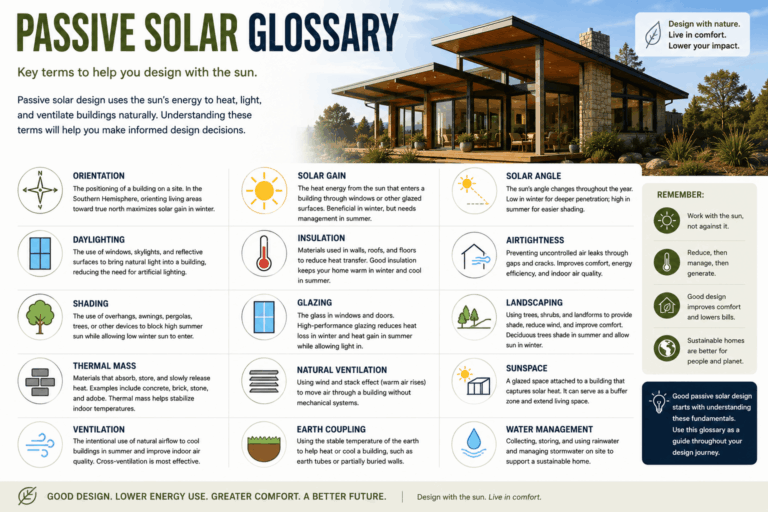
Passive Solar Glossary
This passive solar glossary explains the key terms used in passive solar architecture, climate-responsive design, building science, thermal comfort, glazing, shading, insulation, ventilation, and energy-efficient buildings.
Use this glossary when you come across an unfamiliar term in a guide, calculator, checklist, case study, or design discussion.
Passive solar design depends on climate, site orientation, solar access, window placement, shading, thermal mass, insulation, airtightness, ventilation, construction quality, and user behavior. These definitions are written to help you understand the concepts clearly, but real projects should always be checked against local climate data, building codes, product specifications, and professional guidance.
How to Use This Glossary
You can read this page from top to bottom, or use it as a reference when studying passive solar design.
For a step-by-step introduction, start with:
- Start Here
- Learn
- What Is Passive Solar Architecture?
- Passive Solar Fundamentals
- Passive Solar Design Principles
A
Active Solar System
An active solar system uses mechanical or electrical equipment to collect, convert, store, or distribute solar energy. Solar photovoltaic panels, solar thermal collectors, pumps, fans, inverters, and storage systems are examples of active solar technologies.
Active solar systems are different from passive solar design, which uses the building itself through orientation, windows, shading, materials, insulation, and ventilation.
Related: What Is Passive Solar Architecture?, Passive Solar Systems
Airtightness
Airtightness describes how well a building limits uncontrolled air leakage through gaps, cracks, joints, and poorly sealed connections. Good airtightness helps reduce heat loss, improve comfort, control moisture, and support predictable ventilation.
Airtightness is important in modern passive solar buildings because solar gain is less useful if warm or cool indoor air escapes uncontrollably.
Related: Insulation, Airtightness & Ventilation
Air Leakage
Air leakage is uncontrolled air movement through the building envelope. It can occur around windows, doors, roof joints, wall penetrations, service openings, and poorly sealed construction details.
Air leakage can reduce energy efficiency and comfort. It can also increase moisture risk in some climates.
Related: Insulation, Airtightness & Ventilation
B
Building Envelope
The building envelope is the physical separation between indoor and outdoor conditions. It includes walls, roof, floor, windows, doors, insulation, air barriers, vapor control layers, and other components that affect heat, air, and moisture movement.
In passive solar architecture, the envelope must work with solar gain, shading, thermal mass, and ventilation.
Related: Insulation, Airtightness & Ventilation
Building Form
Building form refers to the overall shape, massing, volume, roof geometry, and layout of a building. Form affects heat loss, solar exposure, daylight, ventilation, shading, and construction cost.
A compact form may reduce heat loss in cold climates, while a more elongated form may improve solar access and daylight when designed carefully.
Related: Orientation & Building Form
C
Clerestory Window
A clerestory window is a window set high in a wall, above eye level, usually above a lower roof or in a raised roof section. It brings daylight deep into a room, preserves privacy and, when operable, lets warm air escape at the top of the house.
Related: Clerestory Windows, Passive Solar Window Placement
Climate-Responsive Design
Climate-responsive design is an architectural approach that adapts the building to local climate conditions. It considers sun path, temperature, humidity, wind, rainfall, seasonal change, and comfort needs.
Passive solar architecture is one part of climate-responsive design.
Related: Climate Guides, Passive Solar Design by Climate
Cold Climate Passive Solar Design
Cold climate passive solar design usually focuses on collecting useful winter sun, reducing heat loss, using high-performance windows, improving insulation and airtightness, and placing thermal mass where it can help stabilize indoor temperatures.
Even in cold climates, summer and shoulder-season overheating should still be considered.
Related: Climate Guides
Compact Building Form
A compact building form has less external surface area compared with its internal volume. This can reduce heat loss in cold climates and simplify construction, but it may reduce solar exposure or daylight if not carefully planned.
Related: Orientation & Building Form
Cross Ventilation
Cross ventilation occurs when outdoor air enters through one opening and exits through another, usually on an opposite or adjacent side of the building. It can help remove heat and improve comfort when outdoor conditions are suitable.
Cross ventilation depends on wind direction, window placement, room layout, security, outdoor air quality, and humidity.
Related: Shading & Passive Cooling, Insulation, Airtightness & Ventilation
D
Daylighting
Daylighting is the use of natural light to illuminate indoor spaces. Good daylighting improves visual comfort and reduces the need for artificial lighting during the day.
In passive solar design, daylighting must be balanced with glare control, heat gain, heat loss, shading, and window placement.
Related: Windows, Glazing & Daylighting
Direct Gain System
A direct gain system is a passive solar approach where sunlight enters directly through windows and warms interior surfaces such as floors, walls, or other thermal mass materials.
Direct gain systems are simple, but they require careful window sizing, shading, thermal mass, and climate-specific design to avoid glare or overheating.
Related: Passive Solar Systems, Thermal Mass
E
Earth-Sheltered Home
An earth-sheltered home has soil against some of its walls, on its roof, or both. The soil moderates temperature swings and blocks wind and noise. The main types are earth-bermed, in-hill (earth-covered) and underground (atrium) houses; all need careful waterproofing, drainage, insulation and structural design.
Related: Earth-Sheltered Homes, Thermal Mass
East-West Axis
The east-west axis describes the long direction of a building when it is stretched from east to west. In many passive solar designs, an east-west building axis can help create more equator-facing wall area for useful solar access.
This is not a universal rule. Site constraints, views, wind, privacy, climate, and local planning rules also matter.
Related: Orientation & Building Form, Passive Solar Orientation
Embodied Carbon
Embodied carbon refers to greenhouse gas emissions associated with producing, transporting, installing, maintaining, and eventually disposing of building materials. It is different from operational energy, which relates to energy used while the building is occupied.
Passive solar design often focuses on operational comfort and energy demand, but material choices and embodied carbon can also be important in sustainable architecture.
Related: Passive Solar Materials
Energy Efficiency
Energy efficiency means using less energy to provide the same or better level of comfort, light, ventilation, or function. In buildings, energy efficiency can be improved through insulation, airtightness, efficient windows, shading, ventilation design, efficient equipment, and climate-responsive architecture.
Related: Passive Solar Design Principles
Equator-Facing Glazing
Equator-facing glazing means windows oriented toward the equator. In the Northern Hemisphere, this usually means south-facing glazing. In the Southern Hemisphere, this usually means north-facing glazing.
This term is useful for global passive solar design because “south-facing windows” is not correct for every hemisphere.
Related: Passive Solar Orientation, Climate Guides
F
Facade
A facade is an exterior face of a building. In passive solar design, each facade should be considered separately because solar exposure, window performance, shading needs, and heat gain vary by orientation.
Related: Windows, Glazing & Daylighting
Fixed Shading
Fixed shading is a shading device that does not move, such as a roof overhang, permanent canopy, balcony, or fixed screen. It can be simple and durable, but it must be designed carefully for local sun angles and seasonal needs.
Related: Passive Solar Shading & Overhangs, Roof Overhang Calculator
G
Glare
Glare is visual discomfort caused by excessive brightness or strong contrast in the field of view. In passive solar buildings, glare can occur when sunlight enters directly through windows without proper control.
Good daylighting design should provide useful natural light without creating glare or overheating.
Related: Windows, Glazing & Daylighting
Glazing
Glazing refers to the glass or transparent part of a window, door, skylight, or curtain wall. In passive solar design, glazing affects solar gain, daylight, heat loss, glare, and comfort.
Important glazing properties include U-value, SHGC, visible transmittance, and frame performance.
Related: Passive Solar Windows, Passive Solar Window Placement
Green Building
A green building is designed to reduce environmental impact and improve occupant health, comfort, or resource efficiency. Passive solar architecture can be part of green building, but green building may also include water efficiency, low-carbon materials, renewable energy, waste reduction, and healthy indoor materials.
Related: Passive Solar Design Principles
H
Heat Gain
Heat gain is heat that enters or is generated inside a building. It may come from the sun, occupants, appliances, lighting, or outdoor air.
In passive solar design, useful heat gain can help in cold periods, while unwanted heat gain can cause overheating in warm periods.
Related: Passive Solar Design Principles
Heat Loss
Heat loss is the movement of heat from indoors to outdoors. It can happen through walls, roofs, floors, windows, air leakage, ventilation, and thermal bridges.
Reducing heat loss is especially important in cold and mixed climates.
Related: Insulation, Airtightness & Ventilation
Hot-Dry Climate
A hot-dry climate typically has strong sun, high daytime temperatures, low humidity, and often cooler nights. Passive design usually focuses on shading, reducing daytime heat gain, using thermal mass carefully, and supporting night cooling when suitable.
Related: Climate Guides, Shading & Passive Cooling
Hot-Humid Climate
A hot-humid climate typically has high temperatures and high humidity. Passive design usually prioritizes shading, airflow, moisture control, reduced heat gain, and careful material choices.
Thermal mass must be used cautiously because stored heat may be difficult to release when nights remain warm and humid.
Related: Climate Guides, Insulation, Airtightness & Ventilation
HRV
HRV stands for heat recovery ventilation. It is a mechanical ventilation system that transfers heat between outgoing stale air and incoming fresh air. HRVs are often used in airtight, energy-efficient buildings.
An HRV is not passive solar design, but it can support comfort and indoor air quality in a high-performance building.
Related: Insulation, Airtightness & Ventilation
I
Indirect Gain System
An indirect gain system collects solar heat in a material or space between the sun and the occupied area. A Trombe wall is a common example. The thermal mass absorbs heat and releases it gradually into the interior.
Indirect gain systems require careful climate, glazing, ventilation, and overheating analysis.
Related: Passive Solar Systems, Thermal Mass, Trombe Wall Design Guide
Indoor Air Quality
Indoor air quality describes the condition of indoor air, including freshness, pollutants, moisture, odors, and ventilation. Airtight and energy-efficient buildings still need planned ventilation to maintain healthy indoor air.
Related: Insulation, Airtightness & Ventilation
Insulation
Insulation slows heat flow through the building envelope. It helps keep heat inside during cold periods and outside during hot periods.
In passive solar buildings, insulation supports the overall design by reducing heating and cooling demand.
Related: Insulation, Airtightness & Ventilation
Isolated Gain System
An isolated gain system collects solar heat in a separate space, such as a sunspace or attached greenhouse, before transferring some of that heat to the occupied building.
Isolated gain systems need careful control to prevent overheating, heat loss, and moisture problems.
Related: Passive Solar Systems, Passive Solar Greenhouse and Sunspace Design
L
Latitude
Latitude describes how far a location is north or south of the equator. It affects sun angles, day length, solar path, and seasonal solar design.
Latitude is important for roof overhangs, shading design, window placement, and solar angle calculations.
Related: Solar Angle Calculator, Roof Overhang Calculator
Low-Energy Building
A low-energy building is designed to use less energy than a typical building. It may use passive solar design, strong insulation, airtightness, efficient windows, mechanical ventilation, efficient equipment, renewable energy, or other strategies.
Related: Passive Solar vs Passive House
M
Mechanical Ventilation
Mechanical ventilation uses fans and ductwork to provide fresh air and remove stale air. It may include heat recovery, energy recovery, filtration, humidity control, or balanced airflow.
Mechanical ventilation can be important in airtight buildings or climates where natural ventilation is unreliable.
Related: Insulation, Airtightness & Ventilation
Microclimate
A microclimate is the specific climate condition of a small area or site. It may be affected by slope, vegetation, nearby buildings, water, wind exposure, paving, shade, and urban heat.
Microclimate can significantly affect passive solar design decisions.
Related: Site & Climate Analysis
Mixed Climate
A mixed climate has both heating and cooling needs. Passive solar design in mixed climates must balance useful winter sun with summer overheating control.
Related: Climate Guides, Passive Solar Design by Climate
N
Natural Ventilation
Natural ventilation uses wind pressure, temperature differences, or stack effect to move air through a building without mechanical fans.
It can support passive cooling and fresh air when outdoor conditions are suitable, but it may not be reliable in all climates or sites.
Related: Shading & Passive Cooling, Insulation, Airtightness & Ventilation
Net-Zero Energy Building
A net-zero energy building is designed to produce as much energy as it uses over a defined period, often through a combination of energy efficiency and renewable energy systems.
Passive solar design can help reduce demand, but net-zero usually also depends on active systems such as solar panels.
Related: Passive Solar vs Passive House
Night Ventilation
Night ventilation uses cooler night air to remove stored heat from a building. It can be useful in hot-dry climates or places with large day-night temperature swings.
Night ventilation is less effective where nights remain hot, humid, noisy, polluted, or unsafe for open windows.
Related: Shading & Passive Cooling
O
Orientation
Orientation describes the direction a building or facade faces. It affects solar gain, daylight, overheating risk, wind exposure, views, privacy, and room comfort.
In passive solar design, orientation is one of the most important early decisions.
Related: Passive Solar Orientation, Passive Solar Orientation Calculator
Overhang
An overhang is a horizontal projection that shades windows, walls, or outdoor spaces. Roof overhangs are commonly used in passive solar design to block high summer sun while allowing lower winter sun where climate and geometry support this strategy.
Overhang design depends on latitude, window height, facade orientation, climate, and sun angles.
Related: Passive Solar Shading & Overhangs, Roof Overhang Calculator
Overheating
Overheating occurs when indoor temperatures rise above comfortable levels. It can happen because of excessive solar gain, poor shading, too much glass, insufficient ventilation, internal heat gains, or poorly placed thermal mass.
Preventing overheating is a major part of passive solar design.
Related: Shading & Passive Cooling, Passive Solar Shading & Overhangs
P
Passive Cooling
Passive cooling uses building design strategies to reduce heat gain and improve comfort without relying only on mechanical air conditioning. Strategies may include shading, ventilation, reflective surfaces, night cooling, courtyards, thermal mass, insulation, and careful window placement.
Related: Shading & Passive Cooling, Passive Cooling Strategies for Homes
Passive House
Passive House is a performance-based building standard focused on very low energy demand, airtightness, high insulation, high-performance windows, reduced thermal bridges, and controlled ventilation.
Passive House is not the same as passive solar design, although a building can use both approaches.
Related: Passive Solar vs Passive House
Passive Solar Architecture
Passive solar architecture is a design approach that uses the building itself to work with the sun and climate. It relies on orientation, windows, shading, thermal mass, insulation, airtightness, ventilation, and building form to improve comfort and reduce unnecessary heating or cooling demand.
Related: What Is Passive Solar Architecture?
Passive Solar Design
Passive solar design is the practical method of arranging a building to collect, block, store, or release solar heat depending on the season and climate. It includes both passive heating and passive cooling strategies.
Related: Passive Solar Design Principles
Passive Solar Heating
Passive solar heating uses sunlight to help warm a building without relying entirely on mechanical heating. It typically involves equator-facing glazing, thermal mass, good insulation, airtightness, and seasonal shading.
Related: Passive Solar Design Principles, Thermal Mass
Passive Solar Home
A passive solar home is designed to use sun, climate, orientation, glazing, shading, thermal mass, insulation, and ventilation to improve comfort and reduce energy demand.
A passive solar home is not automatically a solar-powered home or a certified Passive House.
Related: Passive Solar House Design
Passive Solar System
A passive solar system is a building strategy that collects, stores, distributes, or controls solar heat without relying primarily on mechanical equipment. Common types include direct gain, indirect gain, and isolated gain systems.
Related: Passive Solar Systems
PV Panels
PV panels, or photovoltaic panels, convert sunlight into electricity. They are active solar technology, not passive solar design.
A building can have both passive solar design and PV panels, but they are different strategies.
Related: What Is Passive Solar Architecture?
R
R-Value
R-value measures resistance to heat flow. Higher R-values usually mean better insulation performance for a material or assembly.
R-value should be considered together with airtightness, thermal bridges, moisture control, and construction quality.
Related: Insulation, Airtightness & Ventilation
Radiant Heat
Radiant heat is heat transferred by infrared radiation between surfaces. In passive solar design, sun-warmed floors, walls, or thermal mass surfaces can affect radiant comfort.
Related: Thermal Mass
Roof Overhang
A roof overhang is the part of a roof that extends beyond the exterior wall. It can shade windows and walls, protect facades from rain, and support passive cooling when designed properly.
Related: Roof Overhang Calculator, Passive Solar Shading & Overhangs
S
Seasonal Shading
Seasonal shading is the design of shading devices to respond differently to summer and winter sun. In many passive solar designs, the goal is to admit useful winter sun and block unwanted summer sun.
Seasonal shading must be checked against local sun angles, climate, and facade orientation.
Related: Passive Solar Shading & Overhangs
SHGC
SHGC stands for Solar Heat Gain Coefficient. It describes how much solar heat passes through a window. A higher SHGC allows more solar heat gain, while a lower SHGC blocks more solar heat.
The right SHGC depends on climate, orientation, shading, and heating or cooling priorities.
Related: Passive Solar Windows, SHGC Explained
Shading Device
A shading device is any element that blocks or filters sunlight before it enters the building. Examples include roof overhangs, screens, shutters, fins, pergolas, balconies, exterior blinds, trees, and deep reveals.
Related: Shading & Passive Cooling
Site Analysis
Site analysis is the study of a project location before design begins. It may include sun path, slope, wind, views, access, vegetation, shading, neighboring buildings, climate, noise, soil, drainage, and regulations.
Good passive solar design begins with site analysis.
Related: Site & Climate Analysis
Solar Access
Solar access means the ability of a building, window, roof, or outdoor space to receive sunlight. Solar access can be blocked by trees, hills, nearby buildings, roof forms, or future development.
Related: Site & Climate Analysis, Passive Solar Orientation
Solar Altitude
Solar altitude is the angle of the sun above the horizon. It changes by time of day, season, and latitude.
Solar altitude is important for overhang design, daylighting, shading, and solar gain.
Related: Solar Angle Calculator
Solar Azimuth
Solar azimuth is the compass direction of the sun. It helps describe where sunlight is coming from at a particular time.
Solar azimuth is important when studying facade exposure, east and west sun, shading, and solar access.
Related: Solar Angle Calculator
Solar Gain
Solar gain is heat gained from sunlight entering or striking a building. It can be useful in cold periods and problematic in hot periods.
Passive solar design manages solar gain through orientation, window placement, glazing, shading, and thermal mass.
Related: Passive Solar Design Principles
Solar Orientation
Solar orientation is the positioning of a building or window in relation to the sun path. Good solar orientation can improve daylight, comfort, and passive heating or cooling performance.
Related: Passive Solar Orientation
Solar Path
The solar path is the apparent movement of the sun across the sky throughout the day and year. It changes by latitude and season.
Understanding the solar path is essential for passive solar orientation, shading, daylighting, and overhang design.
Related: Site & Climate Analysis, Solar Angle Calculator
Stack Effect
Stack effect is air movement caused by temperature differences between indoor and outdoor air. Warm air rises and may exit through high openings, drawing cooler air through lower openings.
Stack effect can support natural ventilation, but it must be designed carefully to avoid uncontrolled heat loss or moisture problems.
Related: Shading & Passive Cooling
Sunspace
A sunspace is a glazed space attached to a building that collects solar heat. It can act as an isolated gain system when designed to transfer some heat to the main building.
Sunspaces can overheat or lose heat if poorly designed, so climate, glazing, shading, and ventilation must be considered.
Related: Passive Solar Systems
T
Temperate Climate
A temperate climate usually has moderate conditions but may still require both heating and cooling at different times. Passive solar design in temperate climates often focuses on balance: useful winter sun, summer shading, daylight, ventilation, and moderate thermal mass.
Related: Climate Guides
Thermal Bridge
A thermal bridge is a part of the building envelope where heat flows more easily than through surrounding areas. Thermal bridges often occur at structural connections, window frames, balconies, slab edges, corners, and poorly insulated details.
Thermal bridges can reduce energy efficiency, lower comfort, and increase condensation risk.
Related: Insulation, Airtightness & Ventilation
Thermal Comfort
Thermal comfort describes how comfortable people feel with indoor temperature, radiant conditions, air movement, humidity, clothing, and activity level.
Passive solar design aims to improve thermal comfort, not only reduce energy use.
Related: Passive Solar Design Principles
Thermal Lag
Thermal lag is the delay between when a material absorbs heat and when it releases that heat. Thermal lag is important when using thermal mass to moderate indoor temperature swings.
Related: Thermal Mass
Thermal Mass
Thermal mass refers to materials that can absorb, store, and release heat. Common thermal mass materials include concrete, brick, stone, tile, adobe, masonry, and rammed earth.
Thermal mass can improve comfort when it is correctly placed, exposed, and matched to climate, solar gain, shading, and ventilation.
Related: Thermal Mass, Thermal Mass Calculator
Trombe Wall
A Trombe wall is a passive solar wall system that uses a massive wall behind glazing to absorb solar heat and release it gradually into the building.
Trombe walls are a type of indirect gain system and require careful design to avoid overheating or heat loss.
Related: Passive Solar Systems, Thermal Mass
U
U-Value
U-value measures how easily heat passes through a building element such as a window, wall, roof, or floor. Lower U-values usually mean better insulation performance.
For windows, U-value should be considered together with SHGC, visible transmittance, frame quality, airtightness, and orientation.
Related: Passive Solar Windows, Windows, Glazing & Daylighting
V
Ventilation
Ventilation is the process of bringing fresh air into a building and removing stale air. It may be natural, mechanical, or hybrid.
Ventilation supports indoor air quality, moisture control, and passive cooling where outdoor conditions allow.
Related: Insulation, Airtightness & Ventilation
Visible Transmittance
Visible transmittance describes how much visible light passes through glazing. Higher visible transmittance allows more daylight, but daylight design must also control glare and heat gain.
Related: Windows, Glazing & Daylighting
W
Window Placement
Window placement describes where windows are located on each facade and within each room. It affects daylight, views, privacy, solar gain, heat loss, ventilation, glare, and overheating risk.
In passive solar design, window placement should be planned by orientation and climate.
Related: Passive Solar Window Placement
Window-to-Wall Ratio
Window-to-wall ratio is the percentage of a wall or facade made up of windows. It helps evaluate whether a facade may have too much or too little glazing.
Window-to-wall ratio should be considered together with orientation, climate, glazing performance, shading, daylight, and thermal mass.
Related: Window-to-Wall Ratio Calculator
Winter Solar Gain
Winter solar gain is useful heat from the sun during colder months. It can reduce heating demand when combined with good orientation, appropriate glazing, thermal mass, insulation, airtightness, and shading control.
Related: Passive Solar Design Principles, Passive Solar Orientation
Quick Comparison: Commonly Confused Terms
| Term | Meaning | Not the Same As |
|---|---|---|
| Passive Solar Design | Uses building design to manage sun, heat, shade, and comfort. | Solar panels or Passive House certification |
| Solar Panels | Active technology that generates electricity from sunlight. | Passive solar architecture |
| Passive House | A performance standard for very low-energy buildings. | General passive solar design |
| Thermal Mass | Material that stores and releases heat. | Insulation |
| Insulation | Material that slows heat flow. | Thermal mass |
| SHGC | Measures how much solar heat passes through glazing. | U-value |
| U-Value | Measures heat transfer through a building element. | SHGC |
Recommended Learning Path
After reviewing the glossary, continue with the main passive solar learning path:
- What Is Passive Solar Architecture?
- Passive Solar Fundamentals
- Passive Solar Design Principles
- Site & Climate Analysis
- Passive Solar Orientation
- Passive Solar Windows
- Thermal Mass
- Passive Solar Shading & Overhangs
- Passive Solar Design by Climate
- Passive Solar Design Checklist
Useful Tools
Use these tools to apply some of the glossary concepts to early-stage design thinking:
- Solar Angle Calculator
- Roof Overhang Calculator
- Window-to-Wall Ratio Calculator
- Thermal Mass Calculator
- Passive Solar Orientation Calculator
- Passive Solar Design Tools
Frequently Asked Questions
What is the most important passive solar term to understand first?
Start with passive solar architecture. It explains the overall idea: using the building itself to work with the sun, climate, orientation, windows, shading, thermal mass, insulation, and ventilation.
Is passive solar the same as solar panels?
No. Solar panels are active technology that generate electricity. Passive solar design uses architectural decisions such as orientation, glazing, shading, and thermal mass.
Is passive solar the same as Passive House?
No. Passive solar design is a design approach. Passive House is a performance standard with specific energy, airtightness, insulation, window, and ventilation requirements.
What does equator-facing glazing mean?
Equator-facing glazing means windows facing toward the equator. In the Northern Hemisphere, this usually means south-facing windows. In the Southern Hemisphere, this usually means north-facing windows.
What is the difference between thermal mass and insulation?
Thermal mass stores and releases heat. Insulation slows heat flow. Both can be important, but they do different jobs.
Why does climate matter in passive solar design?
Climate determines whether the building should prioritize winter solar gain, summer shading, passive cooling, humidity control, heat retention, or a balance of several strategies.
Continue Learning
This glossary is a reference tool. To understand how the terms work together in real design decisions, continue with the main learning guides.
Recommended next step: Explore the Learn Hub
Next step: check your own project
Try the ideas on your own project with the free passive solar design tools. It is free and runs in your browser.
Keep your results in one place
The free Passive Solar Design Checklist & Project Brief is a printable PDF with pages for your site’s sun angles, orientation, glazing per facade, shading and thermal mass, plus 12 questions to take to your architect or designer.