
Passive Solar Resources
Passive solar resources help you move from basic concepts to practical design decisions. Use this page to find guides, calculators, checklists, references, glossary terms, and case studies related to orientation, glazing, thermal mass, shading, insulation, ventilation, climate strategy, and energy-efficient building design.
Explore practical resources for learning, planning, reviewing, and improving passive solar architecture projects.
This page brings together the most useful guides, calculators, checklists, case studies, glossary entries, references, and learning paths on PassiveSolarArchitecture.com.
Use these resources whether you are an architect, self-builder, homeowner, student, investor, developer, or client trying to understand how passive solar design works in real buildings.
Passive solar architecture is climate-dependent. The right strategy depends on site orientation, latitude, local climate, glazing, shading, thermal mass, insulation, airtightness, ventilation, construction quality, and user behavior. These resources are designed to help you make better early decisions before a project becomes expensive to change.
Start With the Main Learning Hubs
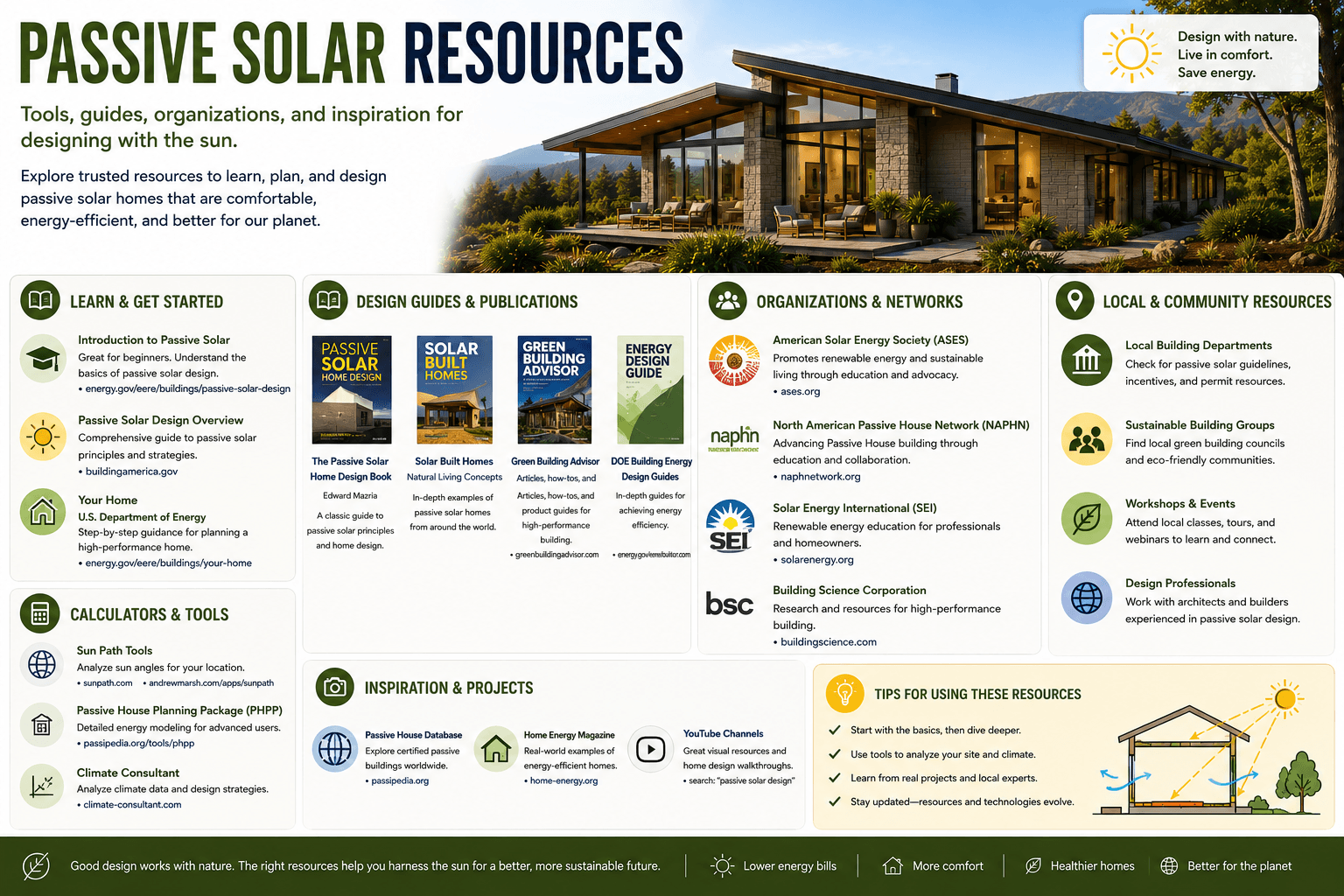
If you are new to passive solar architecture, begin with the main learning pages below.
| Resource | Best For | Open |
|---|---|---|
| Start Here | A simple introduction to the whole website and learning path | Open Start Here |
| Learn | Core passive solar design principles and topic hubs | Open Learn |
| Climate Guides | Climate-specific passive solar strategies | Open Climate Guides |
| Calculators & Tools | Early-stage design checks, calculators, and checklists | Open Tools |
| Case Studies | Practical examples and design lessons | Open Case Studies |
| Glossary | Definitions of passive solar and building science terms | Open Glossary |
| FAQ | Quick answers to common passive solar questions | Not yet published |
Essential Passive Solar Guides
These are the core guides to read first. They explain the most important passive solar concepts in a practical order.
- What Is Passive Solar Architecture?
- Passive Solar Fundamentals
- Passive Solar Design Principles
- Passive Solar House Design
- Passive Solar Systems
- Passive Solar vs Passive House
These pages are useful if you want to understand the difference between passive solar architecture, solar panels, active solar systems, and Passive House certification.
Site, Climate, and Orientation Resources
Passive solar design begins with the site and climate. Before choosing windows, overhangs, materials, or thermal mass, you need to understand solar access, sun path, heating demand, cooling demand, humidity, wind, and seasonal comfort needs.
- Site & Climate Analysis
- Passive Solar Design by Climate
- Climate Guides
- Passive Solar Orientation
- Orientation & Building Form
- Passive Solar Orientation Calculator
- Solar Angle Calculator
Helpful reminder
For a global audience, it is often more accurate to use the term equator-facing glazing. In the Northern Hemisphere, this usually means south-facing glazing. In the Southern Hemisphere, this usually means north-facing glazing.
Windows, Glazing, and Daylighting Resources
Windows are one of the most important passive solar design decisions. They affect daylight, views, heat gain, heat loss, glare, overheating risk, and comfort.
Large areas of glass are not automatically good passive solar design. Window size and placement must be matched to climate, orientation, glazing performance, shading, and thermal mass.
- Windows, Glazing & Daylighting
- Passive Solar Windows
- Passive Solar Window Placement
- Window-to-Wall Ratio Calculator
Thermal Mass and Materials Resources
Thermal mass can help stabilize indoor temperatures when it is correctly placed and matched to the climate. It can also cause problems when used without shading, ventilation, or climate-specific design logic.
Common thermal mass materials include concrete, brick, stone, tile, adobe, masonry, and rammed earth. The right choice depends on climate, construction system, budget, interior design, and comfort goals.
Shading and Passive Cooling Resources
Passive solar architecture is not only about collecting winter sun. In many climates, passive cooling and overheating prevention are even more important.
Good shading design can improve comfort, reduce unwanted solar gain, and protect interiors from excessive heat.
- Shading & Passive Cooling
- Passive Solar Shading & Overhangs
- Roof Overhang Calculator
- Solar Angle Calculator
Shading strategies may include roof overhangs, screens, shutters, pergolas, balconies, deep reveals, verandas, exterior blinds, vegetation, and facade self-shading.
Insulation, Airtightness, and Ventilation Resources
Passive solar design does not replace good building envelope design. Solar gain is less useful if the building loses heat through poor insulation, air leakage, weak windows, or thermal bridges.
Modern passive solar buildings should also consider ventilation, indoor air quality, moisture control, and passive cooling potential.
- Insulation, Airtightness & Ventilation
- Passive Solar vs Passive House
- Passive Solar House Design
- Passive Solar Design Principles
Passive Solar Calculators
Use these calculators for early-stage design thinking, feasibility checks, and educational review. They are useful for comparing options, but they do not replace professional design, local code review, energy modeling, or project-specific analysis.
| Calculator | Use It For | Open |
|---|---|---|
| Solar Angle Calculator | Understanding seasonal sun angles and solar altitude | Open calculator |
| Roof Overhang Calculator | Estimating overhang depth and seasonal shading | Open calculator |
| Window-to-Wall Ratio Calculator | Checking glazing area by wall or facade | Open calculator |
| Thermal Mass Calculator | Reviewing heat storage assumptions and material strategy | Open calculator |
| Passive Solar Orientation Calculator | Testing building direction and solar access potential | Open calculator |
For the full overview, visit Passive Solar Design Tools and Passive Solar Calculations.
Checklists and Design Review Resources
Checklists are useful because passive solar design is a whole-building strategy. Good orientation can be weakened by excessive glazing. Useful winter sun can become summer overheating. Thermal mass can help in one climate and create problems in another.
- Passive Solar Design Checklist
- Passive Solar Design Tools
- Passive Solar Calculations
- Site & Climate Analysis
Use the checklist before:
- Buying land
- Choosing a house plan
- Approving concept design
- Finalizing window sizes
- Designing roof overhangs
- Selecting thermal mass materials
- Moving into detailed design or construction
Case Study Resources
Case studies show how passive solar strategies work in real projects. They help explain why climate, budget, building type, construction system, and site constraints matter.
When reading a case study, look for climate, orientation, window placement, shading, thermal mass, ventilation, insulation, construction system, and lessons learned.
Resources by Audience
Different readers need different starting points. Choose the path that matches your role.
| Audience | Best Starting Point | Recommended Resources |
|---|---|---|
| Architects | For Architects | Design Principles, Site Analysis, Tools, Case Studies |
| Self-Builders | For Self-Builders | House Design, Checklist, Orientation Calculator |
| Investors | For Investors | Site Analysis, Climate Guide, Case Studies |
| Students | Learn | What Is Passive Solar Architecture?, Glossary, Fundamentals |
Passive Solar Glossary
The Passive Solar Glossary explains important terms used across this website.
Use it when you need clear definitions for terms such as:
- Passive solar architecture
- Solar gain
- Thermal mass
- Direct gain
- Indirect gain
- Isolated gain
- SHGC
- U-value
- Overhang
- Thermal bridge
- Airtightness
- Passive cooling
- Daylighting
- Equator-facing glazing
FAQ and Quick Answers
The FAQ section answers common questions about passive solar design, solar orientation, windows, shading, thermal mass, passive cooling, Passive House, and solar panels.
Use the FAQ if you want short answers before reading the full guides.
Sources and Editorial Standards
PassiveSolarArchitecture.com is an educational website. The content is designed to be practical, clear, and technically responsible.
Use these pages to understand how information is presented, reviewed, and referenced:
Passive solar design recommendations should always be checked against local climate data, building codes, project requirements, professional guidance, and detailed energy analysis where needed.
Recommended Resource Path
If you want a simple order to follow, use this path:
- Start Here
- What Is Passive Solar Architecture?
- Passive Solar Fundamentals
- Passive Solar Design Principles
- Site & Climate Analysis
- Passive Solar Orientation
- Passive Solar Windows
- Passive Solar Shading & Overhangs
- Thermal Mass
- Passive Solar Design by Climate
- Passive Solar Design Tools
- Passive Solar Design Checklist
Common Resource Questions
Where should I start if I am new to passive solar design?
Start with Start Here, then read What Is Passive Solar Architecture? and Passive Solar Fundamentals.
Which resources are best before buying land?
Use Site & Climate Analysis, Passive Solar Orientation, Passive Solar Orientation Calculator, and Passive Solar Design by Climate.
Which resources are best before choosing windows?
Read Passive Solar Windows, Passive Solar Window Placement, and use the Window-to-Wall Ratio Calculator.
Which resources help prevent overheating?
Start with Shading & Passive Cooling, Passive Solar Shading & Overhangs, and the Roof Overhang Calculator.
Which resources explain Passive House?
Read Passive Solar vs Passive House and Insulation, Airtightness & Ventilation.
Which resources are best for design review?
Use the Passive Solar Design Checklist, Passive Solar Design Tools, and Passive Solar Case Studies.
Continue Learning
Passive solar architecture works best when resources are used together. A calculator can help test one idea, but the full design must also consider climate, site, orientation, windows, shading, thermal mass, insulation, airtightness, ventilation, budget, and user behavior.
Recommended next step: Explore the Learn Hub
Next step: check your own project
Try the ideas on your own project with the free passive solar design tools. It is free and runs in your browser.
Keep your results in one place
The free Passive Solar Design Checklist & Project Brief is a printable PDF with pages for your site’s sun angles, orientation, glazing per facade, shading and thermal mass, plus 12 questions to take to your architect or designer.