
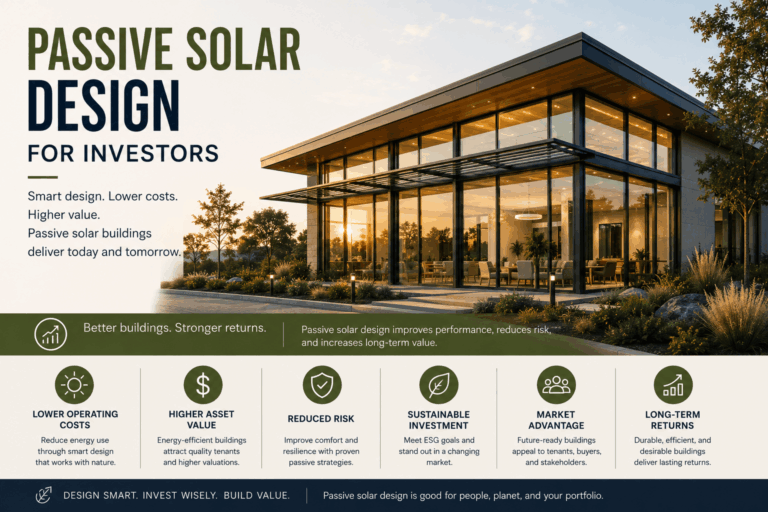
Passive Solar Design for Investors
Passive solar design for investors helps you make better early-stage decisions before buying land, funding a project, or commissioning a climate-responsive home. Use this page to understand how site orientation, solar access, glazing, shading, thermal mass, insulation, ventilation, and local climate can affect comfort, energy demand, project risk, and long-term value.
Use passive solar design to make better early-stage decisions before buying land, commissioning a building, funding a project, or approving a design.
This page is for property investors, developers, clients, land buyers, and decision-makers who want to understand how passive solar architecture can support comfort, energy efficiency, long-term usability, and climate-responsive project planning.
Passive solar design is not only an architectural idea. It can also be a useful decision-making framework. It helps you evaluate whether a site, concept, floor plan, window strategy, or building form is likely to work well with the local climate.
Good passive solar decisions are easiest and cheapest to make early. Once land is purchased, the building is oriented, windows are fixed, and construction begins, many improvements become harder and more expensive.
Start Here
If you are investing in, commissioning, or developing a passive solar home or climate-responsive building, begin with these pages:
- What Is Passive Solar Architecture?
- Passive Solar Fundamentals
- Passive Solar Design Principles
- Passive Solar House Design
- Passive Solar Design by Climate
- Passive Solar Design Checklist
Why Passive Solar Design Matters for Investors
Many project risks are created before construction begins. Poor orientation, excessive glazing, weak shading, unsuitable materials, and poor climate response can lead to comfort problems, higher operating costs, overheating, underheating, and later redesign.
Passive solar design helps investors and clients ask better questions earlier.
- Is the site suitable for passive solar design?
- Can the building be oriented well?
- Does the climate support the proposed strategy?
- Are the windows sized and placed appropriately?
- Is overheating risk being controlled?
- Does the project need more shading, insulation, or thermal mass?
- Are design claims realistic or exaggerated?
- Has the architect considered climate, comfort, and energy demand together?
Passive solar design should not be treated as a guaranteed return on investment or a promise of zero energy bills. It is a design approach that can reduce risk and improve building quality when applied correctly.
What Investors Can Learn Here
| Topic | Why It Matters for Investors | Start Here |
|---|---|---|
| Passive Solar Basics | Understand what the design team is proposing and avoid confusing passive solar with solar panels. | What Is Passive Solar Architecture? |
| Site Feasibility | Evaluate whether land has good solar access, orientation potential, and climate suitability. | Site & Climate Analysis |
| Climate Risk | Check whether the strategy matches local heating, cooling, humidity, and shading needs. | Passive Solar Design by Climate |
| Orientation | Early orientation decisions affect comfort, daylight, solar gain, and overheating risk. | Passive Solar Orientation |
| Windows and Glazing | Large glass areas can improve views but may increase overheating, glare, heat loss, or cooling demand. | Passive Solar Windows |
| Shading and Cooling | Shading is essential for long-term comfort and avoiding summer performance problems. | Passive Solar Shading & Overhangs |
| Thermal Mass and Materials | Material choices affect comfort, cost, construction method, and climate suitability. | Thermal Mass |
| Design Review | A checklist helps identify risks before the project moves into expensive stages. | Passive Solar Design Checklist |
Before Buying Land
Land selection is one of the most important passive solar investment decisions. Some sites naturally support passive solar design. Others make it difficult because of shading, poor orientation, steep terrain, surrounding buildings, planning restrictions, or climate limitations.
Before buying land, review these questions:
- Does the site receive useful winter sun?
- Are there trees, hills, neighboring buildings, or future developments that may block solar access?
- Can the main building areas face the equator side of the site?
- Does the site allow a practical building footprint and good room layout?
- Will views, access, privacy, slope, or regulations conflict with passive solar orientation?
- Is the local climate cold, temperate, hot-dry, hot-humid, or mixed?
- Will the building need more help with heating, cooling, humidity control, or shading?
- Are local building codes and planning rules compatible with the intended design?
Useful links before buying land:
- Site & Climate Analysis
- Passive Solar Orientation
- Passive Solar Orientation Calculator
- Passive Solar Design by Climate
Passive Solar Feasibility Checklist
Use this checklist before committing to a site, concept design, or investment decision.
Site feasibility
- The site has been checked for solar access.
- Major shading risks have been identified.
- Future neighboring development has been considered where relevant.
- The building can be oriented in a useful direction.
- Views, access, privacy, and slope do not completely conflict with solar design.
Climate feasibility
- The local climate type is clearly understood.
- Heating and cooling priorities have been identified.
- Humidity and moisture risks have been considered.
- Overheating risk has been reviewed.
- The strategy is not copied from a different climate without adaptation.
Design feasibility
- The building form supports solar access, daylight, and comfort.
- Window areas are reasonable by orientation.
- External shading has been planned early.
- Thermal mass is used only where it supports the climate strategy.
- Insulation, airtightness, and ventilation are part of the performance plan.
Financial and project feasibility
- Passive solar strategies are included early, before redesign becomes expensive.
- The design team can explain the strategy clearly.
- Claims about energy savings or comfort are not exaggerated.
- Local code, construction quality, and maintenance requirements have been considered.
- The project has room for professional analysis where needed.
For a full review, use the Passive Solar Design Checklist.
Questions to Ask Your Architect or Designer
Investors do not need to do the architect’s job. But they should know what to ask before approving a design.
Site and orientation questions
- How does the design respond to the sun path on this site?
- Which direction do the main living or occupied spaces face?
- How much does the design deviate from ideal passive solar orientation?
- What site constraints limit solar access?
- Have neighboring buildings, trees, slopes, and future shading risks been reviewed?
Climate and comfort questions
- What are the main climate risks for this project?
- Is the design more concerned with heating, cooling, humidity, or all three?
- How will the design prevent overheating?
- How will the home remain comfortable during shoulder seasons?
- Does the strategy change between winter and summer?
Windows and shading questions
- How much glazing is proposed on each facade?
- Are the largest windows facing the right direction for this climate?
- How are east- and west-facing windows controlled?
- Are roof overhangs or external shading devices designed for local sun angles?
- Are window U-value and SHGC appropriate for the project?
Materials and envelope questions
- Does the project need thermal mass?
- Where is thermal mass located and why?
- How does the construction system support the passive solar strategy?
- What insulation and airtightness targets are being considered?
- How will ventilation and moisture control be handled?
Performance and risk questions
- Has the design been reviewed for overheating risk?
- Are early calculations or energy modeling recommended?
- What assumptions are uncertain at this stage?
- Which design decisions are most important to make now?
- Which decisions can be refined later?
Passive Solar Design and Project Value
Passive solar design can support project value when it improves comfort, daylight, usability, and long-term performance. However, value depends on the market, climate, design quality, construction quality, buyer expectations, and local energy costs.
Potential value drivers include:
- Better indoor comfort
- Improved daylight and livability
- Reduced heating or cooling demand when properly designed
- Lower risk of overheating when shading is included
- More resilient design during seasonal temperature changes
- Clear sustainability story for buyers or occupants
- Better alignment with low-energy and climate-responsive building trends
These benefits are not automatic. Passive solar design must be adapted to the site, climate, budget, construction system, and user behavior.
Investment Risks Passive Solar Design Can Help Identify
Passive solar analysis can reveal risks before they become expensive construction or operation problems.
| Risk | Why It Matters | Useful Resource |
|---|---|---|
| Poor orientation | Can reduce useful solar gain, daylight quality, and comfort. | Passive Solar Orientation |
| Too much glazing | Can increase overheating, glare, heat loss, and cooling demand. | Window-to-Wall Ratio Calculator |
| Weak shading | Can create summer and shoulder-season overheating problems. | Roof Overhang Calculator |
| Wrong climate strategy | A cold-climate strategy may fail in a hot-humid or mixed climate. | Passive Solar Design by Climate |
| Misused thermal mass | Mass can improve comfort or store unwanted heat depending on climate and placement. | Thermal Mass |
| Weak envelope | Solar gain is less useful if the building loses heat or leaks air. | Insulation, Airtightness & Ventilation |
Passive Solar Design by Climate for Investors
Climate determines which passive solar strategies are useful and which may create problems.
| Climate | Investment Priority | Main Design Risk |
|---|---|---|
| Cold | Capture useful winter sun and reduce heat loss. | Poor insulation, weak windows, or excessive heat loss. |
| Temperate | Balance winter gain, daylight, summer shading, and comfort. | Overheating from too much glass. |
| Hot-Dry | Control solar exposure and support night cooling where possible. | Thermal mass storing unwanted heat without release. |
| Hot-Humid | Prioritize shade, airflow, moisture control, and reduced heat gain. | Heat and humidity trapped inside the building. |
| Mixed | Design for both heating and cooling seasons. | A design that works in winter but overheats in summer. |
Useful links:
Useful Calculators for Investors
These tools can help you review early assumptions before committing to a project direction.
| Tool | Use It For | Open Tool |
|---|---|---|
| Passive Solar Orientation Calculator | Testing site layout and building direction. | Open calculator |
| Solar Angle Calculator | Understanding seasonal solar angles and site shading. | Open calculator |
| Roof Overhang Calculator | Checking approximate seasonal shading potential. | Open calculator |
| Window-to-Wall Ratio Calculator | Reviewing whether glazing areas may be excessive or too limited. | Open calculator |
| Thermal Mass Calculator | Understanding heat storage assumptions in passive solar design. | Open calculator |
| Passive Solar Design Checklist | Reviewing the full design strategy before approval. | Open checklist |
For all resources, visit Passive Solar Design Tools.
Before Approving a Design
Before approving concept drawings, planning drawings, or a developed design, review the passive solar strategy as a complete system.
Ask whether the design clearly explains:
- The climate strategy
- The site and solar access analysis
- The orientation logic
- The window and glazing strategy
- The shading and overheating control strategy
- The thermal mass and material strategy
- The insulation and airtightness approach
- The ventilation and moisture control approach
- The main assumptions, risks, and trade-offs
If these points are unclear, the design may need further review before moving forward.
Common Passive Solar Mistakes Investors Should Watch For
- Buying land without checking solar access. Poor solar access can limit passive solar potential before design begins.
- Approving large glass areas without analysis. Large windows can create overheating, glare, and heat loss.
- Ignoring climate. A strategy from one climate may fail in another.
- Relying on passive solar language without design evidence. Ask how the strategy works, not just whether the project is described as sustainable.
- Forgetting shading. Shading is essential in many climates, including mixed and temperate regions.
- Assuming thermal mass is always beneficial. Thermal mass must match the climate and building design.
- Ignoring the building envelope. Passive solar design still needs insulation, airtightness, and good detailing.
- Confusing passive solar with solar panels. Solar panels generate electricity; passive solar design shapes the building itself.
- Confusing passive solar with Passive House. Passive solar is a design approach; Passive House is a performance standard.
Passive Solar vs Solar Panels vs Passive House
Investors often see several sustainability terms used together. They are related, but they are not the same.
| Term | What It Means | Investor Question |
|---|---|---|
| Passive Solar Design | Uses orientation, windows, shading, thermal mass, insulation, and ventilation to work with climate. | Is the building itself designed to reduce heating and cooling demand? |
| Solar Panels | Active technology that generates electricity or heats water. | How much energy can the system produce, and does the roof support it? |
| Passive House | A performance standard focused on very low energy demand, airtightness, insulation, high-performance windows, and controlled ventilation. | Is the project targeting certification or simply using some Passive House principles? |
Useful links:
Case Studies for Investors
Case studies are useful because they show how passive solar design decisions change by climate, budget, building type, construction system, and project constraints.
When reviewing case studies, look for:
- Climate type and design priorities
- Site orientation and solar access
- Window and shading strategy
- Thermal mass and material choices
- Envelope performance
- Overheating control
- Budget and construction trade-offs
- Lessons learned
Explore:
Due Diligence Checklist for Passive Solar Projects
Use this simplified due diligence checklist when reviewing a potential site, design, or project proposal.
- Has the site been analyzed for solar access?
- Is the building orientation suitable for the hemisphere and climate?
- Has the climate strategy been clearly explained?
- Are windows sized by orientation rather than only by view?
- Is there a clear shading strategy?
- Has overheating risk been considered?
- Is thermal mass used appropriately for the climate?
- Are insulation, airtightness, and ventilation included in the design logic?
- Are passive solar claims supported by drawings, calculations, or analysis?
- Are there local code, planning, or construction risks?
- Has a professional reviewed the assumptions?
- Are future maintenance and occupant behavior considered?
For a more complete process, visit Passive Solar Design Checklist.
Recommended Learning Path for Investors
Follow this learning path if you want to understand passive solar design well enough to evaluate projects and ask better questions.
- What Is Passive Solar Architecture?
- Passive Solar House Design
- Site & Climate Analysis
- Passive Solar Design by Climate
- Passive Solar Orientation
- Passive Solar Windows
- Passive Solar Shading & Overhangs
- Thermal Mass
- Insulation, Airtightness & Ventilation
- Passive Solar Design Checklist
Helpful Resources for Investors
- Learn Passive Solar Architecture
- Climate Guides
- Passive Solar Design Tools
- Passive Solar Case Studies
- For Architects
- For Self-Builders
- Passive Solar Glossary
- Sources / References
Frequently Asked Questions
Why should investors care about passive solar design?
Passive solar design can help investors evaluate site quality, design risk, comfort, daylight, overheating potential, and long-term building performance before expensive decisions are fixed.
Does passive solar design guarantee lower operating costs?
No. Passive solar design can reduce heating and cooling demand when done well, but results depend on climate, design quality, construction, systems, energy prices, and occupant behavior.
Should passive solar design be considered before buying land?
Yes. Solar access, orientation, shading, slope, local climate, and planning constraints can strongly affect passive solar potential.
Is passive solar design the same as solar panels?
No. Solar panels are active technology that generate electricity or heat water. Passive solar design uses the building itself through orientation, windows, shading, materials, insulation, and ventilation.
Is passive solar design the same as Passive House?
No. Passive solar design is an architectural design approach. Passive House is a performance standard with specific criteria for energy demand, airtightness, insulation, windows, and ventilation.
Can passive solar design increase property value?
It may support value when it improves comfort, daylight, energy performance, and market appeal. However, value depends on location, market demand, construction quality, design quality, and buyer priorities.
What is the biggest passive solar risk for investors?
One major risk is approving a design that uses passive solar language but does not properly address climate, orientation, glazing, shading, thermal mass, insulation, and overheating control.
Continue Learning
Passive solar design helps investors and clients make better early-stage decisions. The most important step is to evaluate site, climate, orientation, windows, shading, materials, and envelope strategy before the project becomes difficult to change.
Recommended next step: Use the Passive Solar Design Checklist
Next step: check your own project
Try the ideas on your own project with the free passive solar design tools. It is free and runs in your browser.
Keep your results in one place
The free Passive Solar Design Checklist & Project Brief is a printable PDF with pages for your site’s sun angles, orientation, glazing per facade, shading and thermal mass, plus 12 questions to take to your architect or designer.