
Window-to-Wall Ratio Calculator
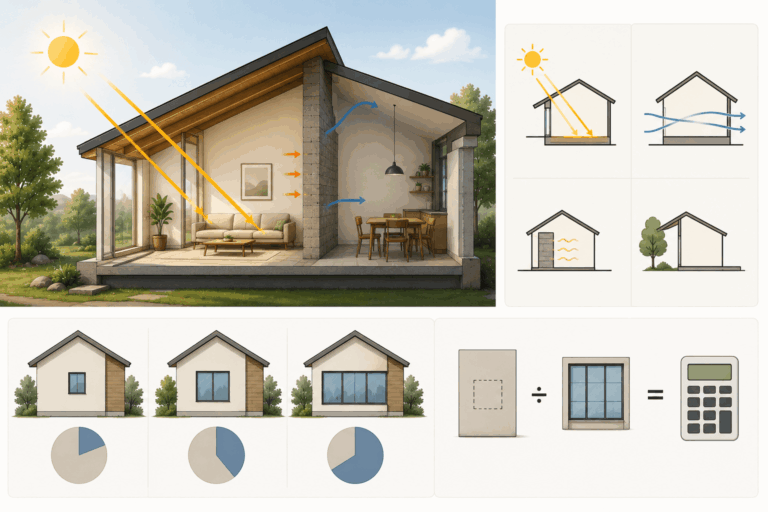
Use this window-to-wall ratio calculator to estimate how much of each facade is glazing. Window-to-wall ratio, often shortened to WWR, compares the area of windows to the total wall area.
Example inputs are pre-filled. Replace them with your project values. Reset restores this example.
Passive solar design tool
Calculate WWR by facade
Compare glazing area by orientation, see total WWR, and get early design prompts for climate, shading, glare, and heat-loss review.
Results
Enter wall and window areas, then calculate the window-to-wall ratio.
Window-to-wall ratio matters in passive solar design because windows affect solar gain, heat loss, daylight, glare, views, privacy, overheating risk, shading, construction cost, and indoor comfort.
This calculator is intended for early-stage passive solar design and education. It does not replace professional design, product specifications, local climate data, energy modeling, daylight analysis, HVAC calculations, or building code review.
Window-to-Wall Ratio Calculator
Enter the wall width, wall height, and total window area for each facade. Use the same unit throughout. Leave a facade blank if it does not apply.
What Is Window-to-Wall Ratio?
Window-to-wall ratio compares the total area of windows to the total area of a wall or facade.
The basic formula is:
Window-to-wall ratio = total window area ÷ total wall area
To express the result as a percentage:
Window-to-wall ratio (%) = (total window area ÷ total wall area) × 100
Example
If a facade has 40 square meters of wall area and 10 square meters of window area:
WWR = 10 ÷ 40 = 0.25
WWR = 25%
This means 25% of that facade is glazing.
Worked WWR calculation: use the gross facade area
For this calculator, measure the full rectangular facade, including its window openings. Suppose a facade is 8 m wide and 3 m high, with two windows each 1.5 m wide and 1.2 m high:
- Gross facade area: 8 × 3 = 24 m².
- Total window area: 2 × 1.5 × 1.2 = 3.6 m².
- Window-to-wall ratio: 3.6 ÷ 24 × 100 = 15%.
Do not subtract the windows from the wall area: dividing by 20.4 m² would give a different ratio. Use one consistent convention and the same length unit throughout; feet work the same way because the area units cancel. For compliance calculations, follow the measurement definitions of the applicable code or standard.
A 15% result describes the geometry, not an ideal target. Compare it with window orientation, glazing and climate, then check window shading.
Why Window-to-Wall Ratio Matters in Passive Solar Design
Windows are usually weaker thermal elements than insulated walls. They can provide daylight, views, ventilation, and useful solar gain, but they can also increase heat loss, glare, overheating, and cooling demand.
Window-to-wall ratio affects:
- Passive solar heat gain
- Heat loss in cold weather
- Summer overheating risk
- Daylight level and glare
- Window cost and construction complexity
- Privacy and facade design
- Shading requirements
- Thermal mass needs
- Mechanical heating and cooling loads
More glass is not automatically better. Good passive solar design uses the right amount of glass on the right facade, with the right shading and glazing performance.
For the full guide, read Passive Solar Windows.
Why You Should Calculate WWR by Facade
A whole-building window-to-wall ratio can hide important problems. For passive solar design, it is usually more useful to calculate WWR separately for each facade.
For example, a house may have a reasonable total window-to-wall ratio but still have too much west-facing glass. This can create glare and overheating even if the overall glazing percentage looks acceptable.
Facade-by-facade review helps you understand:
- Where solar gain is useful
- Where solar gain is unwanted
- Which windows need stronger shading
- Which facades may lose too much heat
- Whether daylight is balanced across the plan
- Whether window placement supports room use
For placement guidance, read Passive Solar Window Placement.
Window-to-Wall Ratio by Orientation
| Orientation | Passive Solar Role | Design Caution |
|---|---|---|
| Equator-facing | Can provide useful winter sun in heating and mixed climates | Needs shading, thermal mass, and climate-appropriate glazing. |
| East-facing | Can provide morning daylight and some solar gain | May need shading or size control in warm climates. |
| West-facing | Often creates late-day heat and glare risk | Usually needs reduced glazing or strong exterior shading. |
| Pole-facing | Can provide softer daylight with less direct solar gain | May increase heat loss in cold climates if oversized. |
For global passive solar design, use equator-facing rather than only “south-facing.” In the Northern Hemisphere, equator-facing usually means south-facing. In the Southern Hemisphere, it usually means north-facing.
For orientation guidance, read Passive Solar Orientation.
Window-to-Wall Ratio and Climate
The right WWR depends strongly on climate. A glazing strategy that works in a cold climate may overheat in a hot climate.
| Climate | WWR Design Priority | Main Risk |
|---|---|---|
| Cold | Balance useful winter solar gain with heat loss through glazing. | Too much glass or weak window performance can increase heat loss. |
| Temperate | Balance winter solar gain, summer shading, daylight, and ventilation. | Moderate or high glazing can cause shoulder-season overheating if shading is weak. |
| Hot-Dry | Limit unwanted solar gain and use strong shading. | Unshaded glazing can overheat interior spaces and thermal mass. |
| Hot-Humid | Reduce solar heat gain while supporting airflow, shade, and moisture control. | Large unshaded windows can trap heat and increase cooling demand. |
| Mixed | Use balanced glazing with flexible or seasonal shading. | A winter-focused WWR may fail in summer. |
For climate-specific guidance, read Passive Solar Design by Climate.
Window-to-Wall Ratio and Shading
Higher window-to-wall ratio usually increases the need for shading. This is especially important on equator-facing, east-facing, and west-facing facades.
Shading options include:
- Roof overhangs
- Exterior blinds
- Sliding shutters
- Vertical fins
- Solar screens
- Balconies
- Pergolas
- Deep window reveals
- Vegetation where suitable
Exterior shading is usually more effective than interior blinds because it blocks solar heat before it passes through the glass.
Use the Roof Overhang Calculator and read Passive Solar Shading & Overhangs.
Window-to-Wall Ratio and Thermal Mass
Window-to-wall ratio should be reviewed together with thermal mass. Windows admit solar heat. Thermal mass can store and release some of that heat.
If a room has a high glazing area and little useful thermal mass, it may overheat quickly. If it has thermal mass but poor shading, the mass may store unwanted summer heat.
Good design should ask:
- How much solar gain enters the room?
- Where does the sunlight land?
- Is the thermal mass exposed to indoor air?
- Is the mass protected from summer sun?
- Can stored heat be released when needed?
- Does the climate support thermal storage?
For more detail, read Thermal Mass and use the Thermal Mass Calculator.
Window-to-Wall Ratio and Glazing Performance
WWR tells you how much glass is present, but it does not tell you how the glass performs. Two windows with the same area can behave very differently.
Important glazing properties include:
- U-value or U-factor: how easily heat passes through the window.
- Solar Heat Gain Coefficient, or SHGC: how much solar heat passes through the glazing.
- Visible transmittance: how much visible light passes through the glass.
- Frame performance: how well the frame reduces heat flow and air leakage.
- Installation quality: how well the window connects to the wall, air barrier, and water control layers.
A high WWR with poor glazing can cause heat loss, overheating, glare, and comfort problems. A moderate WWR with high-quality glazing and good shading may perform much better.
For more detail, read Windows, Glazing & Daylighting.
How to Measure Wall Area and Window Area
For early design, wall area is usually estimated as:
Wall area = wall width × wall height
Window area is usually the total area of all windows on that facade. For a simple rectangular window:
Window area = window width × window height
If a facade has multiple windows, add them together:
Total window area = window 1 area + window 2 area + window 3 area
Important measurement notes
- Use the same unit for all dimensions.
- Calculate each facade separately.
- Use actual glass area where possible for more precise review.
- For early design, rough opening area may be acceptable if exact product data is not available.
- Do not include roof area in wall area.
- Be consistent about whether doors with glass are included.
For final design, use accurate architectural drawings and window specifications.
Common Window-to-Wall Ratio Mistakes
- Using only one whole-building WWR: Facade-by-facade review is more useful for passive solar design.
- Adding too much glass: More glazing can increase heat loss, overheating, glare, and cost.
- Ignoring west-facing windows: West sun is often difficult to shade and can create late-day overheating.
- Ignoring climate: The right WWR changes between cold, temperate, hot-dry, hot-humid, and mixed climates.
- Ignoring glazing performance: U-value, SHGC, visible transmittance, and frame performance matter.
- Using interior blinds as the main heat-control strategy: Exterior shading is usually more effective.
- Forgetting thermal mass: Solar gain should be balanced with heat storage where appropriate.
- Forgetting daylight quality: High window area can still cause glare or visual discomfort.
- Ignoring privacy: Large windows may reduce comfort if they expose bedrooms, bathrooms, or living spaces.
- Skipping overheating review: High WWR should always be checked against climate and shading.
Window-to-Wall Ratio Design Checklist
Use this checklist before finalizing window area.
- The climate type has been identified.
- The hemisphere and equator-facing direction are clear.
- WWR has been calculated by facade.
- Equator-facing glazing is matched with shading and thermal mass where useful.
- East-facing glazing is reviewed for morning heat and glare.
- West-facing glazing is limited or strongly shaded.
- Pole-facing glazing is reviewed for heat loss in cold climates.
- Window U-value or U-factor has been considered.
- SHGC has been reviewed by orientation and climate.
- Visible transmittance supports daylight without excessive glare.
- Exterior shading is designed early.
- Thermal mass is balanced with solar gain where appropriate.
- Ventilation and passive cooling have been considered.
- Overheating risk has been checked.
- Local codes, product data, and professional review are included.
Useful Related Tools
Use these tools together for better passive solar window decisions:
- Solar Angle Calculator
- Roof Overhang Calculator
- Passive Solar Orientation Calculator
- Thermal Mass Calculator
- Passive Solar Design Tools
- Passive Solar Design Checklist
Window-to-Wall Ratio Calculator for Different Readers
| Reader | How to Use This Calculator | Recommended Next Page |
|---|---|---|
| Architects | Use WWR to compare facade options, daylight strategy, overheating risk, and energy performance assumptions. | Passive Solar Windows |
| Self-Builders | Use WWR to understand whether a plan may have too much or poorly placed glass before approving drawings. | Passive Solar Window Placement |
| Investors and Developers | Use WWR to evaluate comfort risk, facade performance, cooling demand, and long-term building quality. | Passive Solar Design Checklist |
| Students | Use WWR to connect facade design, solar gain, heat loss, daylight, and climate response. | Passive Solar Calculations |
Frequently Asked Questions
What is window-to-wall ratio?
Window-to-wall ratio is the total window area divided by the total wall area. It is usually expressed as a percentage.
How do you calculate window-to-wall ratio?
Divide total window area by total wall area, then multiply by 100. For example, 10 square meters of windows on a 40 square meter wall equals a 25% window-to-wall ratio.
What is a good window-to-wall ratio for passive solar design?
There is no universal ideal ratio. The right WWR depends on climate, orientation, glazing performance, shading, thermal mass, daylight needs, ventilation, comfort goals, and local codes.
Should WWR be calculated for the whole building or each facade?
For passive solar design, facade-by-facade calculation is more useful. Each orientation receives sun differently and has different heat gain, heat loss, glare, and shading risks.
Why is west-facing WWR important?
West-facing windows receive low-angle afternoon sun, often when outdoor temperatures are high. A high west-facing WWR can create glare and overheating unless shading and glazing are carefully designed.
Does a higher WWR improve daylight?
Not always. More glass can increase daylight, but it can also increase glare, overheating, heat loss, and cost. Window height, placement, glazing, room depth, and shading also matter.
Does WWR affect heating and cooling demand?
Yes. Windows can admit useful solar gain, but they can also lose heat and increase cooling demand. The effect depends on climate, orientation, glazing, shading, and envelope performance.
Can this calculator replace energy modeling?
No. This calculator is useful for early design review. Final decisions should use product data, local climate information, code requirements, energy modeling, and professional guidance where needed.
Recommended Learning Path
After using this calculator, continue with these pages:
- Passive Solar Windows
- Passive Solar Window Placement
- Windows, Glazing & Daylighting
- Roof Overhang Calculator
- Solar Angle Calculator
- Thermal Mass
- Passive Solar Design by Climate
- Passive Solar Calculations
- Passive Solar Design Tools
Continue Learning
Window-to-wall ratio is most useful when it is reviewed together with climate, orientation, glazing performance, shading, thermal mass, daylight, ventilation, and building envelope quality.
Recommended next step: Use the Thermal Mass Calculator