
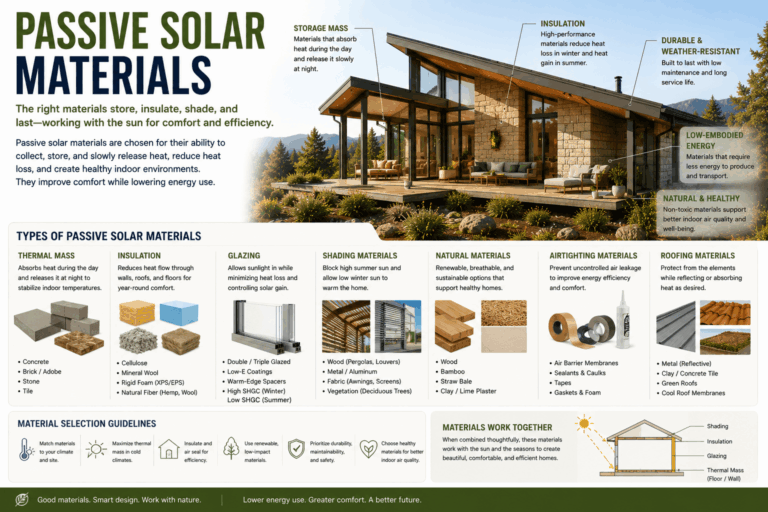
Passive Solar Materials
Passive solar materials are the materials that help a building manage heat, light, comfort, moisture, and energy demand through design rather than relying only on mechanical systems.
In passive solar architecture, materials are not chosen only for appearance. They affect thermal mass, insulation, airtightness, moisture control, durability, daylight, shading, indoor comfort, and climate response.
The best passive solar materials depend on climate, site orientation, window design, shading, building envelope performance, ventilation, local availability, construction quality, budget, and user behavior. A material that works well in one climate may create comfort or moisture problems in another.
Try it on your own design: Thermal Mass Calculator (free, about a minute).
What Are Passive Solar Materials?
Passive solar materials are building materials selected and placed to support passive solar design goals.
They may help a building:
- Absorb and store useful solar heat
- Release stored heat slowly
- Reduce unwanted heat loss
- Reduce unwanted heat gain
- Improve airtightness and comfort
- Control moisture and condensation risk
- Support shading and passive cooling
- Improve daylight and reduce glare
- Increase durability and long-term performance
Passive solar materials are part of a whole-building strategy. They should be designed together with orientation, windows, shading, thermal mass, insulation, airtightness, ventilation, and climate analysis.
For the broader design framework, read Passive Solar Design Principles.
Passive Solar Materials at a Glance
| Material Category | Passive Solar Role | Common Examples |
|---|---|---|
| Thermal mass materials | Absorb, store, and release heat | Concrete, brick, stone, tile, adobe, masonry, rammed earth |
| Insulation materials | Slow heat flow through the building envelope | Mineral wool, cellulose, wood fiber, cork, fiberglass, foam insulation |
| Glazing materials | Control solar gain, heat loss, daylight, and views | Double glazing, triple glazing, low-e glass, coated glass |
| Airtightness materials | Reduce uncontrolled air leakage | Air barriers, tapes, membranes, sealants, gaskets |
| Shading materials | Block unwanted sun before it enters the building | Timber screens, metal louvers, shutters, exterior blinds, pergolas |
| Interior finish materials | Affect heat exchange, daylight, glare, and comfort | Polished concrete, tile, plaster, light-colored finishes, exposed masonry |
The Most Important Rule: Materials Must Match the Climate
Passive solar materials should never be chosen from a generic list without climate context.
For example:
- Heavy concrete floors may help store winter sun in a cold climate.
- The same concrete floor may store unwanted heat in a hot-humid climate if it is not shaded and ventilated correctly.
- High insulation may be essential in cold climates, but moisture control and ventilation become critical in humid climates.
- Large glass areas may support passive heating in some climates, but they can cause overheating in warm or mixed climates.
Before choosing materials, identify whether the building needs more help with heating, cooling, humidity control, daylighting, or seasonal balance.
Helpful links:
Thermal Mass Materials
Thermal mass materials absorb, store, and release heat. They are central to many passive solar buildings, especially where useful solar gain can be stored and released later.
Common thermal mass materials include:
- Concrete
- Brick
- Stone
- Tile over a massive substrate
- Adobe
- Rammed earth
- Masonry
- Earthen plasters or walls in some construction systems
Thermal mass is most useful when it is inside the insulated envelope, exposed to indoor air, and connected to useful solar gain or daily temperature swings.
It should not be confused with insulation. Thermal mass stores heat. Insulation slows heat flow.
Helpful links:
Concrete as a Passive Solar Material
Concrete is one of the most common thermal mass materials in passive solar homes. It is often used in floor slabs, polished concrete floors, structural walls, countertops, and other interior elements.
Potential benefits
- High thermal mass
- Durable surface when properly finished
- Can store useful solar heat when exposed
- Works well with radiant comfort when designed carefully
- Can be integrated into structural systems
Design cautions
- Concrete must be exposed to indoor air to work well as thermal mass.
- Thick carpet, insulating finishes, or raised floors can reduce heat exchange.
- Unshaded concrete can store unwanted summer heat.
- In hot-humid climates, stored heat may be difficult to release.
- Embodied carbon and material sourcing should be considered in sustainable design.
Concrete is useful only when it supports the whole passive solar strategy. It should be coordinated with glazing, shading, ventilation, insulation, and climate.
Brick, Stone, Adobe, and Rammed Earth
Brick, stone, adobe, and rammed earth can provide useful thermal mass when placed and detailed correctly.
| Material | Passive Solar Strength | Design Caution |
|---|---|---|
| Brick | Stores heat and can be used in exposed interior walls or masonry elements | Works best when exposed to indoor air and protected from unwanted heat gain |
| Stone | Dense, durable, and visually strong thermal mass | Can store unwanted heat if poorly shaded |
| Adobe | Can moderate indoor temperature and support earthen building traditions | Needs climate-appropriate moisture protection and detailing |
| Rammed earth | High thermal mass with strong architectural character | May need additional insulation depending on climate and code requirements |
These materials can be valuable in passive solar architecture, but they are not universal solutions. Moisture, structural design, insulation, local skills, maintenance, and building codes all matter.
Tile and Floor Finishes
Tile can support passive solar design when it is installed over a thermal mass substrate such as concrete or masonry. Thin tile alone does not provide much heat storage, but it can help expose the mass beneath it.
Good passive solar floor finishes may include:
- Polished concrete
- Tile over concrete
- Stone flooring over a massive base
- Exposed earthen floors where appropriate
Finishes that reduce thermal mass performance may include:
- Thick carpet
- Insulating underlay
- Raised timber floors over mass
- Large rugs covering sunlit areas
This does not mean all soft finishes are wrong. Comfort, acoustics, accessibility, maintenance, and interior design still matter. The key is to understand which surfaces need to exchange heat with the room.
Insulation Materials
Insulation is essential in modern passive solar buildings. Solar gain is less useful if heat escapes quickly through walls, roofs, floors, windows, air leakage, or thermal bridges.
Common insulation materials include:
- Mineral wool
- Cellulose
- Wood fiber
- Fiberglass
- Cork
- Rigid foam boards
- Spray foam in some applications
- Straw bale or other bio-based systems where appropriate
The best insulation material depends on climate, wall assembly, moisture conditions, fire requirements, local codes, cost, availability, embodied carbon goals, and construction skills.
Insulation should be evaluated by:
- Thermal performance
- Moisture behavior
- Fire performance
- Airtightness compatibility
- Durability
- Installation quality
- Local code compliance
- Environmental impact
For more detail, read Insulation, Airtightness & Ventilation.
Airtightness Materials
Airtightness materials help reduce uncontrolled air leakage. They are not always visible, but they are critical for comfort and energy performance.
Common airtightness materials include:
- Air barrier membranes
- Airtight sheathing layers
- Sealing tapes
- Gaskets
- Sealants
- Window and door flashing systems
- Service cavity details
- Carefully sealed penetrations
Good airtightness helps passive solar buildings perform more predictably. It reduces drafts, helps retain useful heat in cold climates, and supports controlled ventilation.
Airtightness must be paired with ventilation. A tight building without planned fresh air can create indoor air quality and moisture problems.
Glazing and Window Materials
Windows are material systems. Glass, frames, spacers, coatings, seals, and installation details all affect passive solar performance.
In passive solar design, glazing should be selected for climate and orientation.
Important window properties include:
- U-value or U-factor: how easily heat passes through the window
- SHGC: how much solar heat passes through the glazing
- Visible transmittance: how much visible light passes through
- Frame performance: how well the frame resists heat flow and air leakage
- Airtight installation: how well the window is connected to the building envelope
High solar gain glazing may be useful on equator-facing windows in some cold climates. Lower solar gain glazing may be useful for hot climates or difficult east and west facades. The right choice depends on climate, orientation, shading, and comfort goals.
Helpful links:
- Passive Solar Windows
- Passive Solar Window Placement
- Windows, Glazing & Daylighting
- Window-to-Wall Ratio Calculator
Shading Materials
Shading materials help block unwanted sun before it enters the building. In many climates, shading materials are just as important as thermal mass materials.
Common shading materials and systems include:
- Timber screens
- Metal louvers
- Exterior blinds
- Sliding shutters
- Fixed fins
- Pergolas
- Fabric awnings
- Vegetation and deciduous trees where suitable
- Balconies and roof overhangs
- Deep window reveals
Exterior shading is usually more effective than interior blinds because it blocks solar heat before it passes through the glass.
Shading materials should be chosen for durability, climate exposure, maintenance, wind loads, corrosion resistance, fire requirements, and visual design.
Helpful links:
Roof and Wall Materials
Roof and wall materials play a major role in heat gain, heat loss, durability, moisture control, and comfort.
In passive solar buildings, roof and wall assemblies should be designed as complete systems, not just surface finishes.
They may include:
- Structure
- Insulation
- Air barrier
- Vapor control layer where needed
- Weather barrier
- Ventilation cavity where appropriate
- Cladding or roofing material
- Interior finish
Roof materials
Roofs often receive intense solar exposure. Depending on climate, roof design may need high insulation, ventilation, reflective surfaces, durable roofing, fire resistance, or solar-ready orientation.
Wall materials
Walls should respond to climate, moisture, structure, insulation requirements, and construction quality. Heavy wall materials may provide thermal mass only when located inside the insulated envelope and exposed to indoor conditions.
A heavy exterior wall outside the insulation may not provide useful indoor thermal mass in the same way as exposed interior mass.
Interior Finish Materials
Interior finishes affect daylight, comfort, heat storage, glare, acoustics, and how thermal mass performs.
Light-colored surfaces can improve daylight distribution, but very bright surfaces may increase glare if not designed carefully.
Dark thermal mass surfaces may absorb more solar heat, but they can also create visual contrast or comfort issues depending on room design.
Interior finish decisions should consider:
- Thermal mass exposure
- Daylight reflection
- Glare control
- Acoustics
- Maintenance
- Indoor air quality
- Material emissions
- Moisture behavior
- Comfort underfoot
Good passive solar interiors are not only technically efficient. They should also be comfortable, durable, healthy, and pleasant to live in.
Materials by Climate
Passive solar materials must be selected by climate. The same material can perform differently depending on solar exposure, humidity, temperature swing, ventilation, and envelope design.
| Climate | Material Priorities | Common Caution |
|---|---|---|
| Cold | High insulation, airtightness, high-performance windows, exposed thermal mass where useful | Do not rely on mass without strong envelope performance |
| Temperate | Balanced insulation, moderate thermal mass, seasonal shading, good glazing | Avoid too much glass and too little shading |
| Hot-Dry | Deep shading, durable exterior materials, controlled thermal mass, night cooling support | Mass can overheat if it cannot release heat at night |
| Hot-Humid | Shade, moisture-aware assemblies, airflow, reduced heat storage, ventilated details | Heavy materials can store unwanted heat and moisture problems can increase |
| Mixed | Flexible shading, balanced glazing, insulation, careful mass, ventilation strategy | A material strategy that works in winter may fail in summer |
For climate-specific design, read Passive Solar Design by Climate.
Materials for Cold Climate Passive Solar Design
In cold climates, materials should help reduce heat loss and store useful winter solar gain where appropriate.
Useful material priorities
- High levels of insulation
- Airtight membranes and careful sealing
- High-performance windows
- Exposed interior thermal mass in sunlit areas
- Thermal bridge reduction
- Durable moisture-aware envelope materials
Cold-climate passive solar buildings should not rely only on heavy materials. Without good insulation and airtightness, stored heat can be lost quickly.
Materials for Temperate Climate Passive Solar Design
Temperate climates often require balance. Materials should support useful winter gain, summer shading, moderate thermal storage, daylight, and ventilation.
Useful material priorities
- Moderate exposed thermal mass
- Climate-appropriate insulation
- Good window performance
- Exterior shading materials
- Interior finishes that support daylight without glare
- Materials that support natural or hybrid ventilation
The main risk is one-season thinking. Materials that help in winter should not create overheating in summer.
Materials for Hot-Dry Climate Passive Solar Design
Hot-dry climates often benefit from materials that reduce daytime heat gain and support night cooling where nights are cool enough.
Useful material priorities
- Deep exterior shading materials
- Durable roof and wall assemblies that reduce heat gain
- Thermal mass used carefully with night ventilation
- Courtyard and shaded outdoor surface materials
- Light-colored exterior finishes where appropriate
- Operable shading devices
Thermal mass can help in hot-dry climates, but only if the building can release stored heat. Without night cooling or strong shading, mass can become a heat reservoir.
Materials for Hot-Humid Climate Passive Solar Design
Hot-humid climates usually require shade, airflow, moisture control, and reduced heat storage.
Useful material priorities
- Wide overhangs and durable shading materials
- Moisture-aware wall and roof assemblies
- Materials that dry safely in local conditions
- Ventilated cavities where appropriate
- Shaded openings and screened ventilation
- Limited exposed thermal mass unless carefully justified
In hot-humid climates, materials must be selected with moisture risk in mind. A material that performs well in a dry climate may fail if it traps humidity or cannot dry properly.
Materials for Mixed Climate Passive Solar Design
Mixed climates need materials that support both heating and cooling seasons. This often requires flexibility and careful detailing.
Useful material priorities
- Balanced insulation
- Airtightness with reliable ventilation
- Moderate thermal mass protected from summer sun
- Adjustable shading materials
- Windows selected by orientation
- Moisture-aware construction details
In mixed climates, it is especially important to test whether materials improve comfort across the full year, not only during winter.
Material Selection and Embodied Carbon
Passive solar design often focuses on operational energy and comfort, but material impact also matters. Some materials have higher embodied carbon because of extraction, manufacturing, transport, and installation.
When appropriate, sustainable material decisions may consider:
- Local availability
- Durability and lifespan
- Repairability
- Recycled content
- Bio-based alternatives
- Material efficiency
- Low-emission finishes
- End-of-life reuse or recycling
- Embodied carbon data where available
A material with good passive solar performance is not automatically the lowest-impact choice. Good design should consider comfort, energy demand, durability, moisture safety, cost, and environmental impact together.
Material Selection and Moisture Risk
Moisture is one of the most important material issues in energy-efficient and passive solar buildings.
As insulation and airtightness improve, moisture control becomes more important. Materials must be able to manage vapor, rain, condensation, drying potential, and indoor humidity safely.
Moisture-aware design should consider:
- Climate and humidity
- Rain exposure
- Vapor control strategy
- Drying direction
- Thermal bridges
- Window installation
- Ventilation rate
- Material compatibility
- Local building codes
Moisture problems can reduce durability, comfort, indoor air quality, and material performance. For real projects, moisture-sensitive assemblies should be reviewed by qualified professionals.
Material Selection and Construction Quality
Materials do not perform well by specification alone. Installation quality matters.
A high-performance insulation material can perform poorly if it is compressed, gapped, wet, or poorly installed. An airtightness membrane can fail if joints, penetrations, and window connections are not sealed correctly. Thermal mass can be ineffective if it is covered or placed outside the useful heat flow.
Good passive solar construction requires:
- Clear drawings and details
- Coordination between architect, builder, and consultants
- Careful sequencing on site
- Attention to junctions and penetrations
- Quality control
- Testing where appropriate
- Maintenance planning
Passive solar architecture depends on design and execution. Materials alone cannot fix poor planning or poor construction.
Common Passive Solar Material Mistakes
Many passive solar material problems come from choosing materials without understanding climate, windows, shading, or building envelope behavior.
- Using thermal mass without shading: The mass may store unwanted summer heat.
- Confusing mass with insulation: Heavy materials do not replace insulation.
- Oversizing glass without enough mass or shading: This can cause overheating and glare.
- Covering thermal mass with insulating finishes: Thick carpet or raised flooring can reduce heat exchange.
- Ignoring moisture: Materials must be suitable for humidity, rain exposure, and drying potential.
- Choosing materials from another climate: A solution from a cold climate may fail in a hot-humid region.
- Using poor window specifications: Glazing performance must match climate and orientation.
- Relying only on product claims: Materials must work as part of the whole building assembly.
- Ignoring installation quality: Poor workmanship can reduce performance dramatically.
- Forgetting maintenance: Shading, timber, exterior finishes, and seals may need upkeep.
Use the Passive Solar Design Checklist to review material choices as part of the whole building.
Passive Solar Materials Checklist
Use this checklist before finalizing materials for a passive solar project.
- The local climate type has been identified.
- Heating, cooling, humidity, and daylight priorities are clear.
- Thermal mass materials are placed where they can actually work.
- Thermal mass is protected from unwanted summer sun.
- Insulation levels are appropriate for climate and code.
- Airtightness materials and details are planned early.
- Ventilation is included, especially if the building is airtight.
- Window materials and glazing specifications match orientation.
- Shading materials are durable and climate-appropriate.
- Moisture behavior has been reviewed.
- Thermal bridges are considered.
- Interior finishes do not block useful thermal mass unnecessarily.
- Material durability and maintenance are considered.
- Embodied carbon and local availability are considered where relevant.
- Local building codes and professional review are included.
Passive Solar Materials for Different Readers
| Reader | How to Use This Guide | Recommended Page |
|---|---|---|
| Architects | Use this guide to coordinate thermal mass, envelope assemblies, glazing, shading, and moisture-safe detailing. | For Architects |
| Self-Builders | Use this guide before choosing concrete floors, masonry walls, insulation, windows, or shading materials. | For Self-Builders |
| Investors and Developers | Use material review to reduce comfort risk, maintenance risk, and long-term performance problems. | For Investors |
| Students | Use this guide to understand how materials influence heat flow, storage, comfort, and climate response. | Learn |
Useful Tools for Passive Solar Materials
These tools can support early-stage thinking about materials, windows, shading, and thermal mass. They do not replace professional design, energy modeling, structural engineering, moisture analysis, or local code review.
- Thermal Mass Calculator
- Window-to-Wall Ratio Calculator
- Solar Angle Calculator
- Roof Overhang Calculator
- Passive Solar Design Tools
- Passive Solar Design Checklist
Frequently Asked Questions
What are the best passive solar materials?
The best passive solar materials depend on climate and design goals. Common useful materials include concrete, brick, stone, tile, adobe, rammed earth, high-performance insulation, airtightness membranes, good glazing, and durable exterior shading systems.
What is the best thermal mass material?
There is no single best thermal mass material. Concrete, brick, stone, tile over concrete, adobe, masonry, and rammed earth can all work when placed correctly and matched to climate, glazing, shading, and ventilation.
Is concrete good for passive solar design?
Concrete can be useful as thermal mass when it is exposed to indoor air, receives useful solar gain, and is protected from unwanted heat. It should be balanced with insulation, shading, ventilation, and climate-specific design.
Are brick and stone good passive solar materials?
Brick and stone can provide useful thermal mass when exposed inside the insulated envelope. They should not be used as a universal solution because climate, moisture, insulation, and shading all matter.
Is thermal mass the same as insulation?
No. Thermal mass stores heat. Insulation slows heat flow. Passive solar buildings often need both, but they perform different roles.
Can passive solar materials cause overheating?
Yes. Heavy materials can store unwanted heat if there is too much glass, poor shading, weak ventilation, or a climate where nights remain warm and humid.
Are natural materials always better for passive solar design?
Not always. Natural, bio-based, or local materials can be valuable, but they still need to meet structural, moisture, fire, durability, comfort, and code requirements.
Should material choices be different in hot and cold climates?
Yes. Cold climates often need strong insulation, airtightness, high-performance windows, and useful thermal mass. Hot climates often need shading, reduced heat gain, moisture-aware assemblies, airflow, and careful control of thermal mass.
Recommended Learning Path
After reading this guide, continue with these related pages:
- Thermal Mass
- Thermal Mass Calculator
- Passive Solar Windows
- Passive Solar Window Placement
- Passive Solar Shading & Overhangs
- Insulation, Airtightness & Ventilation
- Passive Solar Design by Climate
- Passive Solar Design Checklist
Continue Learning
Passive solar materials work best when they are selected as part of a complete climate-responsive design. Thermal mass, insulation, glazing, airtightness, shading, finishes, and ventilation should all support the same comfort and performance goals.
Recommended next step: Read Passive Solar Windows
A natural insulation option
This section contains an affiliate link (via the Awin network). If you buy through it, we may earn a commission at no extra cost to you. We have not tested this product; compare its data sheet with your wall assembly, climate and local building code.
- HempWool® batt insulation (Hempitecture): a plant-based alternative to the insulation materials listed above; hemp-fiber batts (about 90% hemp fiber) for wood- and steel-framed walls, floors, ceilings and attics. The manufacturer states R-3.7 per inch (about 0.039 W/m·K), comparable to mineral wool or fiberglass. Made in the United States and sold there. See HempWool on Hempitecture
Next step: check your own project
Estimate how much heat your floor or wall can store with the Thermal Mass Calculator. It is free and runs in your browser.
Keep your results in one place
The free Passive Solar Design Checklist & Project Brief is a printable PDF with pages for your site’s sun angles, orientation, glazing per facade, shading and thermal mass, plus 12 questions to take to your architect or designer.