
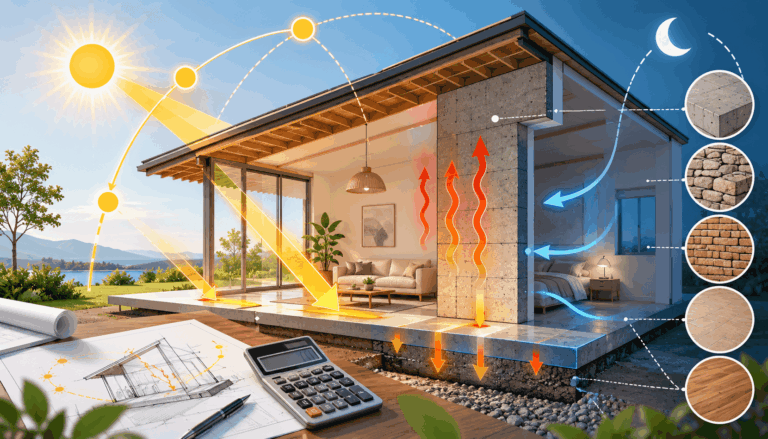
Thermal Mass Calculator
Use this thermal mass calculator to estimate the approximate heat storage potential of common passive solar materials such as concrete, brick, stone, tile, adobe, rammed earth, and water.
Example inputs are pre-filled. Replace them with your project values. Reset restores this example.
Thermal Mass Calculator
Estimate active mass, stored heat, and storage intensity for common passive solar materials using area, effective thickness, material density, specific heat, and temperature swing.
Results
Ready
Enter the thermal mass area, effective thickness, material, and temperature change, then calculate the approximate heat storage.
Tip: effective active thickness is often less than the full structural thickness because not all material responds quickly to daily temperature swings.
Thermal mass is important in passive solar design because dense materials can absorb, store, and release heat. When designed well, thermal mass can help reduce indoor temperature swings, store useful winter solar gain, and support comfort. When designed poorly, it can also store unwanted summer heat and contribute to overheating.
This calculator is intended for early-stage design and education. It does not replace professional thermal modeling, energy simulation, structural design, moisture analysis, HVAC design, or local building code review.
Thermal Mass Calculator
Enter the exposed area, effective active thickness, material type, and expected temperature change. The calculator estimates stored heat using a simplified heat storage formula.
What Is Thermal Mass?
Thermal mass is the ability of a material to absorb, store, and release heat. In passive solar design, thermal mass is often used to store useful solar heat during the day and release it later when indoor temperatures fall.
Common thermal mass materials include:
- Concrete
- Brick
- Stone
- Tile over concrete
- Adobe
- Rammed earth
- Masonry
- Water
Thermal mass is not the same as insulation. Thermal mass stores heat. Insulation slows heat flow. A good passive solar building may need both.
For the full guide, read Thermal Mass.
Thermal Mass Formula
This calculator uses a simplified heat storage formula:
Stored heat = mass × specific heat capacity × temperature change
Or:
Q = m × c × ΔT
Where:
- Q is stored heat.
- m is the active mass of the material.
- c is the specific heat capacity of the material.
- ΔT is the temperature change of the material.
The calculator estimates active mass using:
Active mass = exposed area × effective active thickness × density
This approach is useful for early design, but it does not predict exactly how a real building will behave over time.
What Is Effective Active Thickness?
Effective active thickness is the portion of the material you expect to participate in daily heat storage. In a real building, not all of a thick concrete slab, stone wall, or masonry wall may respond quickly to daily temperature changes.
The active layer depends on:
- Material type
- Thickness
- Surface exposure
- Solar radiation reaching the surface
- Air movement across the surface
- Floor coverings or wall finishes
- Time period being studied
- Indoor temperature swing
- Night ventilation or heat release conditions
For early design, use a reasonable effective thickness rather than assuming that the entire structural thickness is active. For detailed design, use energy modeling or professional thermal analysis.
Why Thermal Mass Matters in Passive Solar Design
Thermal mass can help stabilize indoor temperature when it is correctly matched with solar gain, shading, insulation, and ventilation.
Good thermal mass can help:
- Absorb useful winter solar gain
- Release stored heat later in the day
- Reduce rapid indoor temperature swings
- Improve comfort near sunlit rooms
- Support passive heating in suitable climates
- Support passive cooling when paired with night ventilation in suitable climates
Thermal mass can also create problems when poorly designed. If unshaded summer sun hits a concrete floor, brick wall, or stone surface, the mass may store unwanted heat and release it later when cooling is needed.
For related design, read Passive Solar Design Principles.
Thermal Mass and Windows
Thermal mass should be designed together with windows. Windows admit solar heat. Thermal mass stores some of that heat.
Good design should ask:
- How much sun enters through the windows?
- Which surfaces receive direct sunlight?
- Is the mass exposed or covered?
- Is the glazing area appropriate?
- Is the glazing shaded in summer?
- Does the climate benefit from stored heat?
Too much glass and too little thermal mass can cause overheating. Too much mass without useful solar gain may have limited passive solar benefit.
Helpful links:
Thermal Mass and Shading
Shading is essential when using thermal mass. A mass floor or wall should receive useful sun when heat storage is desired and be protected from unwanted sun when cooling is needed.
Shading helps thermal mass by:
- Allowing useful winter sun where appropriate
- Blocking unwanted summer sun
- Reducing overheating risk
- Preventing mass from storing unwanted heat
- Improving comfort during hot periods
Without shading, thermal mass can become a heat problem instead of a comfort strategy.
Helpful links:
Thermal Mass by Climate
The usefulness of thermal mass depends strongly on climate. A strategy that works well in one climate can fail in another.
| Climate | Thermal Mass Priority | Main Risk |
|---|---|---|
| Cold | Store useful winter solar gain inside a well-insulated, airtight envelope. | Stored heat may be lost through weak windows, air leaks, or poor insulation. |
| Temperate | Balance winter heat storage with summer shading and ventilation. | Shoulder-season or summer overheating. |
| Hot-Dry | Use mass with shade and night ventilation where nights are cool enough. | Mass storing heat without releasing it at night. |
| Hot-Humid | Use mass cautiously and prioritize shade, airflow, and moisture control. | Stored heat and humidity reducing comfort. |
| Mixed | Use balanced thermal mass with flexible shading and ventilation. | A winter-focused mass strategy that overheats in summer. |
For climate-specific guidance, read Passive Solar Design by Climate.
Common Thermal Mass Materials
| Material | Passive Solar Use | Design Caution |
|---|---|---|
| Concrete | Floors, slabs, walls, exposed structural mass | Needs insulation, shading, and careful surface finish selection. |
| Brick | Interior walls, masonry elements, fireplaces, partition walls | Works best when exposed to indoor air and useful heat flow. |
| Stone | Floors, walls, feature elements | Can be heavy and may require structural review. |
| Tile | Floor finish over concrete or masonry | Thin tile alone provides limited mass unless connected to heavier backing. |
| Adobe | Walls and earthen construction | Requires moisture-aware detailing and climate-appropriate construction. |
| Rammed Earth | Walls and high-mass construction | Needs structural, moisture, insulation, and climate review. |
| Water | Specialized storage systems | Requires leak prevention, structural support, safety, and maintenance access. |
For material guidance, read Passive Solar Materials.
Thermal Mass Is Not Always Better
More thermal mass is not automatically better. Thermal mass must be useful, exposed, shaded, and matched to the climate.
Thermal mass may perform poorly when:
- It is covered with carpet, rugs, timber, or insulated finishes
- It is outside the insulated envelope
- It receives unwanted summer sun
- It is used in a climate where heat cannot be released
- It is paired with excessive glazing
- There is no night ventilation in hot climates that need heat release
- The building has weak insulation or air leakage
- The material creates moisture or durability risks
Thermal mass should support comfort, not simply increase weight or material use.
Limitations of This Thermal Mass Calculator
This calculator gives a simplified heat storage estimate. It does not fully predict real building performance.
It does not account for:
- Solar radiation intensity
- Actual sun exposure duration
- Dynamic heat flow over time
- Surface heat transfer rates
- Time lag
- Thermal diffusivity
- Moisture content
- Floor coverings, rugs, furniture, or finishes
- Insulation position
- Thermal bridges
- Air movement across surfaces
- Night ventilation effectiveness
- Indoor comfort temperature range
- Local climate data
- Occupant behavior
Use this calculator to understand basic heat storage potential. For final decisions, use climate data, energy modeling, construction details, and professional guidance.
Common Thermal Mass Mistakes
- Assuming thermal mass is insulation: Mass stores heat; insulation slows heat flow.
- Adding mass without solar access: Mass needs useful heat input to contribute to passive solar heating.
- Ignoring summer shading: Unshaded mass can store unwanted heat.
- Covering the mass: Carpet, rugs, raised floors, and insulated finishes can reduce heat exchange.
- Using too much glass: Thermal mass cannot always compensate for oversized glazing.
- Ignoring climate: Hot-humid climates often need caution with heat-storing materials.
- Forgetting ventilation: Mass may need night cooling or airflow to release stored heat.
- Placing mass outside the insulated envelope: Stored heat may be lost outdoors.
- Ignoring structural load: Concrete, stone, masonry, and water can be heavy.
- Skipping moisture review: Earthen materials, slabs, and masonry need climate-appropriate moisture detailing.
Thermal Mass Design Checklist
Use this checklist before relying on thermal mass in a passive solar design.
- The climate type has been identified.
- The heating and cooling priorities are clear.
- The mass is inside the insulated envelope.
- The mass is exposed to indoor air.
- The mass receives useful solar gain where passive heating is desired.
- The mass is shaded from unwanted summer sun.
- The glazing area is balanced with thermal mass and shading.
- Window SHGC and U-value have been reviewed.
- Night ventilation or heat release is considered where needed.
- Floor coverings and finishes do not block useful heat exchange.
- Structural loads have been reviewed.
- Moisture and condensation risks have been considered.
- Insulation and airtightness are part of the design.
- Overheating risk has been checked.
- Professional review or energy modeling is used where needed.
Useful Related Tools
Use these tools together for better passive solar design decisions:
- Window-to-Wall Ratio Calculator
- Solar Angle Calculator
- Roof Overhang Calculator
- Passive Solar Orientation Calculator
- Passive Solar Design Tools
- Passive Solar Design Checklist
Thermal Mass Calculator for Different Readers
| Reader | How to Use This Calculator | Recommended Next Page |
|---|---|---|
| Architects | Use it to compare early mass strategies, material options, exposed surfaces, and climate suitability. | Thermal Mass |
| Self-Builders | Use it to understand why exposed concrete, brick, tile, or stone must be matched with windows and shading. | Passive Solar House Design |
| Investors and Developers | Use it to review comfort strategy, overheating risk, structural implications, and construction complexity. | Passive Solar Design Checklist |
| Students | Use it to connect heat storage formulas with real passive solar design decisions. | Passive Solar Calculations |
Frequently Asked Questions
What does a thermal mass calculator estimate?
A thermal mass calculator estimates how much heat a material can store based on its mass, specific heat capacity, and temperature change. This gives a simplified estimate of heat storage potential.
What is the formula for thermal mass heat storage?
The simplified formula is stored heat equals mass multiplied by specific heat capacity multiplied by temperature change: Q = m × c × ΔT.
What materials have good thermal mass?
Common thermal mass materials include concrete, brick, stone, tile over concrete, adobe, rammed earth, masonry, and water. The best material depends on climate, structure, moisture risk, cost, and design goals.
Is thermal mass the same as insulation?
No. Thermal mass stores heat. Insulation slows heat flow. Passive solar buildings often need both, especially in cold and mixed climates.
How much thermal mass does a passive solar house need?
There is no universal amount. It depends on climate, window area, solar gain, shading, room size, ventilation, insulation, material type, and comfort goals.
Can thermal mass cause overheating?
Yes. If thermal mass receives unwanted summer sun or cannot release stored heat, it can contribute to overheating. Shading and ventilation are essential.
Does a concrete floor always work as thermal mass?
Only if it is exposed to indoor air and useful heat flow. Carpet, rugs, raised timber floors, and insulated finishes can reduce its effectiveness.
Is this calculator accurate enough for final design?
No. It is useful for early design and education. Final decisions should use climate data, detailed drawings, energy modeling, structural review, moisture analysis, and professional guidance where needed.
Recommended Learning Path
After using this calculator, continue with these pages:
- Thermal Mass
- Passive Solar Materials
- Passive Solar Windows
- Window-to-Wall Ratio Calculator
- Passive Solar Shading & Overhangs
- Roof Overhang Calculator
- Passive Solar Calculations
- Passive Solar Design Tools
Continue Learning
Thermal mass works best when it is designed with the whole passive solar system. Windows, shading, climate, insulation, ventilation, surface finishes, and room use all determine whether mass improves comfort or creates overheating risk.
Recommended next step: Use the Passive Solar Orientation Calculator
Recommended books and tools
This section contains affiliate links. As an Amazon Associate we earn from qualifying purchases, at no extra cost to you. We only list items that relate to this page; we have not tested specific products.
- The Passive Solar House by James Kachadorian: a practical, builder-oriented guide to designing a sun-heated house with thermal mass. View on Amazon
- Infrared thermometers: for checking how warm floors and walls get in the sun, and how long they hold heat. Browse on Amazon
- Indoor thermometer / hygrometer loggers: record room temperatures over days to see whether thermal mass is smoothing the swings. Browse on Amazon