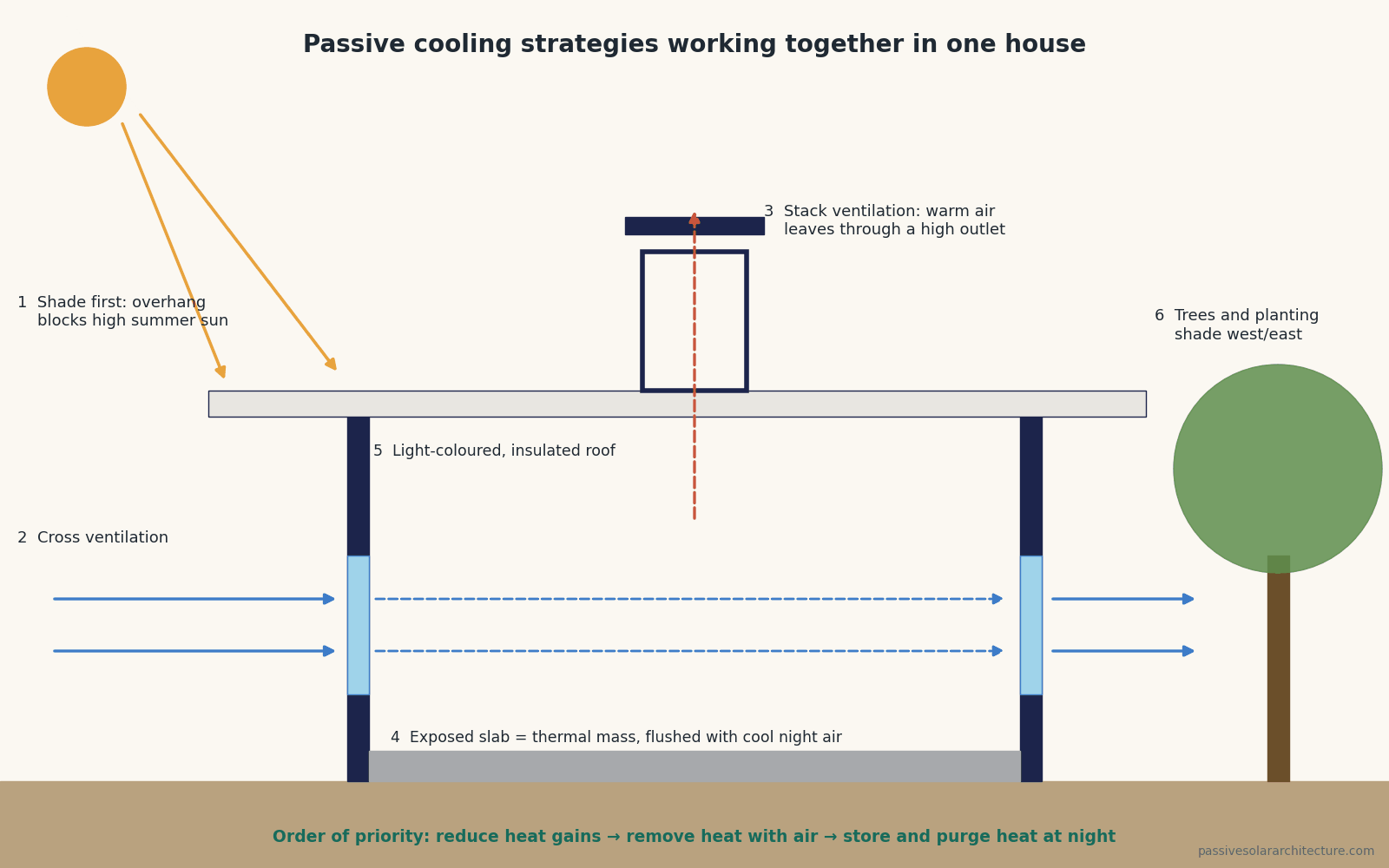
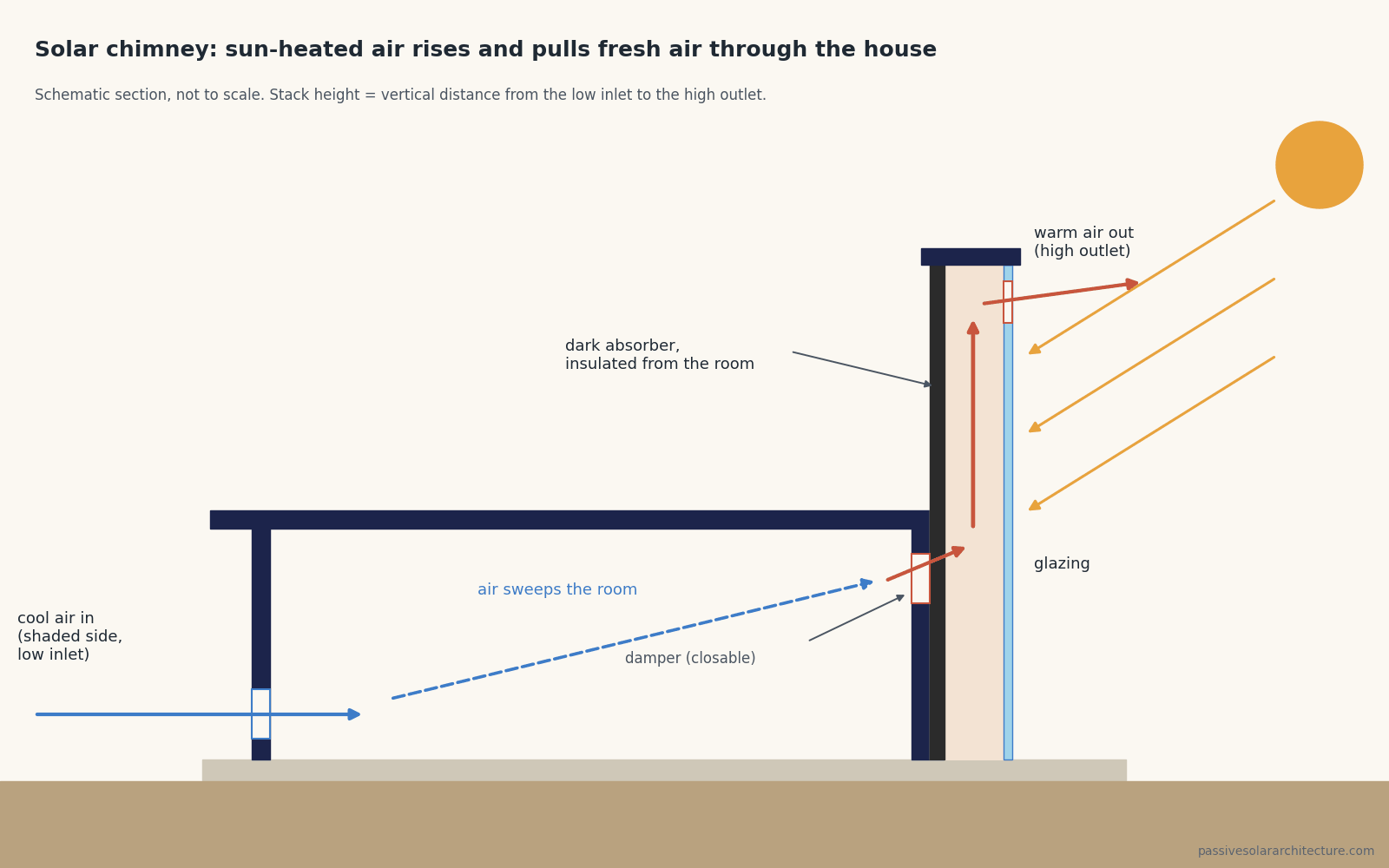
A solar chimney is a tall, sun-heated air shaft that pulls fresh air through a house without fans. The sun warms a dark surface behind glass; the warm air inside the shaft rises and leaves at the top, and replacement air is drawn in through low openings on the cooler side of the house. It is a ventilation device, not a heater, and it works best as part of a wider passive cooling strategy.
This guide explains how a solar chimney works, how to estimate its airflow with a worked example, which design details matter, and when it is not worth building. (If you were looking for solar updraft towers that generate electricity, that is a different technology.)
Key takeaways
- A solar chimney boosts the stack effect: it makes the air in a tall shaft warmer than the air indoors, so it rises faster and draws air through the house.
- In a simplified model, airflow grows with the cube root of chimney height and solar heat: doubling either adds only about 26%. Doubling the effective opening area adds about 59%.
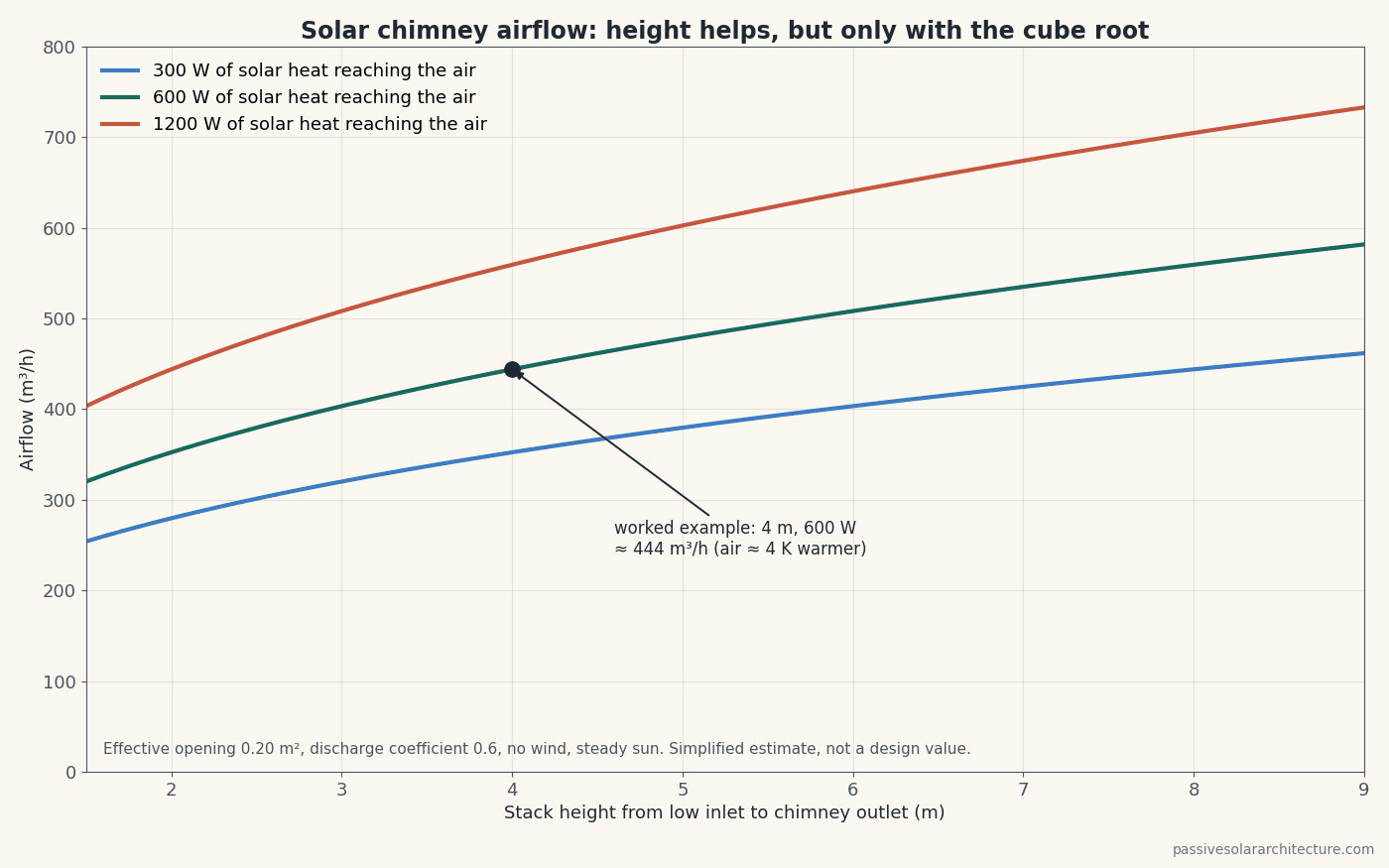
- Our worked example, a 4 m stack with about 600 W of solar heat reaching the air and an effective opening of 0.20 m², moves roughly 444 m³/h (261 cfm), about 1.5 air changes per hour in a 300 m³ house.
- It helps most when outdoor air is cooler than indoor air, the house has low inlets on a shaded side, and the chimney can be closed in winter.
- It is not a substitute for shading, insulation or night ventilation, and it does little on hot, still afternoons when outdoor air is hotter than indoors.
What is a solar chimney?
A solar chimney (also called a thermal chimney) is a vertical shaft with a sun-facing glazed side and a dark, heat-absorbing back wall. Openings connect the bottom of the shaft to the rooms and the top of the shaft to the outside. When the sun heats the absorber, the air in the shaft warms, becomes lighter and rises. As it leaves at the top, it pulls air from the rooms, and fresh air enters the house through low inlets.
Any tall, open space creates some stack ventilation: a stairwell, a double-height living room or an operable clerestory window. A solar chimney adds two things: extra height above the roof and solar heat that keeps the air in the shaft warmer than the air in the house, even when the indoor–outdoor temperature difference is small.
It is related to the Trombe wall, but the purpose is different. A Trombe wall stores heat and releases it into the room. A solar chimney insulates the absorber from the room and uses the heat only to move air. A vented Trombe wall can be switched to work as a solar chimney in summer.
How a solar chimney works
The driving force is buoyancy. The pressure that pushes air through a stack depends on its height and on how much warmer the air inside is than the air outside. The standard stack-flow relationship is:
Q = Cd × A × √(2 × g × H × ΔT ÷ T)
- Q: airflow (m³/s)
- Cd: discharge coefficient of the openings, often taken as about 0.6–0.7
- A: effective opening area (m²)
- g: 9.81 m/s²
- H: height between the low inlet and the high outlet (m)
- ΔT: how much warmer the air in the stack is than the outdoor air (K)
- T: absolute temperature of the stack air (K, about 300 K)
In an ordinary stack, ΔT comes from the house being warmer than outside. In a solar chimney, the sun adds heat to the air in the shaft. That creates a feedback: more airflow carries the heat away faster, so the air warms less. Solving the heat balance and the stack equation together gives a useful rule:
Q ∝ (A² × H × q)1/3, where q is the solar heat that reaches the air (W).
In plain terms:
- doubling the chimney height raises airflow by only about 26%;
- doubling the solar heat (a larger or better absorber) also raises it by about 26%;
- doubling the effective opening area raises it by about 59%.
Generous, unobstructed openings are therefore usually the cheapest way to more airflow. Height still matters, but a very tall chimney with small vents disappoints.
Worked example: how much air can a solar chimney move?
Assumptions for a single-storey house of about 300 m³:
- Stack height from the low inlet to the chimney outlet: 4 m (about 13 ft).
- Absorber: 1 m wide × 4 m tall = 4 m², receiving about 500 W/m² of sun on the glazing on a clear summer afternoon.
- About 30% of that sunlight ends up as heat in the moving air (the rest is reflected, lost through the glass, or stored): q ≈ 4 × 500 × 0.30 = 600 W. This fraction is an assumption for illustration; real values depend on glazing, absorber and air gap.
- Effective opening area 0.20 m². Openings in series combine: two openings of 0.30 m² each give an effective area of about 0.21 m².
- Cd = 0.6, stack air at about 300 K, no wind.
Solving the stack equation and the heat balance together gives:
- Airflow ≈ 123 L/s ≈ 444 m³/h (261 cfm)
- Air in the chimney ≈ 4 K warmer than outdoor air
- About 1.5 air changes per hour for a 300 m³ house
That is a useful flow for ventilation and for air movement through the rooms the air passes. It is not enough to cool a house on its own during hot afternoons: if the outdoor air is 32 °C, the chimney simply brings 32 °C air in. A solar chimney cools best when outdoor air is cooler than indoor air, for example in the evening, in mild weather, or when the intake is pre-cooled by a shaded courtyard or planting.
| Stack height | 300 W of solar heat | 600 W | 1,200 W |
|---|---|---|---|
| 2 m (7 ft) | ≈ 280 m³/h (165 cfm) | ≈ 352 m³/h (207 cfm) | ≈ 444 m³/h (261 cfm) |
| 4 m (13 ft) | ≈ 352 m³/h (207 cfm) | ≈ 444 m³/h (261 cfm) | ≈ 559 m³/h (329 cfm) |
| 6 m (20 ft) | ≈ 403 m³/h (237 cfm) | ≈ 508 m³/h (299 cfm) | ≈ 640 m³/h (377 cfm) |
| 8 m (26 ft) | ≈ 444 m³/h (261 cfm) | ≈ 559 m³/h (329 cfm) | ≈ 705 m³/h (415 cfm) |
Simplified estimate for an effective opening of 0.20 m², Cd 0.6, no wind and steady sun; not a design value. Imperial values are conversions.
When a solar chimney helps, and when it does not
| Situation | Usefulness | Why |
|---|---|---|
| Hot-dry climate with cool evenings | Good | Drives evening and early-night ventilation while the sun-warmed shaft is still hot; pairs well with night flushing of thermal mass. |
| Mild or Mediterranean summers | Good | Outdoor air is often cooler than indoors, so extra airflow removes heat. |
| Still sites with little wind | Good | Buoyancy works without wind; cross ventilation does not. |
| Hot-humid climate | Limited | Air movement helps comfort, but warm, humid outdoor air limits cooling; ceiling fans and shading usually matter more. |
| Very hot afternoons | Poor for cooling | It brings in outdoor air that is hotter than indoors; close the house and rely on shading and thermal mass. |
| Cold climates in winter | Close it | An open chimney loses heated air. It needs tight dampers. |
Check your own climate first: our guide to passive solar design by climate and site and climate analysis show what to look for.
Design details that matter
Orientation and sun angle
The glazed face should receive strong sun when you most need ventilation. An equator-facing chimney gets sun through the middle of the day; a west-facing one peaks in the afternoon and early evening, which often suits cooling. Check the sun angles for your site and dates with the solar angle calculator.
Absorber and glazing
The absorber should be dark and matt, and insulated on the room side so the chimney does not heat the house. Glazing traps the heat in the shaft; better glazing loses less heat through the glass on cooler days.
Openings and air path
- Put inlets low, on the shaded or pole-facing side, ideally drawing from a shaded courtyard, planting or the cooler side of the site.
- Make sure the air actually crosses the rooms you want to ventilate: interior doors, transfer grilles or open plans complete the path.
- Keep the openings into the chimney and at the outlet at least as large as the inlets. The smallest opening in the series limits the flow.
- Place the outlet above the roof ridge or in a zone where wind creates suction, not where wind blows into it.
Air gap and height
The shaft must be deep enough that the air can move without much friction, and tall enough to give a useful stack height. Very narrow gaps add friction; very wide ones heat the air less evenly. Ask your designer to check the gap and opening sizes with a natural-ventilation calculation for your climate.
Control: dampers, screens and night operation
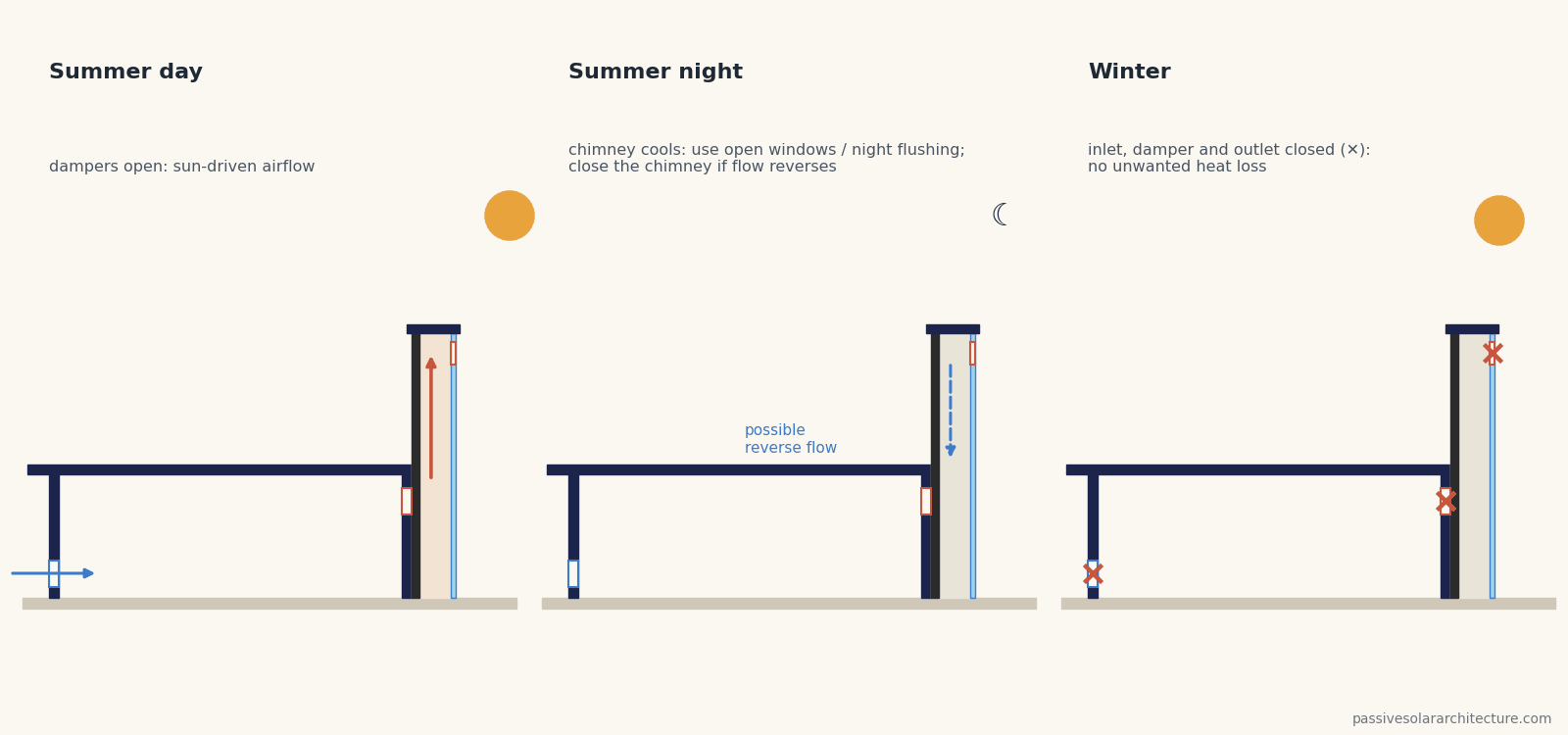
- Closable dampers at the room opening and the outlet stop heat loss in winter.
- At night, the glazed shaft cools and may even pull air downward. Use open windows for night ventilation and close the chimney if flow reverses.
- Fit insect screens (they reduce the effective opening area, so allow for that) and keep rain out at the outlet.
- Check fire, smoke and security rules: a vertical shaft connecting rooms can affect fire separation and smoke movement under local building codes.
A step-by-step design check
- Confirm the climate: when is outdoor air cooler than indoor air, and is there wind?
- Decide what the chimney should do: daytime ventilation, evening purge, or air movement in still weather.
- Choose the location: sun on the glazed face at the right time of day, outlet clear of the roof.
- Plan the air path from low, shaded inlets through the rooms to the chimney.
- Estimate the airflow with the stack equation, as in the worked example above, and size the openings generously.
- Add dampers, screens and rain protection, and plan how occupants will operate them.
- Coordinate with shading, overhangs and thermal mass, and have the design checked for fire and building-code compliance.
Common mistakes
- Expecting it to cool on hot afternoons. It can only bring in outdoor air.
- Tall chimney, small vents. Opening area usually matters more than extra height.
- Uninsulated absorber. The chimney then heats the house it is meant to ventilate.
- No dampers. The house loses heat all winter.
- Inlets on the sunny side. The chimney pulls in the warmest air on the site.
- No air path. Closed interior doors stop the flow through the rooms.
Frequently asked questions
Does a solar chimney work at night?
Only weakly. The shaft keeps some heat for a while after sunset, but as it cools the stack effect fades and can even reverse. Night ventilation is usually better done with open windows on different sides of the house.
Does it work on cloudy days?
Less well. Diffuse sunlight still heats the absorber a little, and the normal stack effect still works if the house is warmer than outdoors, but airflow is lower.
How tall should a solar chimney be?
Tall enough to rise clearly above the roof and give a useful stack height, often several metres from the lowest inlet. Because airflow grows only with the cube root of height, generous openings and a good air path usually matter more than extra height.
Is a solar chimney the same as a whole-house fan?
No. A whole-house fan uses electricity to force a large airflow and works at any time; a solar chimney is passive, quieter and smaller in airflow, and depends on sun and temperature differences.
Can I add a solar chimney to an existing house?
Sometimes, for example by converting a stairwell or adding a glazed shaft on a sunny wall. The roof penetration, structure, fire separation and air path need professional design.
Sources and further reading
- Wikipedia: Stack effect (stack-flow equation and discharge coefficient).
- Wikipedia: Solar chimney (definition and history).
Continue learning
- Passive Cooling Strategies for Homes
- Trombe Wall: How It Works, Design Rules & Diagrams
- Night Ventilation and Thermal Mass
- Clerestory Windows
Published and editorially checked: 19 October 2026. Airflow figures are simplified calculations with stated assumptions, not design values; ventilation, fire safety and structure need project-specific design. Featured image, diagrams and charts: AI-generated original schematics, checked by our editorial team; they are not to scale and not a design calculation.
Next step: check your own project
Try the ideas on your own project with the free passive solar design tools. It is free and runs in your browser.
Keep your results in one place
The free Passive Solar Design Checklist & Project Brief is a printable PDF with pages for your site’s sun angles, orientation, glazing per facade, shading and thermal mass, plus 12 questions to take to your architect or designer.