
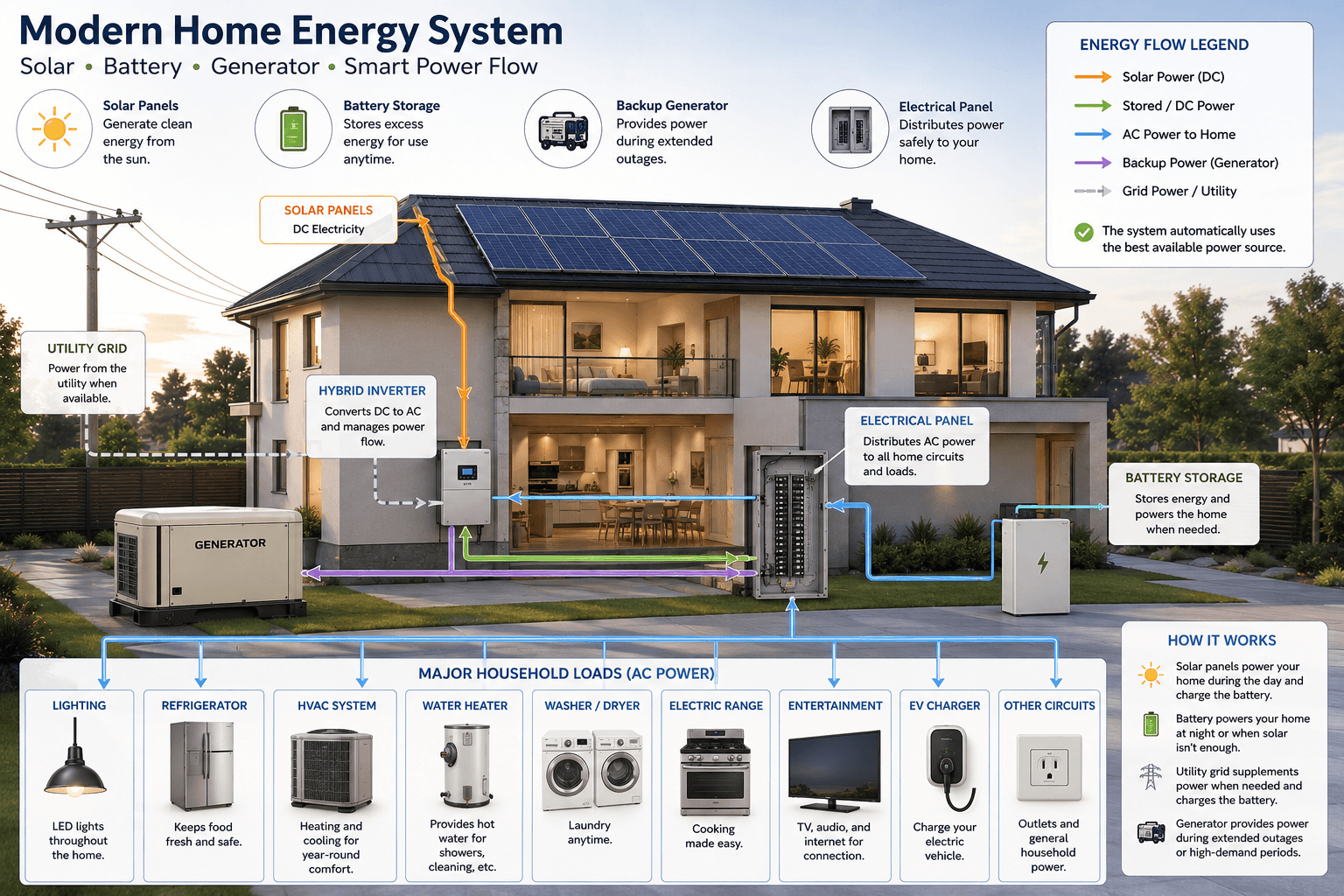
A typical U.S. home uses an average of about 1,180 watts continuously when its annual electricity consumption is spread across every hour of the year.
However, that does not mean a 1,200-watt generator, solar inverter, or battery can power an entire house.
Real household electricity demand changes throughout the day. A home may use less than 500 watts during quiet overnight hours but exceed 10,000 or even 20,000 watts when heating, cooling, water heating, cooking, laundry equipment, pumps, and electric vehicle charging operate simultaneously.
For early planning, use the following ranges:
| Power requirement | Approximate wattage |
|---|---|
| Average continuous household demand | 1,000–1,500 W |
| Basic essential circuits | 3,000–5,000 W |
| Essentials with pumps or limited HVAC | 5,000–8,000 W |
| Typical whole-house backup | 10,000–20,000 W |
| Large all-electric house | 20,000–30,000+ W |
These figures are preliminary estimates rather than final design values.
The correct answer to how many watts to power a house depends on:
- simultaneous electrical loads;
- HVAC type and efficiency;
- motor and compressor startup current;
- electric water heating;
- cooking and laundry equipment;
- electric vehicle charging;
- climate;
- building-envelope performance;
- occupant behavior;
- load-management controls.
For new construction, electrical demand should be considered alongside the building’s overall passive solar design principles. Improving orientation, windows, shading, insulation, airtightness, and thermal mass can reduce heating and cooling loads before electrical systems are sized.
Quick Answer: How Many Watts Does a House Need?
The wattage needed depends on how much of the house must operate at the same time.
- 3,000–5,000 watts can often support refrigerators, lights, internet, selected outlets, and a few essential appliances.
- 5,000–8,000 watts may support essential circuits plus a well pump, sump pump, furnace blower, or small air-conditioning system.
- 10,000–15,000 watts may operate much of a typical house when major loads are managed.
- 15,000–25,000 watts may be needed for unrestricted whole-house operation.
- More than 25,000 watts may be required for large all-electric homes with multiple HVAC systems, resistance heating, pools, workshops, or EV chargers.
The number should not be selected from floor area alone. Two houses of the same size can have completely different peak loads.
How Many Watts Does the Average House Use?
The U.S. Energy Information Administration reports that the average residential electricity customer used approximately 863 kWh per month in 2024.
To convert monthly electricity use into average continuous wattage:
[
\text{Average watts} =
\frac{\text{Monthly kWh} \times 1{,}000}
{\text{Hours per month}}
]
Using 863 kWh and an average month of 730.5 hours:
[
\frac{863 \times 1{,}000}{730.5}
\approx 1{,}181 \text{ watts}
]
This equals approximately:
- 1.18 kW of average continuous demand
- 28.4 kWh of electricity per day
- 10,356 kWh of electricity per year
This calculation is useful for evaluating annual energy consumption, electricity costs, and preliminary solar production.
It is not enough for sizing:
- a generator;
- a battery inverter;
- an electrical service;
- an off-grid power system;
- a transfer switch;
- a transformer;
- a backup-load panel.
Those systems must handle the highest realistic combination of loads, not merely the annual average.
Average Power vs. Peak Power
Understanding the difference between average and peak power is essential when determining how many watts it takes to run a house.
Average power
Average power represents electricity consumption spread across a specific period.
It is useful for:
- comparing annual household energy performance;
- estimating utility costs;
- assessing energy-efficiency improvements;
- sizing a grid-connected solar array;
- calculating emissions;
- comparing buildings.
Peak power
Peak power is the highest electrical demand that occurs at one time or during a defined measurement interval.
It affects the sizing of:
- generators;
- inverters;
- batteries;
- electrical services;
- distribution panels;
- feeders;
- transformers;
- transfer switches.
Consider a house with an annual average demand of only 1.2 kW. During the evening, the following equipment could operate simultaneously:
| Electrical load | Approximate power |
| Heat pump | 3,500 W |
| Electric water heater | 4,500 W |
| Induction cooktop | 3,000 W |
| Dishwasher | 1,300 W |
| Refrigerator and lighting | 500 W |
| Plug loads and electronics | 700 W |
| Simultaneous demand | 13,500 W |
The annual average may remain close to 1,200 watts, while the instantaneous demand reaches 13,500 watts.
This difference explains why average electricity consumption cannot be used directly to select a generator or inverter.
Watts, Kilowatts, and Kilowatt-Hours
Watts, kilowatts, and kilowatt-hours measure related but different quantities.
| Unit | Meaning | Common application |
| Watt, W | Instantaneous power | Light bulb or small appliance |
| Kilowatt, kW | 1,000 watts of power | Generator or inverter capacity |
| Watt-hour, Wh | Energy used over time | Small battery capacity |
| Kilowatt-hour, kWh | 1,000 watt-hours | Utility bills and battery storage |
For example, a 2,000-watt electric heater running for three hours uses:
[
2{,}000 \text{ W} \times 3 \text{ hours}
= 6{,}000 \text{ Wh}
= 6 \text{ kWh}
]
A home battery may have:
- 13.5 kWh of stored energy, showing how long it may support loads;
- 5 kW of continuous output, showing how much power it can deliver at one time;
- a higher short-duration surge rating, showing whether it can start motors and compressors.
A battery may contain enough energy to operate essential loads overnight but still be unable to start a large well pump if its inverter output is too low.
Running Watts vs. Starting Watts
Electrical equipment with motors or compressors often requires more power when starting than during normal operation.
Running watts
Running watts describe the power used after equipment has started and is operating normally.
Starting watts
Starting watts describe the brief surge needed to start a motor or compressor.
Equipment with potentially significant startup demand includes:
- central air conditioners;
- heat pumps;
- refrigerators;
- freezers;
- well pumps;
- sump pumps;
- furnace blowers;
- workshop tools;
- air compressors.
A refrigerator may use only 150–250 watts while running but temporarily require several times that amount when its compressor starts.
Modern variable-speed equipment can have lower startup demand than conventional single-speed equipment. Manufacturer specifications should therefore take priority over generic wattage charts.
A simplified generator or inverter sizing formula is:
[
\text{Required power} =
\text{Simultaneous running watts}
+
\text{Largest additional startup surge}
]
An engineering margin should then be added so that equipment does not operate continuously at its maximum rating.
Typical Household Appliance Wattage
The following values are approximate. Actual power should be confirmed from product data, nameplates, commissioning records, or direct measurements.
| Household appliance | Typical running watts | Possible starting or peak watts |
| LED light bulb | 7–15 W | Same |
| Wi-Fi router | 10–25 W | Same |
| Television | 50–200 W | Similar |
| Laptop computer | 30–100 W | Similar |
| Desktop computer | 100–500 W | Similar |
| Refrigerator | 100–300 W | 500–1,200 W |
| Freezer | 100–300 W | 500–1,200 W |
| Microwave | 800–1,500 W | Similar |
| Coffee maker | 800–1,500 W | Similar |
| Dishwasher | 1,000–1,800 W | Similar |
| Clothes washer | 400–1,300 W | 800–2,000 W |
| Electric clothes dryer | 3,000–6,000 W | Similar |
| Electric oven | 2,000–5,000+ W | Similar |
| Electric water heater | 3,500–5,500 W | Similar |
| Heat-pump water heater | 300–1,500 W | Higher in resistance mode |
| Portable space heater | 750–1,500 W | Similar |
| Central air conditioner | 2,000–5,000 W | Potentially much higher |
| Residential heat pump | 1,500–5,000 W | Equipment-specific |
| Electric resistance furnace | 10,000–20,000+ W | Similar |
| Gas furnace blower | 300–800 W | 600–1,500 W |
| Sump pump | 500–1,500 W | 1,200–3,000 W |
| Well pump | 700–2,000+ W | 1,500–5,000+ W |
| Level 1 EV charger | 1,200–1,800 W | Similar |
| Level 2 EV charger | 3,800–11,500 W | Similar |
Heating elements generally have little starting surge but can create large sustained loads.
Motors and compressors may have lower running wattage but much higher short-duration startup requirements.
How to Calculate the Watts Needed to Power a House
A reliable house wattage calculation should separate energy use, running demand, startup demand, and code-defined electrical load.
The Department of Energy recommends analyzing current electricity consumption, identifying appliance wattage, recording operating hours, considering seasonal variations, and reducing demand before purchasing a renewable energy system.
Step 1: Define the purpose of the calculation
Determine whether the calculation is being performed for:
- whole-house generator sizing;
- essential-load backup;
- battery storage;
- solar design;
- off-grid operation;
- electrical-service sizing;
- energy modeling;
- resilience planning.
Each application requires a different calculation.
A solar array is primarily sized around energy consumption in kilowatt-hours. A generator or battery inverter must also meet instantaneous demand in kilowatts.
Step 2: Create a load inventory
List each relevant electrical load and record:
- equipment name;
- voltage;
- rated current;
- running watts;
- starting watts;
- operating schedule;
- estimated daily operating time;
- whether the load is essential;
- whether it can be delayed;
- whether it is thermostatically controlled.
For a new building, this inventory should be coordinated with the broader passive solar house design process so that architectural and mechanical decisions are reflected in electrical demand.
Step 3: Calculate equipment wattage
For a simple single-phase load:
[
P = V \times I
]
Where:
- (P) = power in watts;
- (V) = voltage;
- (I) = current in amperes.
For AC equipment where power factor is relevant:
[
P = V \times I \times PF
]
For three-phase equipment:
[
P = \sqrt{3} \times V \times I \times PF
]
Equipment nameplate information should be used whenever available.
Step 4: Identify simultaneous loads
Do not assume that every connected appliance will operate at maximum power at the same time.
Group loads into categories such as:
- always-on loads;
- HVAC;
- water heating;
- cooking;
- laundry;
- pumps;
- EV charging;
- entertainment and electronics;
- optional or deferrable loads.
Then define realistic operating scenarios.
For example, an evening peak might include cooking, lighting, water heating, HVAC, and electronics but not necessarily clothes drying and EV charging.
Step 5: Add motor startup demand
Identify the largest motor or compressor that could start while other equipment is operating.
The system must support:
- the existing simultaneous running load;
- the incremental startup requirement;
- an appropriate design margin.
Step 6: Apply electrical-code requirements
A preliminary appliance list is not a substitute for a code-compliant residential load calculation.
Electrical-service and feeder design must account for:
- continuous loads;
- demand factors;
- heating and cooling loads;
- cooking equipment;
- laundry equipment;
- EV charging;
- local amendments;
- utility requirements;
- equipment ratings.
A licensed electrical professional should complete or verify the final calculation.
Step 7: Verify the result with measured data
For an existing building, measured data is generally more reliable than generic estimates.
Useful sources include:
- utility smart-meter records;
- 15-minute interval data;
- whole-house energy monitors;
- circuit-level monitors;
- solar-inverter records;
- battery-system logs;
- measured motor startup current.
Monthly utility bills show total energy use but usually do not reveal short-duration demand peaks.
How Many Generator Watts Are Needed to Run a House?
Generator size depends on whether the system will power only critical circuits or maintain near-normal whole-house operation.
Essential-load generator
An essential-load system may include:
- refrigerator and freezer;
- selected lighting;
- internet equipment;
- phone charging;
- gas-furnace blower;
- sump pump;
- well pump;
- medical equipment;
- selected receptacles.
A small home with limited essential loads may need approximately 3,000–5,000 watts.
A system that includes pumps, refrigeration startup loads, or limited HVAC may need 5,000–8,000 watts.
Partial-home generator
A partial-home system may also power:
- microwave;
- selected kitchen circuits;
- one small air conditioner;
- heat pump under controlled conditions;
- water heating at scheduled times;
- additional outlets.
These systems frequently fall within a preliminary range of 7,000–12,000 watts.
Whole-house generator
A whole-house generator may need to serve:
- central heating and cooling;
- water heating;
- cooking equipment;
- well or sump pumps;
- laundry equipment;
- lighting;
- general outlets;
- pool equipment;
- workshop loads.
Typical whole-house systems may require approximately 10,000–25,000 watts, while large all-electric homes may require more.
Generator safety
Portable generators must not be operated inside houses, garages, crawl spaces, or partially enclosed areas because of carbon monoxide, fire, and electrocution risks. FEMA also recommends that a qualified electrician install appropriate transfer equipment rather than connecting a generator directly to the home’s wiring.
A properly installed transfer switch prevents dangerous backfeeding into utility lines.
How Many Solar Watts Are Needed to Power a House?
Solar panels are sized differently from generators.
A generator is primarily rated by instantaneous output in kilowatts. A solar array is usually sized according to the amount of energy the house consumes over a day or year.
A simplified preliminary formula is:
[
\text{Solar array size} =
\frac{\text{Daily energy consumption}}
{\text{Peak sun hours} \times \text{system efficiency factor}}
]
Using the U.S. average of approximately 28.4 kWh per day:
- daily consumption: 28.4 kWh;
- peak sun hours: 5;
- overall system factor: 0.80.
[
\frac{28.4}
{5 \times 0.80}
= 7.1 \text{ kW}
]
Under these assumptions, a solar array of approximately 7.1 kW could produce energy comparable to the average household’s daily consumption.
The actual requirement depends on:
- location;
- roof orientation;
- roof pitch;
- shading;
- panel efficiency;
- inverter losses;
- seasonal solar availability;
- local climate;
- snow and soiling;
- utility interconnection rules.
NREL’s PVWatts Calculator estimates the energy production of grid-connected photovoltaic systems using project-specific location and system inputs.
House orientation and photovoltaic orientation are related but not identical. Solar panels generate electricity, while building orientation also influences comfort, daylight, overheating, and HVAC demand.
Review house orientation for energy efficiency before finalizing the overall site strategy.
The Passive Solar Orientation Calculator can also support early comparisons of building alignment.
How Many Solar Panels Are Needed?
The number of panels depends on the target array capacity and the rated power of each module.
For a 7.1 kW array:
| Panel rating | Approximate number of panels |
| 350 W | 21 panels |
| 400 W | 18 panels |
| 450 W | 16 panels |
| 500 W | 15 panels |
The result should always be rounded up to a whole panel and checked against:
- available roof area;
- fire setbacks;
- obstructions;
- shading;
- structural capacity;
- inverter configuration;
- electrical-code requirements.
Solar panels alone generally do not keep a grid-connected house operating during a utility outage. Backup operation normally requires a compatible inverter, battery, isolation controls, and appropriately configured loads.
How Large Should a Home Battery Be?
Home battery sizing involves two separate questions:
- How much energy must the battery store?
- How much instantaneous power must it deliver?
Battery energy capacity
A simplified calculation is:
[
\text{Battery capacity} =
\text{Average backed-up load}
\times
\text{Required backup time}
]
For example:
- average essential load: 1.5 kW;
- required backup period: 10 hours.
[
1.5 \times 10 = 15 \text{ kWh}
]
The system would need approximately 15 kWh of usable energy before accounting for:
- inverter losses;
- battery reserve;
- temperature;
- degradation;
- minimum state of charge;
- future load growth.
Battery inverter capacity
Suppose the essential-load panel includes:
- 2.5 kW of normal running loads;
- a 1.5 kW well pump;
- a significant pump-starting surge.
The battery may contain enough energy for the required duration but still fail to start the pump if its inverter is undersized.
Battery capacity in kWh cannot compensate for insufficient inverter output in kW.
Case Study: All-Electric House
Consider an all-electric house with the following connected loads:
| Electrical load | Operating power |
| Heat pump | 3.5 kW |
| Electric water heater | 4.5 kW |
| Induction cooking | 3.6 kW |
| Clothes dryer | 5.0 kW |
| EV charger | 7.2 kW |
| Lighting and general loads | 1.0 kW |
| Potential simultaneous load | 24.8 kW |
Without load management, the house could approach 25 kW of simultaneous demand before startup surges are considered.
Now introduce basic controls:
- pause EV charging during cooking;
- prevent the clothes dryer and water heater from operating together;
- schedule water heating outside evening peaks;
- disable nonessential loads during an outage;
- prioritize HVAC, refrigeration, lighting, and pumps.
A managed operating condition could be:
| Managed electrical load | Power |
| Heat pump | 3.5 kW |
| Induction cooking | 3.6 kW |
| Lighting and base loads | 1.0 kW |
| Managed simultaneous load | 8.1 kW |
The connected load has not changed, but the maximum simultaneous demand has fallen from 24.8 kW to approximately 8.1 kW.
This can significantly reduce the required capacity of:
- the generator;
- battery inverter;
- electrical service;
- transformer;
- transfer switch.
What Determines How Many Watts a House Needs?
HVAC equipment
Heating and cooling systems are frequently the largest contributors to residential peak demand.
Important variables include:
- climate;
- heating and cooling loads;
- equipment efficiency;
- compressor technology;
- auxiliary resistance heat;
- duct losses;
- thermostat settings;
- equipment startup characteristics.
An oversized HVAC system may increase electrical demand, reduce efficiency, and create poor temperature or humidity control.
Building orientation
Orientation affects solar heat gain, daylight, overheating, and mechanical heating and cooling demand.
A poorly oriented house may experience excessive afternoon solar gain while receiving little useful winter sun.
The guide to passive solar orientation explains how solar access, room layout, and building position influence performance.
Windows and glazing
Windows affect:
- heat loss;
- solar heat gain;
- daylight;
- air leakage;
- glare;
- surface temperature;
- occupant comfort.
Use the Window-to-Wall Ratio Calculator during early façade studies to identify areas where excessive glazing could increase heating and cooling demand.
For a broader design explanation, see Passive Solar Windows.
Shading
Exterior shading can reduce cooling loads and summer peak electricity demand.
The appropriate design depends on:
- façade orientation;
- solar altitude;
- solar azimuth;
- window dimensions;
- climate;
- surrounding obstructions.
Review Passive Solar Shading and Overhangs before finalizing glazing and roof geometry.
The Roof Overhang Calculator can support preliminary overhang sizing.
Thermal mass
Materials such as concrete, brick, stone, tile, adobe, and earth can store and release heat.
Thermal mass may help moderate indoor temperatures when it is:
- exposed to the interior;
- correctly positioned;
- matched to the climate;
- protected from unwanted summer solar gain;
- coordinated with ventilation and insulation.
Poorly designed thermal mass can absorb unwanted heat and contribute to overheating.
Learn more in the guide to Thermal Mass or use the Thermal Mass Calculator for preliminary comparisons.
Water heating
A conventional electric storage water heater may draw several kilowatts whenever its heating elements are active.
A heat-pump water heater normally uses less power in compressor mode but may draw substantially more when electric resistance backup is activated.
Water-heating demand can be reduced through:
- scheduling;
- thermal storage;
- efficient fixtures;
- heat-pump technology;
- demand-response controls.
Electric vehicle charging
A Level 2 EV charger can become one of the largest individual electrical loads in a house.
Its effect can be reduced through:
- overnight charging;
- adjustable charging current;
- dynamic service-load management;
- solar-responsive charging;
- disabling charging during outages.
Occupancy and behavior
A family that cooks, showers, does laundry, heats or cools the house, and charges vehicles during the same period will create a higher peak than a household that schedules these activities separately.
Design assumptions should therefore reflect likely occupancy and operating patterns.
Climate
Warm climates may experience summer afternoon peaks from cooling.
Cold all-electric climates may experience winter peaks from heat pumps and auxiliary resistance heat.
Passive solar strategies must therefore be adapted to the location. The Passive Solar Design by Climate guide explains how orientation, glazing, shading, ventilation, and thermal mass should respond to different climate conditions.
How Passive Solar Design Reduces Electrical Demand
The Department of Energy recommends considering energy-efficiency improvements before purchasing a home renewable-energy system because reducing electricity use can allow a smaller and less expensive system.
For new buildings, designers should reduce demand before sizing supply.
1. Analyze the site and climate
Identify:
- heating and cooling priorities;
- sun path;
- seasonal temperatures;
- prevailing winds;
- surrounding shading;
- humidity;
- diurnal temperature range.
2. Optimize orientation
Place the building and major occupied spaces to use beneficial solar exposure while limiting unwanted heat gain.
The correct direction is generally equator-facing rather than universally south-facing. In the Northern Hemisphere, equator-facing usually means south. In the Southern Hemisphere, it usually means north.
3. Improve insulation and airtightness
A stronger envelope reduces heat transfer and allows smaller heating and cooling equipment.
Focus on:
- continuous insulation;
- airtight construction;
- reduced thermal bridging;
- efficient roof assemblies;
- insulated foundations;
- high-performance windows.
4. Coordinate window placement
Windows should provide daylight and useful solar gain without producing excessive heat loss, glare, or overheating.
The guide to Passive Solar Window Placement explains how window position should respond to room use, orientation, and climate.
5. Design exterior shading
Overhangs, screens, shutters, pergolas, and vegetation can reduce unwanted summer solar gain before it reaches the glazing.
This can lower:
- cooling-system runtime;
- indoor peak temperature;
- afternoon electricity demand;
- battery discharge during outages.
6. Use thermal mass strategically
Thermal mass should be coordinated with solar exposure, shading, insulation, and ventilation.
It should not be added simply because a building is described as passive solar.
7. Select efficient mechanical equipment
After reducing the building load, select:
- variable-speed heat pumps;
- heat-pump water heaters;
- efficient pumps;
- energy-recovery ventilation;
- LED lighting;
- high-efficiency appliances;
- intelligent controls.
8. Manage large electrical loads
Smart controls can prevent high-power appliances from operating simultaneously.
Possible strategies include:
- pausing EV charging during cooking;
- delaying water heating;
- disabling clothes drying during backup operation;
- limiting resistance heating;
- sequencing pumps and compressors.
9. Size power systems last
Only after reducing and managing demand should the project team size:
- the electrical service;
- generator;
- photovoltaic array;
- battery;
- inverter;
- critical-load panel;
- transfer equipment.
The Passive Solar Design Tools hub includes calculators and resources for orientation, solar angles, window ratios, roof overhangs, and thermal mass.
Common House Wattage Calculation Mistakes
Using average watts as generator capacity
Average household power does not capture short periods when multiple major loads operate simultaneously.
Ignoring startup watts
A system may support normal running demand but shut down when a pump or compressor starts.
Adding every appliance at full output
This can lead to expensive oversizing when the loads are unlikely to operate simultaneously.
Sizing only by house area
Square footage does not describe:
- fuel choices;
- HVAC equipment;
- climate;
- insulation;
- water heating;
- EV charging;
- pumps;
- occupant behavior.
Confusing kW and kWh
Kilowatts measure power.
Kilowatt-hours measure energy.
Both values matter when sizing a battery system.
Ignoring auxiliary heat
Electric resistance backup in a heat-pump system can create a substantial winter peak.
Ignoring future electrification
Projects should consider possible future additions such as:
- EV charging;
- induction cooking;
- heat-pump water heating;
- pool equipment;
- workshop tools;
- battery storage;
- accessory dwelling units.
Treating generic wattage charts as final data
Generic tables support early planning. Final design should use product specifications, measured loads, code requirements, and professional calculations.
Frequently Asked Questions
Is 5,000 watts enough to power a house?
Five thousand watts may operate essential loads such as refrigeration, LED lighting, internet equipment, selected outlets, and a furnace blower.
It will usually not support unrestricted operation of central air conditioning, electric water heating, electric cooking, laundry equipment, and EV charging at the same time.
Is 7,500 watts enough to run a house?
A 7,500-watt generator can often support an essential-load panel and may operate selected HVAC equipment.
Large appliances may need to be scheduled, and motor startup requirements must be checked.
Can 10,000 watts run a whole house?
Ten thousand watts can operate much of a typical house when large loads are managed.
It may be sufficient for a house using gas for space heating, water heating, and cooking. An all-electric house can exceed 10 kW when several major appliances operate simultaneously.
How many watts does a three-bedroom house use?
Bedroom count does not determine electrical demand.
A three-bedroom home may average approximately 1–2 kW over time but experience peaks above 10 kW. HVAC, water heating, cooking, pumps, climate, and EV charging are more important than the number of bedrooms.
How many watts does a 2,000-square-foot house use?
There is no reliable universal wattage for a 2,000-square-foot house.
Two homes with the same floor area may have very different loads because of differences in climate, insulation, equipment, fuel type, occupancy, and electrification.
How many watts does a house use per day?
Watts measure instantaneous power rather than daily energy.
Daily consumption should be expressed in kilowatt-hours. Based on 2024 national data, the average U.S. residential customer used approximately 28.4 kWh per day.
Does a 200-amp service equal 48,000 watts?
Multiplying 200 amps by 240 volts gives a simplified value of 48,000 volt-amperes.
That does not mean a house normally uses or should continuously draw 48 kW. Electrical-service capacity must be evaluated using applicable load calculations and equipment ratings.
What is the best way to measure actual house wattage?
Use:
- utility interval data;
- a whole-house energy monitor;
- circuit-level monitoring;
- battery or solar-inverter records;
- measured motor startup current.
For generator and inverter sizing, the monitoring system should capture short-duration peaks rather than only monthly or hourly averages.
Related Passive Solar Resources
Continue planning with these related guides:
- What Is Passive Solar Architecture?
- Passive Solar Fundamentals
- Passive Solar Design Principles
- Passive Solar House Design
- Passive Solar Orientation
- Passive Solar Windows
- Passive Solar Shading and Overhangs
- Thermal Mass
- Passive Solar Design by Climate
- Passive Solar Design Checklist
Conclusion
So, how many watts does it take to power a house?
The average U.S. residential customer uses the equivalent of approximately 1,180 watts continuously when annual electricity consumption is averaged across the year. However, real-time demand can be many times higher.
As a preliminary guide:
- 3,000–5,000 watts may support basic essential loads;
- 5,000–8,000 watts may support essentials, pumps, and limited HVAC;
- 10,000–20,000 watts may support partial or whole-house operation with load management;
- 20,000–30,000 watts or more may be required for large all-electric homes.
Final sizing should be based on:
- a complete load inventory;
- realistic simultaneous demand;
- motor startup requirements;
- measured consumption;
- equipment specifications;
- applicable electrical codes.
For architects and engineers, the most cost-effective approach is often to reduce demand before increasing supply.
Good orientation, insulation, airtightness, glazing, shading, thermal mass, efficient HVAC, and load management can reduce the required size of the electrical service, generator, inverter, solar array, and battery.
Start with Passive Solar Fundamentals, evaluate the design using the available Passive Solar Design Tools, and complete a project-specific electrical load calculation before selecting equipment.
Next step: check your own project
Try the ideas on your own project with the free passive solar design tools. It is free and runs in your browser.
Keep your results in one place
The free Passive Solar Design Checklist & Project Brief is a printable PDF with pages for your site’s sun angles, orientation, glazing per facade, shading and thermal mass, plus 12 questions to take to your architect or designer.