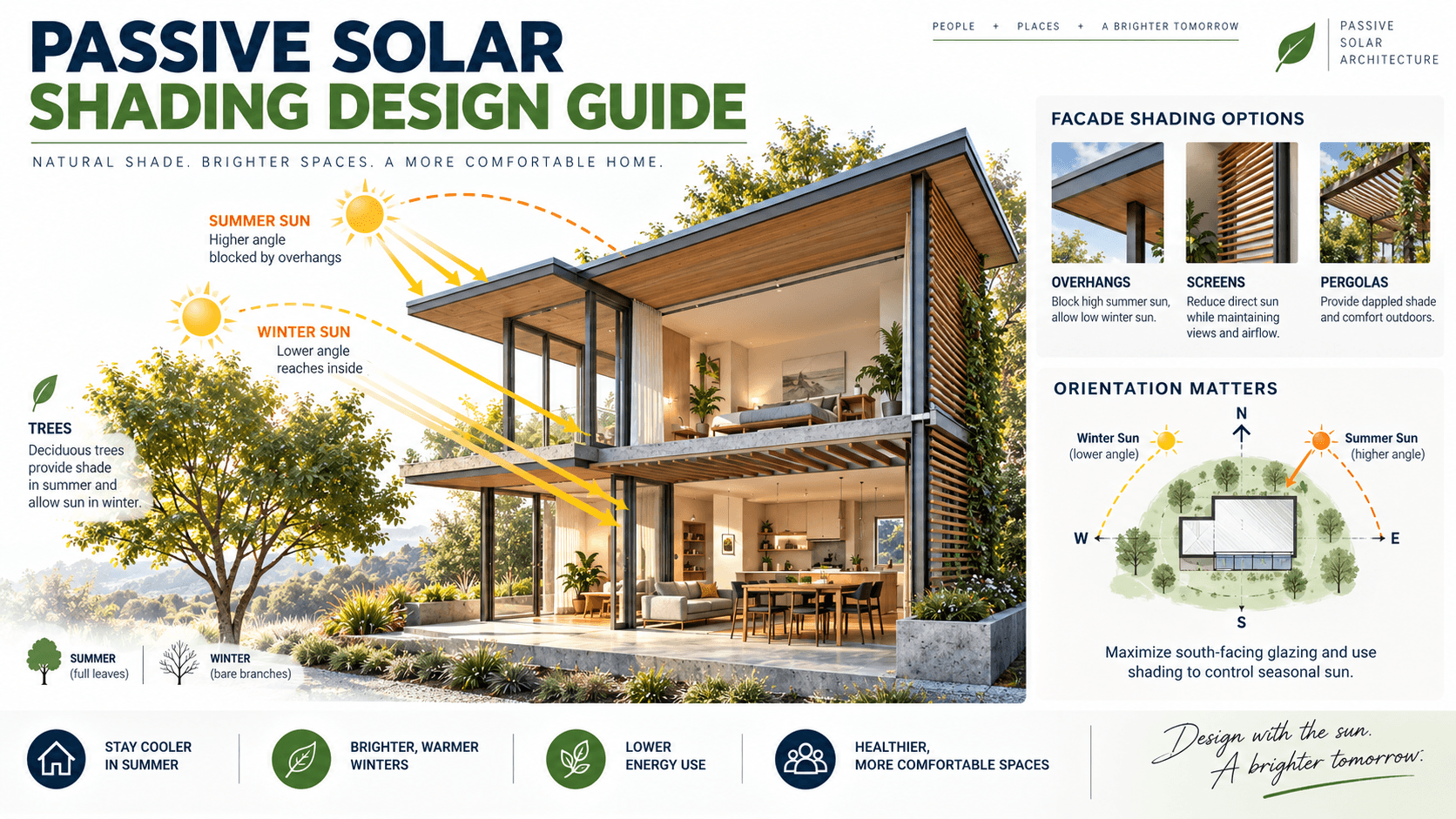
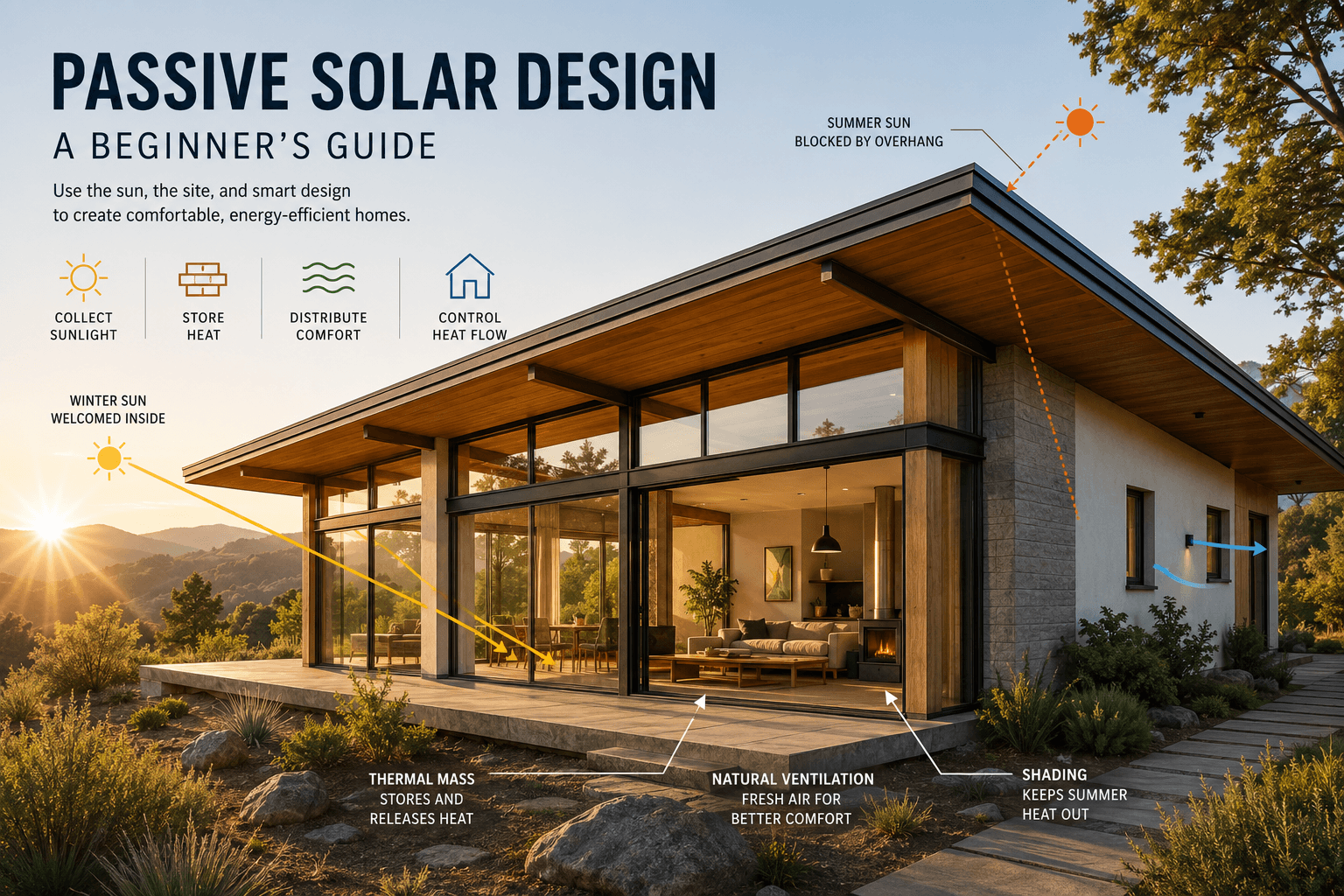
Passive solar design is one of the simplest ideas in sustainable architecture, but it is also one of the easiest to misunderstand.
At its core, passive solar design means using the sun, the site, the building shape, the windows, the materials, and the local climate to make a home more comfortable with less mechanical heating and cooling. It is not about adding solar panels. It is not about buying a single product. It is about designing the building itself to work more intelligently with natural energy.
For beginners, this can feel confusing because passive solar design includes many connected decisions: orientation, glazing, shading, thermal mass, insulation, ventilation, and climate. None of these elements works well in isolation. A house with large sunny windows but no shading may overheat. A house with thermal mass but poor solar access may not benefit from it. A house that faces the right direction but has poor insulation may still lose heat quickly.
This beginner’s guide explains what passive solar design means, when it works best, which design variables matter most, and which mistakes to avoid before you start planning a passive solar home. For a deeper technical foundation, you can also read our guide to passive solar design principles.
Key Takeaways
- Passive solar design uses the building itself to collect, store, distribute, and control heat from the sun.
- Orientation matters, but it is only one part of the design. Windows, shading, thermal mass, insulation, and ventilation must work together.
- More glass is not always better. Poorly placed or oversized glazing can cause glare, heat loss, and overheating.
- Climate changes the strategy. A cold-climate passive solar home needs different priorities than a hot-humid or hot-dry home.
- Passive solar design is not the same as solar panels and should not be confused with Passive House certification.
- The best decisions happen early, before the floor plan, roof overhangs, window sizes, and room layout are fixed.
What Is Passive Solar Design?
Passive solar design is a building design approach that uses the sun’s energy to improve indoor comfort and reduce reliance on mechanical heating and cooling.
In a passive solar home, the building is planned so that sunlight can enter where it is useful, be stored in appropriate materials, and be controlled when it is not wanted. This usually involves a combination of:
- building orientation,
- equator-facing windows,
- properly sized glazing,
- thermal mass,
- exterior shading,
- roof overhangs,
- insulation,
- airtightness,
- ventilation,
- climate-specific design choices.
The word “passive” is important. It means the design does not depend mainly on active mechanical equipment to collect or move solar energy. Instead, the architecture does much of the work.
A simple example is a living room with winter sun entering through well-placed windows. The sunlight warms a concrete or tile floor during the day. Later, as the room cools, that stored heat is slowly released back into the space. In summer, roof overhangs or exterior shading block the high-angle sun before it overheats the interior.
That is the basic idea. But good passive solar design is not just “put big windows on the sunny side.” It is a careful balance between heat gain, heat storage, heat loss, daylight, shading, ventilation, and comfort. If you are new to these ideas, the passive solar fundamentals guide is a helpful next step.
How Passive Solar Design Works
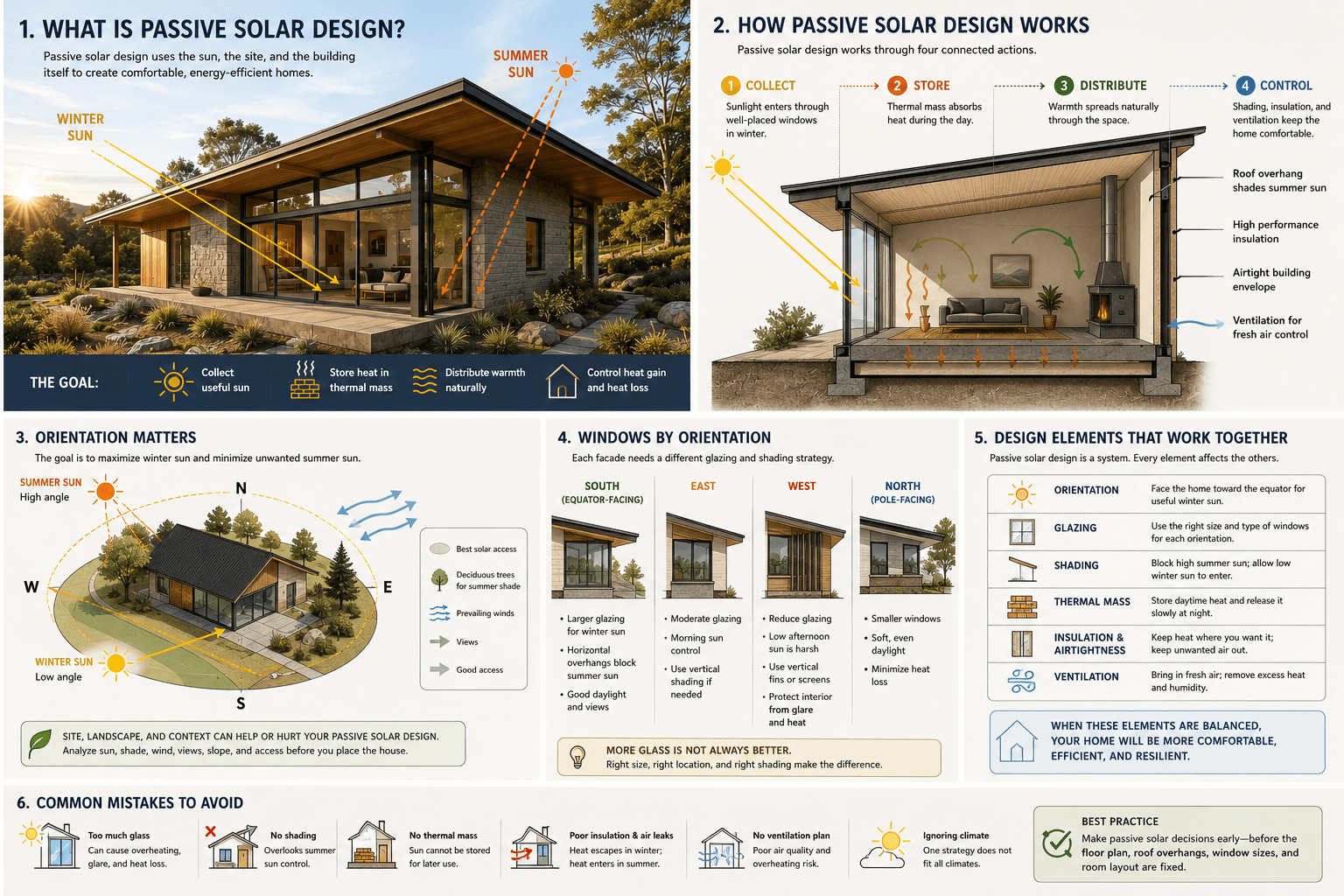
Passive solar design usually works through four connected actions:
- Collect solar heat through carefully placed glazing.
- Store heat in thermal mass such as concrete, brick, stone, tile, or other dense materials.
- Distribute heat naturally through radiation, convection, and air movement.
- Control heat gain and heat loss with shading, insulation, airtightness, and ventilation.
When these elements are balanced, the home can feel more stable and comfortable. When they are not balanced, the same design can create problems.
For example, a large area of sunny glass may feel pleasant on a cold morning. But without enough thermal mass, shading, or ventilation, that same glass can cause overheating in the afternoon. Without high-performance glazing and insulation, it may also lose too much heat at night.
Passive solar design is therefore less about one feature and more about the relationship between features.
The Basic Idea: Collect, Store, Distribute, and Control Heat
A beginner can think about passive solar design through four questions:
| Passive Solar Function | Beginner Question | Design Element |
|---|---|---|
| Collect | Where should useful winter sun enter? | Orientation and glazing |
| Store | What material will absorb and hold heat? | Thermal mass |
| Distribute | How will warmth move through the home? | Layout and airflow |
| Control | How will the home avoid overheating or heat loss? | Shading, insulation, ventilation |
This is why passive solar design should be considered early. Once a house is already designed, it is harder to fix poor orientation, oversized windows, missing shading, or badly placed thermal mass.
For a more complete framework, see passive solar design principles.
Passive Solar Design Is Not the Same as Solar Panels
Passive solar design is often confused with photovoltaic solar panels.
They are not the same thing.
Passive solar design uses the building’s form, orientation, windows, materials, and shading to manage heat and light naturally.
Solar panels, also called photovoltaic or PV panels, convert sunlight into electricity.
A house can have both, but one does not replace the other. A home with solar panels can still be poorly designed for comfort. A passive solar home can reduce heating and cooling demand even if it has no solar panels.
The best results often come when the building is designed efficiently first, and renewable energy systems are considered after the basic energy demand has been reduced. The U.S. Department of Energy also explains passive solar homes as buildings that use south-facing windows, thermal mass, and design features to reduce heating and cooling needs: U.S. Department of Energy: Passive Solar Homes.
Passive Solar Design Is Not the Same as Passive House
Passive solar design is also different from Passive House.
Passive solar design is a design strategy focused on using solar gain, orientation, thermal mass, shading, and climate response.
Passive House is a high-performance building standard focused on very low energy demand, airtightness, continuous insulation, high-performance windows, thermal bridge reduction, and mechanical ventilation with heat or energy recovery.
The two can overlap, but they are not identical. A Passive House may use passive solar principles, but it also follows strict performance criteria. A passive solar home may be climate-responsive and efficient without being certified as a Passive House.
For beginners, the main point is simple: passive solar design is a design approach, not a certification.
When Passive Solar Design Works Best
Passive solar design can be useful in many climates, but it works best when the site, climate, layout, and building envelope support the strategy.
It is most effective when the designer can make decisions early, before the house shape and window layout are fixed.
Good Solar Access
Passive solar design needs access to useful sunlight.
This does not mean every site must be perfectly open. But the building should ideally receive winter sun on the main solar-facing side. Trees, neighboring buildings, hills, fences, and future development can all reduce solar access.
For a global audience, the most accurate term is equator-facing glazing. In the Northern Hemisphere, this usually means south-facing windows. In the Southern Hemisphere, it usually means north-facing windows.
Good solar access is especially important in cold and temperate climates, where winter solar gain can help reduce heating demand. To understand this in more detail, read the guide to passive solar orientation.
A Climate-Responsive Design Strategy
Passive solar design must respond to the local climate.
A cold-climate home may prioritize winter sun, insulation, airtightness, and thermal mass. A hot-humid home may prioritize shading, ventilation, moisture control, and reducing unwanted solar gain. A hot-dry home may benefit from shading, thermal mass, and night cooling, but only if the design is carefully managed.
This is why copying a passive solar design from another region can be risky. The same window size, roof overhang, or wall material may perform very differently in another climate.
If you are comparing strategies for different regions, start with passive solar design by climate.
Early Design Decisions
Passive solar design works best when it is considered before the design is finalized.
Early decisions include:
- where the house sits on the site,
- which direction the main living spaces face,
- how much glazing is placed on each facade,
- where thermal mass is located,
- how roof overhangs are sized,
- how summer sun is blocked,
- how natural ventilation is supported,
- how the building envelope reduces heat loss and heat gain.
If these decisions are left until the end, passive solar design becomes much harder to achieve. Before finalizing a layout, use a passive solar design checklist to review the main design variables.
A Well-Insulated Building Envelope
Passive solar design depends on more than sunlight. The building must also hold comfort.
If a home collects solar heat during the day but loses it quickly through poor insulation, air leaks, weak windows, or thermal bridges, the benefit is reduced. A well-insulated and reasonably airtight envelope helps the building retain useful heat in winter and resist unwanted heat in summer.
This does not mean a home should be sealed without ventilation. Airtight buildings need planned ventilation to protect indoor air quality and manage moisture.
For beginners, the main principle is this: passive solar design works better when the building envelope is strong. Sunlight can help, but it cannot compensate for a poorly insulated or leaky building.
Core Design Variables in Passive Solar Design
Passive solar building design depends on several variables working together. Beginners should understand these before focusing on details such as finishes, window brands, or exact overhang dimensions.
Orientation
Orientation is one of the most important passive solar design decisions.
The goal is usually to place the building so that the main living spaces and key glazing can face the sun when it is useful. In many passive solar homes, this means orienting the long side of the house toward the equator.
Good orientation can help with:
- winter solar gain,
- daylight,
- room comfort,
- roof overhang effectiveness,
- solar access for living spaces,
- reduced dependence on mechanical heating.
But orientation alone is not enough. A well-oriented house with too much glass, poor shading, or weak insulation can still perform badly.
For a deeper explanation of sun-facing design, see passive solar orientation.
Window Placement and Glazing
Windows are one of the most powerful parts of passive solar design.
They can bring in light, views, and useful heat. They can also cause heat loss, overheating, glare, and discomfort.
Important glazing decisions include:
- which direction windows face,
- how large the windows are,
- how much glass is used on each wall,
- the solar heat gain coefficient, or SHGC,
- the U-value,
- frame performance,
- shading,
- daylight needs,
- privacy and view requirements.
Equator-facing windows can collect useful winter sun in many climates. East- and west-facing windows can be harder to control because low-angle morning and afternoon sun can create glare and overheating. North-facing windows in the Northern Hemisphere, or south-facing windows in the Southern Hemisphere, usually provide softer daylight but less direct solar heat.
The right window strategy depends on the climate and the room use. For more detail on glazing choices, read the guide to passive solar windows.
Thermal Mass
Thermal mass is material that can absorb, store, and slowly release heat.
Common thermal mass materials include:
- concrete,
- brick,
- stone,
- tile,
- rammed earth,
- adobe,
- dense plaster,
- masonry walls.
In passive solar design, thermal mass is often used to moderate temperature swings. When sunlight reaches the mass, it absorbs heat. Later, when the air temperature drops, the mass releases heat back into the room.
Thermal mass is most useful when it is:
- located where winter sun can reach it,
- not covered by thick carpet or insulating finishes,
- balanced with the amount of glazing,
- protected from unwanted summer sun,
- used in a climate where daily temperature swings support the strategy.
Thermal mass is not magic. Too much mass in the wrong place can feel cold, slow to respond, or ineffective. Mass without solar access does not work like solar heat storage.
For a deeper explanation, see the guide to thermal mass and the overview of passive solar materials.
Shading and Roof Overhangs
Shading is essential because passive solar design is not only about collecting heat. It is also about blocking heat when it is not wanted.
Good shading can help:
- reduce summer overheating,
- control glare,
- protect windows,
- improve indoor comfort,
- make larger windows more manageable,
- reduce cooling loads.
Common shading strategies include:
- roof overhangs,
- exterior blinds,
- louvers,
- pergolas,
- shutters,
- trees,
- deep window reveals,
- covered porches.
Roof overhangs are especially useful for equator-facing windows because they can be designed to admit lower winter sun and block higher summer sun. However, overhang performance depends on latitude, window height, wall orientation, roof geometry, and seasonal sun angles.
East and west windows often need vertical shading, exterior blinds, trees, or other strategies because low-angle sun is difficult to block with horizontal overhangs alone.
For a more detailed guide, read about roof overhangs in passive solar design or use the roof overhang calculator when checking early design assumptions.
Insulation and Airtightness
Insulation and airtightness help the home keep the comfort it gains.
In cold weather, insulation slows heat loss. In hot weather, it slows unwanted heat gain. Airtightness reduces uncontrolled air leakage, drafts, and energy waste.
However, airtightness must be paired with ventilation. A tight home without planned fresh air can have indoor air quality and moisture problems.
For beginners, the main principle is this: passive solar design works better when the building envelope is strong. Sunlight can help, but it cannot compensate for a poorly insulated or leaky building.
Ventilation and Passive Cooling
Passive solar design should always consider cooling, not only heating.
Natural ventilation can help remove heat, improve comfort, and support passive cooling when outdoor conditions allow. Common ventilation strategies include:
- cross ventilation,
- stack ventilation,
- night flushing,
- operable windows,
- high and low openings,
- shaded outdoor air paths,
- ventilated courtyards or transitional spaces.
Ventilation strategies must be climate-specific. Night cooling may work well in some hot-dry climates with cooler nights. It may be less effective in hot-humid climates where night air remains warm and moist.
This is why passive solar design should be integrated with passive cooling strategies from the beginning.
Climate Considerations for Passive Solar Design
Passive solar design changes by climate. A strategy that improves comfort in one region can create problems in another.
| Climate Type | What Usually Matters | Main Risk | Design Priority |
|---|---|---|---|
| Cold climate | Winter solar gain, insulation, airtightness, thermal mass | Heat loss, underheating, cold glass surfaces | Capture useful winter sun and retain heat |
| Temperate climate | Seasonal balance, daylight, moderate shading | Mild overheating or missed winter gain | Balance glazing, shading, and ventilation |
| Hot-dry climate | Shading, thermal mass, night cooling | Daytime overheating | Block high sun and release heat when nights are cool |
| Hot-humid climate | Shading, ventilation, moisture control | Heat, humidity, and glare | Reduce solar gain and support airflow |
| Mixed climate | Adaptability across seasons | Conflicting winter and summer needs | Use flexible shading and balanced glazing |
A beginner mistake is assuming passive solar design always means maximizing winter heat. In some climates, the main goal is avoiding unwanted heat. In others, the design must balance heating and cooling needs carefully.
The safest starting point is to study the local climate before choosing window sizes, overhang depths, mass materials, or ventilation strategies. The passive solar design by climate guide can help you understand why the right approach changes from one region to another.
Passive Solar Design Strategy Table
The table below summarizes the main design variables and what beginners should check.
| Design Variable | Why It Matters | Beginner Check |
|---|---|---|
| Orientation | Determines how the building receives sun | Are main living spaces positioned for useful solar access? |
| Glazing | Controls light, heat gain, and heat loss | Is glass placed by climate and orientation, not just views? |
| Thermal mass | Stores and releases heat | Can winter sun reach the mass directly or indirectly? |
| Shading | Prevents overheating and glare | Are summer sun angles and east/west sun controlled? |
| Insulation | Reduces heat loss and heat gain | Is the envelope strong enough to support passive strategies? |
| Airtightness | Reduces drafts and uncontrolled heat movement | Is ventilation planned, not accidental? |
| Ventilation | Supports cooling and indoor air quality | Can the home flush heat when outdoor conditions allow? |
| Climate data | Prevents inappropriate design choices | Has the design been checked against local conditions? |
This table can be used as a first-pass review before speaking with an architect or designer. For a more structured review, use the passive solar design checklist.
Illustrative Example: A Small Passive Solar Home
Imagine a small single-story home in a cool temperate climate.
The owners want lower heating demand, good daylight, and a comfortable living area in winter. The site has open solar access to the equator-facing side, but there are trees on the west side.
A basic passive solar strategy might include:
- placing the living room and kitchen on the equator-facing side,
- using carefully sized equator-facing windows,
- limiting large west-facing glazing,
- adding a polished concrete floor in the main living area,
- designing roof overhangs to block high summer sun,
- using high-performance windows,
- insulating and air-sealing the envelope,
- adding operable windows for shoulder-season ventilation.
The likely benefit is a home that receives useful winter sun and has more stable indoor temperatures. But the design still needs checks. The glazing area must be balanced with the amount of thermal mass. The overhangs must be sized for the latitude and window height. The home still needs backup heating, code-compliant ventilation, and summer overheating protection.
The lesson is simple: passive solar design is not one decision. It is a coordinated design strategy.
For more examples of how these principles work in practice, see the passive solar case studies section.
Common Passive Solar Design Mistakes
1. Assuming More Glass Is Always Better
Large windows can collect heat, but they can also lose heat, create glare, and cause overheating. Window area should be designed by orientation, climate, glass performance, shading, and room use.
If you are unsure how much glass is appropriate, the window-to-wall ratio calculator can help with early-stage thinking.
2. Ignoring Summer Overheating
A home that feels excellent in winter can become uncomfortable in summer if shading is not planned. Passive solar design must include cooling control from the start.
3. Using Thermal Mass Without Solar Access
Thermal mass works best when it can absorb useful heat. A concrete floor hidden under thick carpet or placed away from solar gain may not perform as expected.
To understand whether thermal mass is being used effectively, read more about thermal mass in passive solar design.
4. Copying a Design From Another Climate
A passive solar strategy from a cold climate may be inappropriate in a hot-humid climate. Climate should shape every major design decision.
5. Confusing Passive Solar Design With Solar Panels
Solar panels generate electricity. Passive solar design manages heat and light through the building. They can work together, but they are different strategies.
6. Forgetting East and West Sun
East and west windows are often harder to shade because the sun is lower in the sky. These orientations need special attention, especially in warm climates.
7. Treating Rules of Thumb as Final Design
Rules of thumb can help early thinking, but they are not final specifications. A real project should be checked against local climate data, building codes, and professional design analysis.
8. Ignoring Ventilation
A passive solar home needs a plan for fresh air and heat removal. Airtightness without ventilation can create comfort and indoor air quality problems.
9. Designing for Heating Only
Passive solar design should consider the full year. Comfort depends on winter heat, summer cooling, daylight, glare, humidity, and air movement.
10. Adding Passive Solar Features Too Late
Orientation, window placement, roof form, and room layout are hard to fix after the design is complete. Passive solar thinking should begin at site planning.
For a full review of design risks, see the guide to passive solar design mistakes.
Beginner Passive Solar Design Checklist
Use this checklist before reviewing a house plan or speaking with a designer.
- Is the local climate understood before choosing design strategies?
- Does the site have useful solar access?
- Are main living spaces placed where winter sun can help comfort?
- Is the main solar-facing glazing oriented toward the equator?
- Are east and west windows controlled to reduce glare and overheating?
- Is glazing sized carefully, rather than maximized?
- Is thermal mass located where it can absorb useful heat?
- Are roof overhangs or external shading designed for seasonal sun angles?
- Is summer overheating considered from the beginning?
- Is the building envelope well insulated?
- Is airtightness supported by planned ventilation?
- Are passive cooling strategies included where needed?
- Have local codes and climate data been considered?
- Has a qualified professional reviewed project-specific assumptions?
This checklist is not a final design method, but it can help beginners ask better questions early. You can continue with the full passive solar design checklist before discussing your project with an architect, designer, or builder.
Questions to Ask Before Designing a Passive Solar Home
Before committing to a design, ask your architect, designer, builder, or energy consultant:
- What is the best orientation for this site and climate?
- Which rooms should receive the most winter sun?
- How much glazing is appropriate for each orientation?
- What SHGC and U-value should the windows have?
- Where should thermal mass be located?
- How will the design prevent summer overheating?
- Are the roof overhangs sized for this latitude and window height?
- How will the home be ventilated in different seasons?
- Does this strategy work for the local climate, or are we copying a generic design?
- Which assumptions should be checked through energy modeling or professional analysis?
These questions can help move the conversation from style to performance. If you are preparing for an early design meeting, the self-builder guide can help you organize your priorities.
FAQ
What is passive solar design in simple terms?
Passive solar design is a way of designing a building so it uses sunlight, orientation, windows, shading, and materials to improve comfort and reduce heating or cooling demand.
Does passive solar design mean solar panels?
No. Passive solar design uses the building itself to manage heat and light. Solar panels generate electricity. A home can use both strategies, but they are different.
Is passive solar design only useful in cold climates?
No. In cold climates, passive solar design often focuses on useful winter heat. In hot climates, it may focus more on shading, ventilation, and avoiding unwanted solar gain.
For climate-specific guidance, read passive solar design by climate.
Do passive solar homes need heating and cooling systems?
Usually, yes. Passive solar design can reduce demand, but it does not guarantee that mechanical heating or cooling can be eliminated. The result depends on climate, design quality, construction, and comfort expectations.
What is the most important part of passive solar design?
There is no single most important part. Orientation, glazing, shading, thermal mass, insulation, airtightness, and ventilation must work together.
Can passive solar design be added to an existing home?
Some principles can be improved in an existing home, such as shading, insulation, window upgrades, ventilation, or room use. However, orientation and basic building form are much easier to optimize in new construction.
Is passive solar design expensive?
It does not always require expensive technology, but it does require careful planning. Some choices, such as orientation and room layout, are low-cost early decisions. Others, such as high-performance windows or added thermal mass, may affect the budget.
Conclusion
Passive solar design is a practical way to make homes more comfortable, climate-responsive, and energy-conscious by using the building itself more intelligently.
For beginners, the most important lesson is that passive solar design is not one feature. It is not just big windows, thermal mass, or roof overhangs. It is the careful coordination of orientation, glazing, shading, thermal mass, insulation, airtightness, ventilation, and local climate.
If you are planning a new home, reviewing house plans, or trying to understand passive solar building design, start early. Study the site, understand the climate, and use passive solar principles before the layout and window design are locked in.
Next step: Download the Passive Solar Design Checklist and use it to review your early design ideas before speaking with your architect, designer, or builder.
For a deeper technical foundation, continue with the guide to passive solar design principles.
Next step: check your own project
Try the ideas on your own project with the free passive solar design tools. It is free and runs in your browser.
Keep your results in one place
The free Passive Solar Design Checklist & Project Brief is a printable PDF with pages for your site’s sun angles, orientation, glazing per facade, shading and thermal mass, plus 12 questions to take to your architect or designer.