
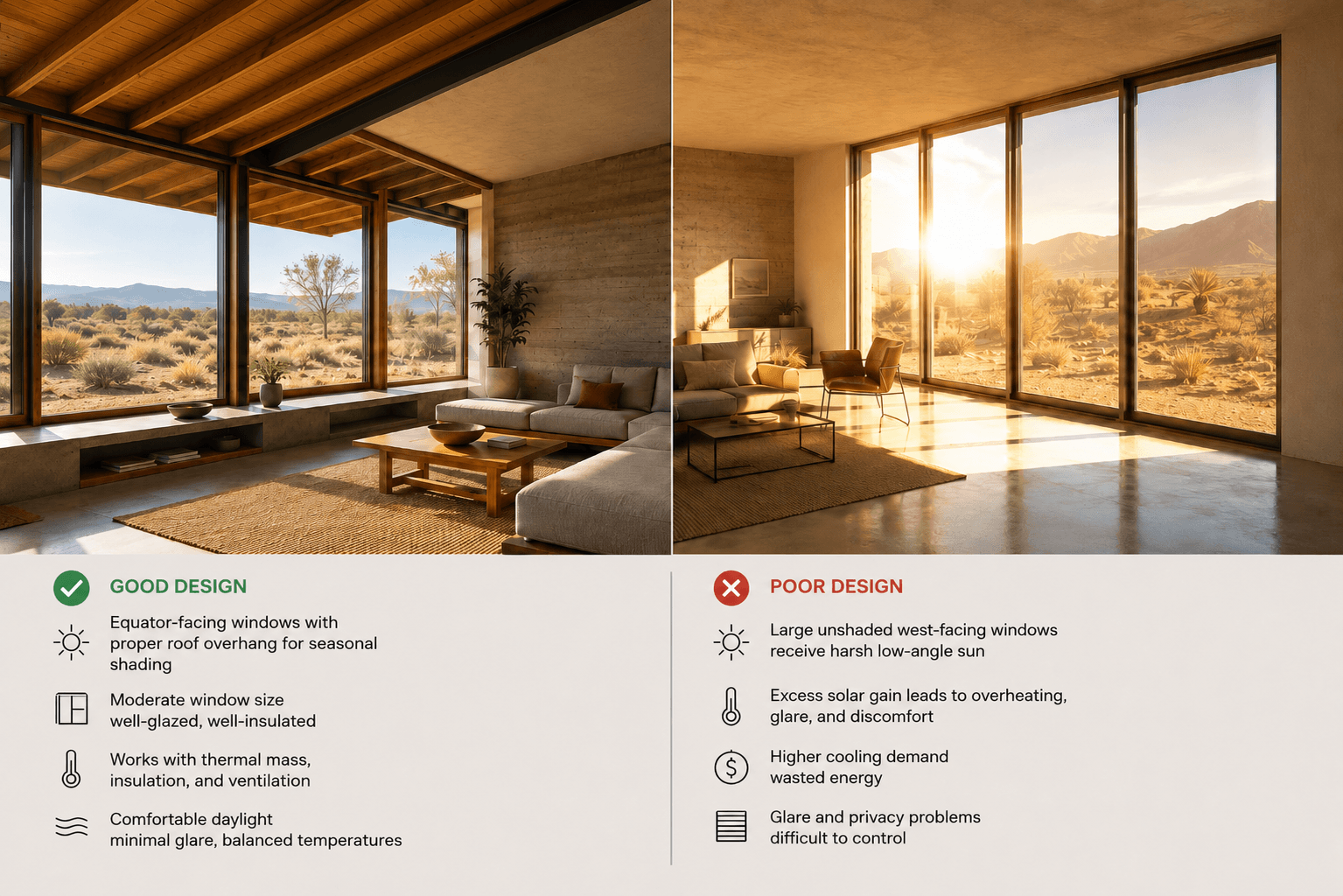
Passive solar window design is not the same in every climate. A window that helps warm a home in a cold region can make a house uncomfortable in a hot-humid climate. A large sun-facing window may be useful in winter, but without the right shading, glazing specification, thermal mass, and ventilation, it can also create glare, overheating, and heat loss.
This is why passive solar window design should always start with climate.
Windows are one of the most important parts of a passive solar home because they control much of the relationship between the indoor space and the sun. They bring in daylight, views, ventilation, and solar heat. They also create some of the biggest risks: unwanted heat gain, nighttime heat loss, summer overheating, glare, privacy problems, and poor comfort near the glass.
Good window design is not simply about choosing “better windows” or adding more glass to the sunny side of the house. It is about deciding where windows belong, how large they should be, what type of glazing they need, how they should be shaded, and how they work with the local climate.
This guide explains how passive solar window design changes by climate, what architects and homeowners should check early, and how to avoid the most common glazing mistakes. For the main technical guide, start with passive solar windows and use this article as a climate-focused companion.
Try it on your own design: Window-to-Wall Ratio Calculator (free, about a minute).
Key Takeaways
- Passive solar window design must respond to climate, not just orientation or views.
- Cold climates usually need windows that balance solar gain with heat retention.
- Hot-humid climates usually need strong shading, reduced unwanted solar gain, and ventilation-aware placement.
- Hot-dry climates may benefit from controlled glazing, shading, thermal mass, and night cooling where conditions allow.
- Window-to-wall ratio matters, but it should be checked by orientation, room use, climate, and glazing performance.
- The best passive solar windows work with shading, thermal mass, insulation, airtightness, and ventilation.
Why Climate Comes First in Passive Solar Window Design
Windows behave differently depending on the climate.
In a cold climate, a window may be valuable because it allows useful winter sun into a living space. But the same window can lose heat at night or during cloudy weather. In a hot climate, that same solar gain may be a liability because it increases cooling demand and discomfort.
Climate affects window decisions such as:
- how much glass to use,
- which direction windows should face,
- how much solar heat gain is helpful,
- how much shading is needed,
- whether thermal mass should be exposed to sunlight,
- how ventilation should work,
- whether glare or overheating is the main risk,
- how important insulation and airtightness are around the window.
This is why passive solar window design should not begin with a product catalog. It should begin with the local climate, the sun path, the room layout, and the comfort goal.
If you are still learning the broader design framework, read passive solar design principles before choosing window sizes or glazing types.
What Passive Solar Windows Need to Do
A passive solar window has several jobs. It is not only an opening in the wall.
Depending on climate and orientation, windows may need to:
- admit useful winter sun,
- reduce unwanted summer heat,
- provide daylight without excessive glare,
- support natural ventilation,
- preserve views,
- protect privacy,
- reduce heat loss,
- avoid cold interior glass surfaces,
- work with thermal mass,
- allow exterior shading to perform well.
The challenge is that these goals can conflict.
A large window may improve daylight but increase heat loss. A high solar gain window may help winter heating but increase overheating risk. A low solar gain window may reduce summer heat but also reduce useful winter solar gain. A well-insulated window may improve comfort but still perform poorly if it is oversized or poorly shaded.
That is why passive solar window design is a balancing exercise, not a single specification.
For detailed guidance on placement, see passive solar window placement.
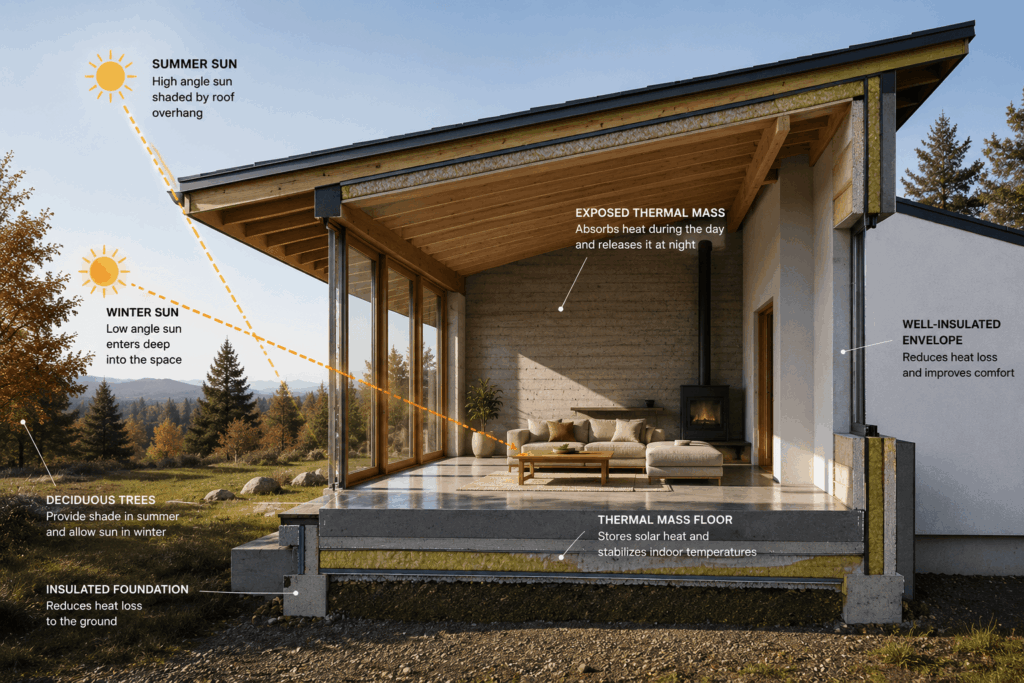
The Three Window Decisions That Matter Most
Before choosing a window brand or frame material, focus on three early design decisions.
1. Where the Window Faces
Orientation determines when a window receives sun and how difficult that sun is to control.
For global accuracy, “equator-facing” is often more precise than “south-facing.” In the Northern Hemisphere, equator-facing usually means south-facing. In the Southern Hemisphere, it usually means north-facing.
Equator-facing windows are often the easiest to use in passive solar design because seasonal sun angles can be more predictable. East-facing windows receive morning sun. West-facing windows receive low-angle afternoon sun, which is often difficult to shade. Pole-facing windows usually receive less direct solar gain but may provide softer daylight.
For a deeper orientation guide, read passive solar orientation.
2. How Much Glass Is Used
Window area has a major effect on comfort and energy performance.
Too little glass may reduce daylight and useful winter gain. Too much glass can cause overheating, glare, heat loss, privacy problems, and higher costs.
Window area should be reviewed by facade, not only as a whole-house percentage. A home with moderate total glazing can still have problems if too much glass is placed on the west side. A home with larger equator-facing glazing may work well in one climate and poorly in another.
Use the window-to-wall ratio calculator for early design checks before finalizing window sizes.
3. What Type of Glazing Is Used
Glazing performance affects how much heat enters, how much heat escapes, and how comfortable the window feels.
Important terms include:
- U-value or U-factor: how easily heat passes through the window.
- Solar Heat Gain Coefficient, or SHGC: how much solar heat passes through the glazing.
- Visible Transmittance, or VT: how much visible light passes through.
- Frame performance: how the window frame affects insulation and airtightness.
- Air leakage: how well the installed window limits drafts.
There is no single best glazing specification for every climate. A heating-focused room may benefit from different glass than a cooling-dominated room. A west-facing window may need a different strategy than an equator-facing window.
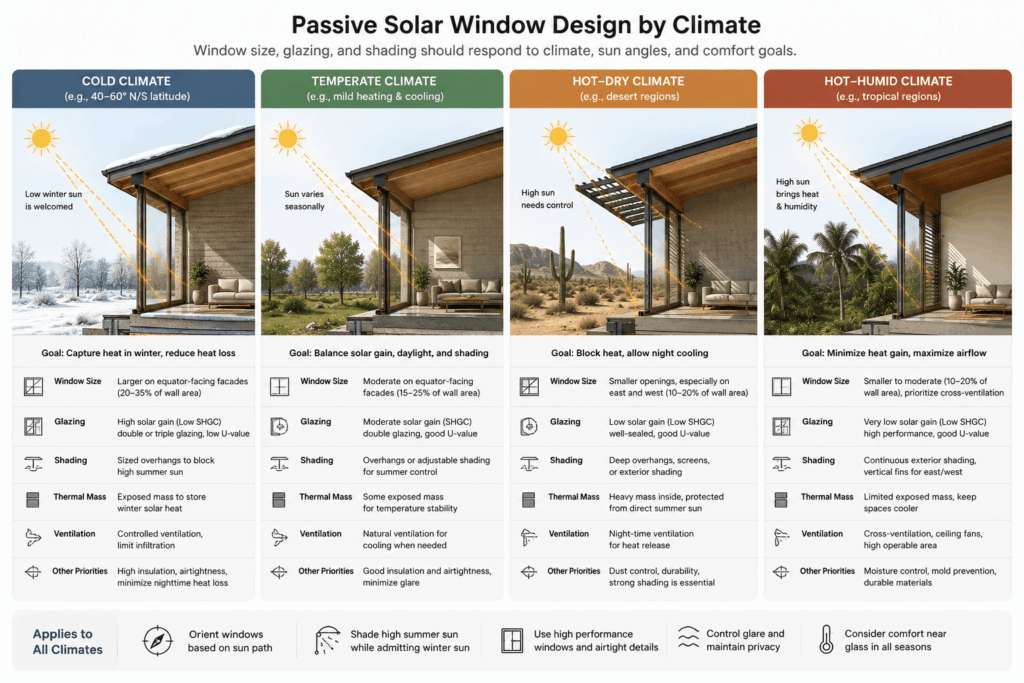
Passive Solar Window Design by Climate
The table below gives a practical climate-based overview. It is not a final specification, but it can help architects, self-builders, and homeowners understand the main design priorities.
| Climate Type | Window Design Priority | Useful Strategies | Main Risk |
|---|---|---|---|
| Cold climate | Capture useful winter sun while reducing heat loss | Equator-facing glazing, low heat-loss windows, thermal mass, airtight installation | Too much glass losing heat at night |
| Temperate climate | Balance winter gain, daylight, and summer shading | Moderate glazing, seasonal overhangs, operable windows, balanced SHGC | Mild overheating in shoulder seasons |
| Hot-dry climate | Block daytime heat and support cooling at night | Shading, limited east/west glass, thermal mass with night ventilation where suitable | Mass and glass storing unwanted heat |
| Hot-humid climate | Reduce solar heat gain and support airflow | Deep shade, lower solar gain glass, controlled openings, reduced west glazing | Heat, glare, humidity, and poor ventilation |
| Mixed climate | Adapt to heating and cooling seasons | Adjustable shading, balanced window area, climate-specific glazing choices | Winter-focused glazing causing summer discomfort |
For a full climate strategy overview, read passive solar design by climate.
Window Design in Cold Climates
In cold climates, passive solar window design often focuses on useful winter heat, daylight, and heat retention.
The goal is not to cover the house with glass. The goal is to place the right amount of glazing where it can provide useful solar gain without creating excessive heat loss.
Cold-climate window priorities often include:
- useful equator-facing glazing,
- high-performance windows with low heat loss,
- careful air sealing around frames,
- controlled window-to-wall ratio,
- thermal mass where winter sun can reach it,
- minimized unnecessary east, west, and pole-facing glass,
- exterior shading for summer and shoulder seasons.
In cold climates, windows can be both helpful and risky. They may collect winter sun during the day, but they can also lose heat at night or during cloudy weather. This is why insulation, airtightness, and window performance are essential.
Thermal mass can help if it is placed where winter sun reaches it. For example, a tile or concrete floor near equator-facing windows may absorb useful solar heat during the day and release some of it later. But mass without solar access does little for passive solar heating.
For more detail on heat storage, read thermal mass.
Cold-Climate Window Checklist
- Is the equator-facing side available for winter solar gain?
- Are windows sized carefully instead of maximized?
- Are U-value and airtight installation prioritized?
- Is thermal mass located where sunlight can reach it?
- Is nighttime heat loss considered?
- Are windows shaded for warmer seasons?
- Is backup heating still included?
Window Design in Temperate Climates
Temperate climates often require balance.
The home may need winter sun, but it may also overheat during mild spring and autumn days. Window design should support comfort across the year, not only in winter.
Temperate-climate window priorities often include:
- moderate equator-facing glazing,
- seasonal roof overhangs,
- controlled east and west glazing,
- operable windows for ventilation,
- balanced SHGC,
- glare control,
- thermal mass used carefully,
- daylight without excessive heat gain.
The main risk in temperate climates is overconfidence. A design that feels reasonable on paper may still overheat on sunny mild days if shading and ventilation are not planned.
Equator-facing windows may work well when combined with correctly sized overhangs. East windows can provide pleasant morning light. West windows require more caution because afternoon sun can create glare and heat late in the day.
Use the solar angle calculator and roof overhang calculator when testing early shading assumptions.
Temperate-Climate Window Checklist
- Is winter solar gain useful but controlled?
- Are overhangs designed for seasonal sun angles?
- Are west-facing windows limited or shaded?
- Is natural ventilation possible during mild weather?
- Is glare controlled in living and working spaces?
- Is the design checked for spring and autumn overheating?
Window Design in Hot-Dry Climates
Hot-dry climates require careful control of solar heat.
In many hot-dry regions, daytime heat is the main problem, but nights may be cooler. This can make passive cooling and thermal mass useful, but only if the design allows stored heat to be released when outdoor conditions improve.
Window priorities in hot-dry climates often include:
- strong exterior shading,
- reduced east and west glazing,
- controlled equator-facing glazing,
- lower unwanted solar gain,
- night ventilation where nights are cool,
- thermal mass protected from daytime overheating,
- shaded outdoor spaces,
- small or protected openings on harsh exposures.
The main risk is allowing glass and thermal mass to work against the home. If unshaded windows admit too much heat during the day, and heavy materials store that heat, the house can remain uncomfortable into the evening.
In a hot-dry climate, window design should often support shade first, then ventilation, then carefully controlled daylight.
For cooling-focused strategies, read passive cooling and passive solar shading and overhangs.
Hot-Dry Climate Window Checklist
- Are east and west windows minimized or strongly shaded?
- Are outdoor spaces shaded before air reaches windows?
- Can windows support night ventilation where nights are cool?
- Is thermal mass protected from unwanted daytime sun?
- Is glare controlled?
- Are roof overhangs, shutters, screens, or exterior blinds included?
Window Design in Hot-Humid Climates
In hot-humid climates, passive solar window design usually focuses less on collecting heat and more on reducing heat gain while supporting comfort, shade, and airflow.
The goal is often to keep direct sun off the glass, reduce internal heat buildup, and allow ventilation where outdoor conditions make it useful.
Hot-humid window priorities often include:
- deep exterior shading,
- reduced solar heat gain,
- careful west-facing window control,
- shaded operable windows,
- cross ventilation where practical,
- moisture-aware detailing,
- glare reduction,
- durable materials,
- insect and security considerations.
Thermal mass must be used carefully in hot-humid climates. Heavy materials can store heat and release it later when the home is already warm. In some cases, lightweight construction with shading and ventilation may be more appropriate than large exposed mass.
Windows in hot-humid climates should also consider moisture and indoor air quality. Natural ventilation can be useful, but it may not always be enough when outdoor air is hot, humid, polluted, or still. Mechanical cooling or dehumidification may still be needed.
The design should be climate-responsive, not idealized.
Hot-Humid Climate Window Checklist
- Are windows shaded before direct sun reaches the glass?
- Is west-facing glass limited or strongly protected?
- Are operable windows placed to support airflow?
- Is humidity considered, not only temperature?
- Are materials and frames suitable for moisture exposure?
- Is mechanical cooling or dehumidification still planned where needed?
Window Design in Mixed Climates
Mixed climates are often the hardest for passive solar window design because the home may need both winter heating support and summer overheating control.
A mixed-climate window strategy should avoid extremes.
It should not copy a cold-climate design with too much solar gain. It should also not eliminate all useful winter sun if heating is still important.
Mixed-climate priorities often include:
- balanced equator-facing glazing,
- limited east and west glazing,
- adjustable or seasonal shading,
- windows that balance heat gain and heat loss,
- operable windows for shoulder seasons,
- overheating analysis,
- thermal mass used only where it improves comfort,
- strong insulation and airtightness.
Adjustable shading can be especially valuable in mixed climates. Fixed overhangs may help with seasonal control, but exterior blinds, shutters, screens, pergolas, or landscape shading can provide more flexibility.
The main risk is designing for one season and regretting it in another.
Mixed-Climate Window Checklist
- Does the design support both heating and cooling seasons?
- Are window areas balanced by orientation?
- Is adjustable shading considered?
- Are east and west windows controlled?
- Is overheating checked for shoulder seasons?
- Is useful winter sun preserved where appropriate?
Window Orientation Rules by Climate
The direction a window faces often matters as much as its size.
| Window Orientation | Cold Climate | Temperate Climate | Hot-Dry Climate | Hot-Humid Climate | Mixed Climate |
|---|---|---|---|---|---|
| Equator-facing | Often useful for winter gain if well insulated | Useful with seasonal shading | Use carefully with strong shade | Usually reduce heat gain and shade deeply | Balance winter gain with summer control |
| East-facing | Moderate morning sun may be acceptable | Good for morning light, watch glare | Limit or shade | Shade carefully, support ventilation | Use carefully by room type |
| West-facing | Usually limit due to glare and heat loss/gain issues | Control strongly | Minimize or heavily shade | Minimize or heavily shade | High overheating risk |
| Pole-facing | Useful for softer daylight, but watch heat loss | Good for daylight with low solar gain | May support diffuse light | Can provide light with less direct heat | Useful but avoid oversizing |
This table should be treated as an early design guide, not a final rule. Local climate data, latitude, room use, shading, glass performance, and building codes all matter.
How to Think About SHGC and U-Value by Climate
Two of the most important glazing terms are SHGC and U-value.
SHGC: Solar Heat Gain Coefficient
SHGC describes how much solar heat passes through the glass.
A higher SHGC allows more solar heat into the building. A lower SHGC blocks more solar heat.
In general:
- heating-focused climates may benefit from more solar gain on selected equator-facing windows,
- cooling-focused climates usually need lower unwanted solar gain,
- mixed climates need a careful balance,
- east and west windows often need stronger solar control.
This does not mean one SHGC value is right for the whole house. Different facades may need different glazing strategies.
U-Value or U-Factor
U-value describes how easily heat moves through the window.
A lower U-value generally means better insulation. This is especially important in cold climates, but it also matters in hot climates where outdoor heat should be kept out.
Window performance should be reviewed together with frame quality, installation, air sealing, and shading. A high-performance glass unit can still underperform if it is poorly installed or used in the wrong place.
Window-to-Wall Ratio: Why It Matters
Window-to-wall ratio, often shortened to WWR, compares window area with wall area.
In passive solar design, WWR helps architects and homeowners avoid one of the most common mistakes: using too much glass without understanding the consequences.
A higher window-to-wall ratio can increase daylight and views, but it can also increase:
- heat loss,
- unwanted heat gain,
- glare,
- cooling demand,
- privacy issues,
- construction cost,
- comfort problems near glass.
The right WWR depends on:
- climate,
- orientation,
- room use,
- glazing performance,
- shading,
- thermal mass,
- insulation,
- ventilation,
- daylight needs.
Do not judge window area only from a rendering. Use a quantitative check early with the window-to-wall ratio calculator, then review the result with an architect or energy consultant.
Practical Workflow for Passive Solar Window Design
Use this workflow before finalizing window sizes and glazing specifications.
Step 1: Identify the Climate Goal
Decide whether the main goal is heating support, cooling control, daylight, ventilation, or seasonal balance.
This prevents the design from using a cold-climate window strategy in a cooling-dominated region.
Step 2: Map Window Orientation
Separate windows by facade: equator-facing, east-facing, west-facing, and pole-facing.
Do not evaluate all windows as one group. A west-facing window and an equator-facing window create very different comfort risks.
Step 3: Check Window-to-Wall Ratio
Use the window-to-wall ratio calculator to review the amount of glazing by wall.
This is especially important before construction drawings are finalized.
Step 4: Choose the Glazing Strategy
Review U-value, SHGC, visible transmittance, frame performance, and installation quality.
The right glazing depends on climate and orientation, not only price or appearance.
Step 5: Design Exterior Shading
Add shading before the design overheats. Exterior shading is usually more effective than interior blinds because it blocks solar heat before it passes through the glass.
Use passive solar shading and overhangs and the roof overhang calculator when testing early concepts.
Step 6: Coordinate With Thermal Mass and Ventilation
If windows admit useful sun, decide whether thermal mass should store some of that heat. If windows create heat gain, decide how ventilation and passive cooling will remove it.
The window strategy must work with the whole home, not just the facade.
Step 7: Review the Design as a System
Before approving the design, check orientation, glazing, shading, thermal mass, insulation, airtightness, and ventilation together.
The passive solar design checklist is a useful final review tool before moving forward.
Example: Same Window, Different Climate
Imagine a large equator-facing living room window.
In a cold, sunny climate, this window may provide useful winter heat and daylight if it is paired with good insulation, thermal mass, airtight installation, and seasonal shading.
In a hot-humid climate, the same large window may increase heat gain, glare, cooling demand, and discomfort unless it is deeply shaded and carefully specified.
In a mixed climate, the window may be useful in winter but risky in summer and shoulder seasons. It may need adjustable shading, balanced SHGC, operable ventilation, and careful sizing.
The lesson is simple: the window itself is not “good” or “bad.” Its performance depends on climate, orientation, size, glass type, shading, room use, and the rest of the building design.
Common Passive Solar Window Design Mistakes
1. Using the Same Window Strategy in Every Climate
Passive solar window design should change by climate. A cold-climate glazing strategy can cause overheating in warmer regions.
2. Choosing Windows Before Studying the Sun Path
Window decisions should follow sun path and orientation analysis. Use the solar angle calculator before finalizing major glazing areas.
3. Adding Too Much Glass for Views
Views matter, but oversized glazing can create heat loss, overheating, glare, and comfort problems. View windows should be balanced with climate and shading.
4. Ignoring West-Facing Glass
West-facing windows often create the worst overheating and glare problems because afternoon sun is low and intense. They usually need special control.
5. Treating SHGC as a Whole-House Specification
Different orientations may need different solar heat gain strategies. One glazing type may not be ideal for every facade.
6. Forgetting Exterior Shading
Interior blinds may reduce glare, but they do not stop all solar heat before it enters. Exterior shading should be considered early.
7. Using Thermal Mass Without Controlling Sun
Thermal mass can store useful heat, but it can also store unwanted heat. Window design and shading must control what reaches the mass.
8. Ignoring Installation Quality
A good window can perform poorly if it is badly installed. Air leakage, thermal bridging, flashing errors, and moisture problems can reduce performance.
9. Designing for Daylight but Not Glare
A bright room is not always comfortable. Glare control matters in living rooms, kitchens, offices, and bedrooms.
10. Forgetting That Passive Solar Windows Are Part of a System
Windows must work with orientation, shading, insulation, thermal mass, ventilation, and climate. They cannot solve comfort problems alone.
Passive Solar Window Design Checklist
Use this checklist before approving windows in a passive solar home.
- Has the local climate type been identified?
- Is the main goal heating support, cooling control, daylight, ventilation, or seasonal balance?
- Are windows reviewed separately by orientation?
- Is equator-facing glazing used appropriately for the climate?
- Are east and west windows limited or shaded where needed?
- Has the window-to-wall ratio been checked?
- Are U-value and SHGC selected by climate and orientation?
- Is visible transmittance considered for daylight and glare?
- Is exterior shading included before overheating occurs?
- Are roof overhangs sized for sun angles and window height?
- Is thermal mass placed only where it improves comfort?
- Is ventilation planned for heat removal and indoor air quality?
- Are window frames and installation details considered?
- Has privacy been balanced with daylight and solar gain?
- Has a qualified professional reviewed the window strategy?
This checklist is not a final specification, but it can help identify early design risks.
Questions to Ask Your Architect or Designer
Before finalizing passive solar window design, ask:
- What climate problem are these windows solving?
- How much glazing is on each facade?
- Why are the largest windows placed where they are?
- What SHGC is appropriate for each orientation?
- What U-value or U-factor should we target for this climate?
- How will west-facing windows be controlled?
- How will summer overheating be prevented?
- Does the design rely on thermal mass, and is that mass correctly placed?
- Are roof overhangs or exterior shading sized for this latitude?
- Has the window-to-wall ratio been checked?
- How will the window installation reduce air leakage and moisture risk?
- Which assumptions should be reviewed with an energy model or local climate data?
These questions help move the conversation beyond appearance and into performance.
Suggested Diagram for This Article
Add a diagram after the section “Passive Solar Window Design by Climate.”
Suggested diagram prompt:
“Create a clean educational diagram comparing passive solar window design in five climate types: cold, temperate, hot-dry, hot-humid, and mixed. Show a simple house facade with different glazing sizes, shading devices, sun angles, and notes for SHGC, U-value, thermal mass, and ventilation. Use a clear architectural style with labeled elements.”
Suggested alt text:
“Passive solar window design by climate showing glazing, shading, thermal mass, and ventilation strategies for different climate types.”
FAQ
What is passive solar window design?
Passive solar window design is the process of placing, sizing, specifying, and shading windows so they support comfort, daylight, solar gain, cooling control, and energy performance in a specific climate.
What is the best window orientation for passive solar design?
The best orientation depends on hemisphere, climate, and design goals. In many heating-focused passive solar homes, useful glazing faces the equator: south in the Northern Hemisphere and north in the Southern Hemisphere.
Are bigger windows better for passive solar homes?
Not always. Larger windows can increase daylight and solar gain, but they can also increase heat loss, overheating, glare, and cooling demand. Window size should be checked by orientation and climate.
What SHGC is best for passive solar windows?
There is no universal best SHGC. Heating-focused windows may need more solar gain, while cooling-focused windows usually need less. The right SHGC depends on climate, orientation, shading, and room use.
Why are west-facing windows difficult in passive solar design?
West-facing windows receive low-angle afternoon sun, often when outdoor temperatures are already high. This can create overheating and glare, especially in warm and mixed climates.
Do passive solar windows need thermal mass?
Not always, but thermal mass can help in some climates when windows admit useful solar heat. The mass must be placed where it can absorb that heat and must be protected from unwanted summer sun.
Can passive solar window design be improved in an existing home?
Yes, some improvements are possible. These may include exterior shading, window upgrades, better air sealing, insulation improvements, ventilation changes, and reducing unwanted heat gain. However, orientation and basic window placement are easier to optimize in new construction.
Conclusion
Passive solar window design is climate-specific. The right window strategy for a cold climate may be wrong for a hot-humid climate, and a good temperate-climate solution may need careful adjustment for a mixed climate.
The most important lesson is that windows should not be designed by appearance alone. They should be reviewed by climate, orientation, size, glazing performance, shading, room use, thermal mass, insulation, airtightness, and ventilation.
For architects, self-builders, and homeowners, the best time to make these decisions is early, before window openings and facade proportions are fixed.
Next step: Use the window-to-wall ratio calculator to check your early glazing assumptions, then review the full passive solar windows guide before finalizing your window design.
Next step: check your own project
Check the glazing on each facade of your design with the Window-to-Wall Ratio Calculator. It is free and runs in your browser.
Keep your results in one place
The free Passive Solar Design Checklist & Project Brief is a printable PDF with pages for your site’s sun angles, orientation, glazing per facade, shading and thermal mass, plus 12 questions to take to your architect or designer.