
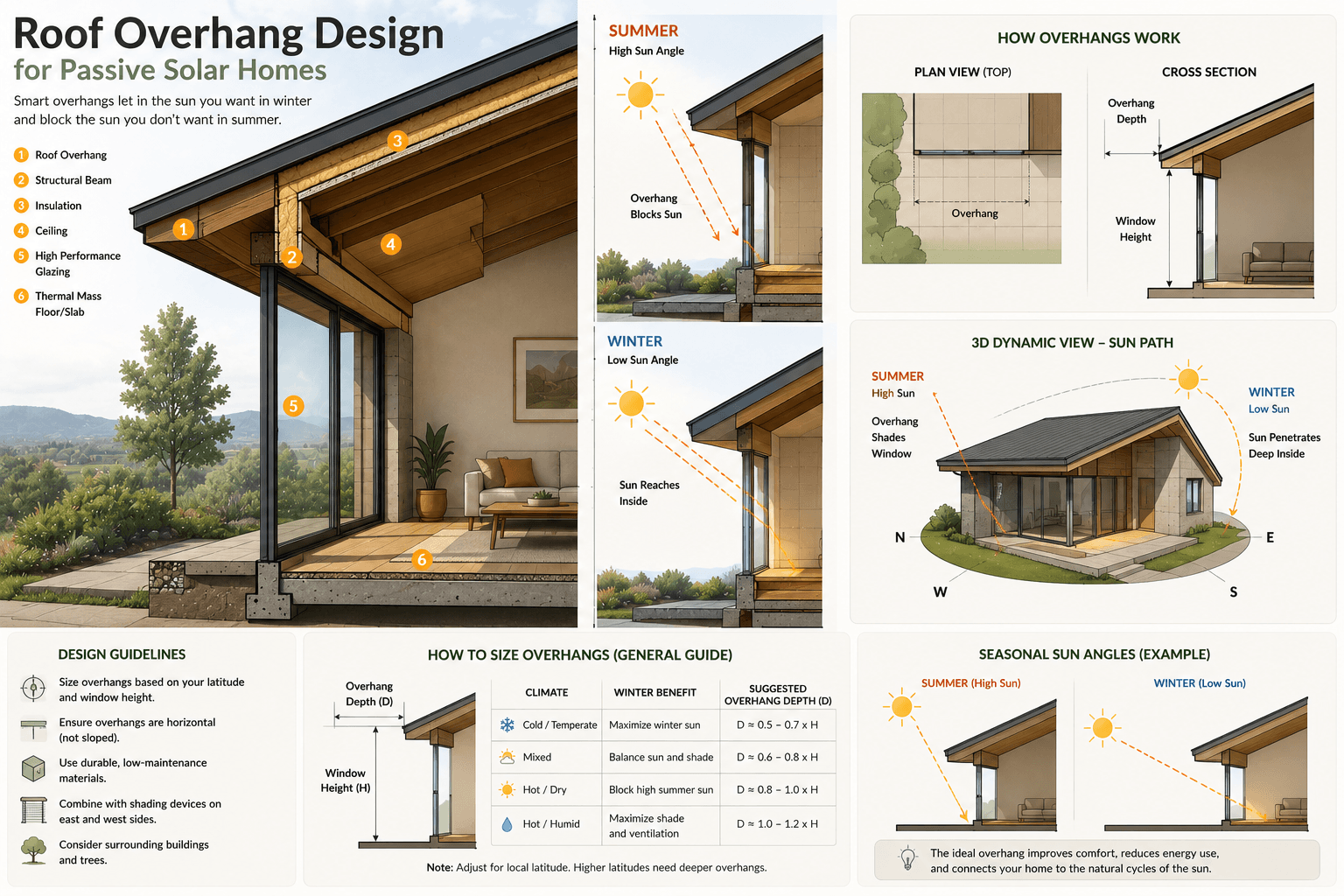
Roof overhangs are one of the most useful passive solar design tools because they help a home accept desirable sun and block unwanted sun. When designed well, they can reduce summer overheating, improve indoor comfort, protect windows and walls, and support better daylighting. When designed poorly, they can block useful winter sun or fail to stop harsh summer heat.
In passive solar design, a roof overhang is not just a decorative detail. It is part of the building’s climate response. Its job is to work with orientation, glazing, solar angles, and room use.
The basic idea is simple: on the equator-facing side of the house, the summer sun is higher in the sky and the winter sun is lower. A correctly sized overhang can block the high summer sun while allowing the lower winter sun to enter the windows. In the Northern Hemisphere, this usually applies to south-facing windows. In the Southern Hemisphere, it usually applies to north-facing windows.
But good overhang design is never universal. The best overhang depth depends on climate, latitude, window height, glazing area, wall orientation, and the amount of solar gain the house actually needs. A cold climate house, a mixed climate house, and a hot-humid house may all need different solutions.
This guide explains how roof overhang design works in passive solar homes, how to think about sizing, and how to avoid common mistakes.
Try it on your own design: Roof Overhang Calculator (free, about a minute).
Key Takeaways
- Roof overhangs help block high summer sun and admit lower winter sun on the equator-facing side of the house.
- The best overhang depth depends on climate, latitude, facade orientation, and window geometry.
- Overhangs usually work best on equator-facing facades and are less effective on east and west windows.
- In hot climates, overhangs are often part of a larger shading strategy that may also include fins, screens, shutters, trees, and covered outdoor spaces.
- In cold climates, overhangs should be designed carefully so they do not block too much useful winter solar gain.
- Overhang design should be coordinated with window placement, thermal mass, insulation, and ventilation.
What Is a Roof Overhang in Passive Solar Design?
A roof overhang is the part of the roof that projects beyond the exterior wall. In passive solar design, it acts as a fixed external shading device. It is most effective when it is positioned above windows that receive strong sun during warm periods.
The main passive solar purpose of a roof overhang is to improve seasonal solar control. It can:
- reduce overheating in summer;
- allow useful solar gain in winter;
- improve daylight quality by reducing glare;
- protect windows and doors from rain;
- help preserve exterior finishes and reduce weather exposure;
- support outdoor comfort at entries, terraces, and circulation zones.
For a broader introduction, see Passive Solar Shading & Overhangs.
Why Roof Overhangs Matter in Passive Solar Homes
Passive solar design is not just about collecting sunlight. It is about collecting the right amount of sunlight at the right time and keeping the house comfortable across the seasons.
A home with large equator-facing windows can benefit from winter sun, but without shading it may overheat during spring, summer, and early autumn. A roof overhang helps make those windows more usable.
This is especially important because windows are both an opportunity and a risk. They bring light, views, and solar heat gain, but they can also cause glare, high cooling loads, and unwanted temperature swings. Overhangs help balance these trade-offs.
To understand the window side of the design, see Passive Solar Windows and Passive Solar Window Placement.
How Roof Overhangs Work
The logic behind roof overhangs depends on solar altitude, which is the height of the sun above the horizon.
- In summer, the sun is higher in the sky.
- In winter, the sun is lower in the sky.
Because of this seasonal difference, a horizontal overhang can block high-angle summer sun while still letting in lower-angle winter sun. This is why fixed horizontal overhangs are usually most effective on equator-facing facades.
However, they are much less effective for low morning and afternoon sun from the east and west. That is why east and west windows often need additional strategies such as:
- vertical fins;
- external blinds;
- shutters or screens;
- reduced glazing area;
- trees or landscape shading;
- service rooms as thermal buffers.
Which Facades Benefit Most From Roof Overhangs?
| Facade Orientation | How Well Overhangs Work | Main Notes |
|---|---|---|
| Equator-facing facade | Very effective | Best location for fixed horizontal overhangs because seasonal sun angles are easier to control. |
| East facade | Limited effectiveness | Morning sun is low in the sky, so horizontal overhangs alone usually do not provide enough shading. |
| West facade | Limited effectiveness | Afternoon sun is low, strong, and a major overheating risk in many climates. |
| Pole-facing facade | Usually not a solar-control priority | Solar heat gain is usually limited, so overhangs may be more about rain protection than passive solar gain control. |
For this reason, passive solar homes often place their most carefully designed fixed overhangs above equator-facing windows.
Global Rule: Think “Equator-Facing,” Not Just “South-Facing”
For a global audience, it is more accurate to think in terms of equator-facing glazing.
- In the Northern Hemisphere, this usually means south-facing windows.
- In the Southern Hemisphere, this usually means north-facing windows.
This matters because many passive solar articles assume a Northern Hemisphere audience. But the passive solar logic is global only when the direction is described correctly.
If you are new to this topic, read Passive Solar Orientation and Passive Solar Design by Climate.
Roof Overhang Design by Climate
Overhang design should respond to climate. The same depth that works well in one place may perform poorly in another.
| Climate Type | Overhang Priority | Main Goal | Typical Risk |
|---|---|---|---|
| Cold climate | Moderate, carefully sized | Allow useful winter sun while limiting summer overheating | Overhang too deep, blocking winter solar gain |
| Temperate climate | High priority | Balance seasonal comfort and improve daylight | Using generic dimensions without checking solar angles |
| Mixed climate | High priority | Support both heating and cooling seasons | Design that helps in winter but overheats in summer |
| Hot-dry climate | Very high priority | Reduce direct sun, protect openings, support cooler interiors | Too much exposed glass even with overhangs |
| Hot-humid climate | Very high priority | Maximize shade, reduce solar gain, improve outdoor comfort | Relying on solar gain strategies where cooling is the main issue |
In colder climates, the overhang often needs to be shallower or more carefully calibrated so that valuable winter sunlight is not lost. In hot climates, deeper shading may be appropriate, especially when overheating is a larger concern than solar heating.
The Main Factors That Determine Overhang Size
There is no single ideal overhang depth. A good design depends on several variables working together.
1. Latitude
Latitude affects the sun’s path across the sky. The higher the latitude, the lower the winter sun and the greater the seasonal contrast in sun angles. This has a direct effect on how shading should be designed.
2. Climate
Climate tells you whether the design priority is winter heating, summer cooling, or a careful balance of both. This should guide how much summer exclusion and winter admission the overhang is meant to achieve.
3. Facade Orientation
Overhangs above equator-facing windows are usually the most effective. On east and west facades, the same overhang may do far less because the sun is low and enters from the side.
4. Window Height and Position
The geometry of the window matters. A tall window or a high head height changes the relationship between the top of the window and the projected shadow. The same overhang depth will shade different windows differently.
5. Desired Shading Period
Do you want the overhang to block sun only in peak summer, or also in late spring and early autumn? Do you want partial shading or full shading at solar noon? These decisions affect design depth.
6. Building Form and Architecture
Sometimes the overhang is part of a porch, balcony, veranda, pergola, or terrace roof. In these cases, architectural intent and practical use may be combined with solar control.
7. Window Performance and Internal Thermal Mass
A house with high-performance glazing, controlled window area, and good thermal mass may tolerate solar gain differently than a lightweight house with poor shading and oversized glass.
A Simple Way to Think About Sizing
At an early stage, overhang design can be approached as a geometric problem. The goal is to understand how far a shadow extends down the window at a given solar altitude.
A simplified relationship is:
Overhang projection depth = vertical shading height / tan(solar altitude angle)
In simple terms:
- the greater the sun angle, the shorter the needed projection for shading;
- the lower the sun angle, the deeper the overhang must be to block it;
- the taller the area you want to shade, the deeper the overhang usually needs to be.
This is useful as a concept, but it is only a starting point. Real design also depends on wall thickness, frame depth, glazing position, window reveal, local latitude, climate targets, and the actual times of year you want to control.
That is why calculators and sun studies are useful. For early planning, see the Solar Angle Calculator and the Roof Overhang Calculator.
How to Design Roof Overhangs Step by Step
Step 1: Confirm the Climate and Solar Goal
Start by deciding what the overhang is meant to do. Is the main goal to reduce summer overheating, preserve winter solar gain, improve glare control, or support outdoor living? In many projects, the answer is a mix of these.
Step 2: Identify the Key Windows
Not every window needs the same shading strategy. Focus first on the windows that receive the strongest sun and have the greatest impact on comfort.
Step 3: Check Orientation
Determine which windows are equator-facing, east-facing, west-facing, and pole-facing. Overhangs usually have the highest passive solar value on the equator-facing side.
Step 4: Study Solar Angles
Look at the sun path for your latitude and the periods you want to shade. Many designs focus on midday or early afternoon sun during warm seasons, but project needs vary by climate and occupancy pattern.
Step 5: Set a Shading Target
Define what “success” means. For example, you may want the overhang to shade most of the glazing during the hottest part of summer while allowing winter noon sun to penetrate into the room.
Step 6: Size the Overhang
Estimate an initial projection using simple geometry or a calculator. Then refine it based on window proportions, facade composition, structural logic, and architectural design.
Step 7: Check Summer and Winter Performance
Do not size overhangs using only one season. A projection that blocks summer sun well may also reduce winter solar gain too much. The design should be tested for both periods.
Step 8: Coordinate With the Rest of the House
The final design should work with the overall passive solar strategy: glazing, thermal mass, insulation, ventilation, landscaping, and room layout.
Overhangs and Window Placement Must Be Designed Together
A roof overhang does not solve all shading problems by itself. It works best when the windows are already placed intelligently.
For example:
- very large west-facing windows may still overheat even with overhangs;
- clerestory windows may need different shading treatment;
- full-height glazing may require a deeper projection than a smaller window;
- multiple facades may need different shading devices rather than one standard detail.
This is why passive solar design should never treat overhangs as an isolated add-on. The best results come when orientation, glazing, and shading are considered at the same time.
Overhangs and Thermal Mass
Roof overhangs influence how much sunlight reaches the interior. Thermal mass influences what happens after sunlight enters.
In a well-balanced passive solar home:
- summer solar gain is reduced with shading;
- winter solar gain is admitted when useful;
- thermal mass absorbs and moderates some of the incoming heat;
- insulation reduces heat loss and protects comfort.
If the overhang admits large amounts of winter sun but the house has little useful thermal mass, temperatures may rise too quickly during the day and fall quickly at night. If the overhang blocks too much sun, the heating benefit of passive solar design may be reduced.
To understand this balance better, see Thermal Mass and Thermal Mass Calculator.
When Roof Overhangs Are Not Enough
Roof overhangs are valuable, but they are not a universal answer. Some situations need additional or different shading strategies.
East and West Windows
These windows often need vertical or operable shading because low-angle sun can pass under a horizontal overhang.
Hot-Humid Climates
These climates often benefit from larger shaded outdoor areas, verandas, covered walkways, and broad protective roofs, not just small window overhangs.
Urban Sites
Neighboring buildings, narrow lots, and privacy constraints may limit the ideal overhang geometry. In these cases, a combination of screens, landscape, and selective glazing may work better.
Multi-Story Buildings
Upper and lower floors may experience different shading patterns. Balconies, slab edges, and facade articulation can be used as part of the shading strategy, but they should still be tested for actual performance.
Application Example: Mixed Climate House
Imagine a house in a mixed climate with warm summers and cool winters. The main living room faces the equator-facing garden and has a row of medium-to-large windows. The project wants winter sun, good daylight, and protection from summer overheating.
A reasonable overhang strategy might include:
- a fixed horizontal overhang above the main living room windows;
- window head heights coordinated so the overhang can shade consistently;
- an initial overhang depth based on solar angle calculations for the hottest months;
- thermal mass in the floor to help absorb winter solar gain;
- reduced west glazing to limit afternoon overheating;
- operable windows for evening cooling in shoulder seasons;
- testing the final design with local climate and sun path data.
This is usually more effective than adding large glass areas first and trying to fix comfort problems later.
Common Roof Overhang Mistakes
Mistake 1: Using the Same Overhang on Every Facade
Different orientations receive different sun. A uniform detail may look tidy, but it often performs poorly. The equator-facing facade, east facade, and west facade usually need different responses.
Mistake 2: Making the Overhang Too Deep
An overhang that is too deep may block useful winter sun, reduce daylight, and weaken the passive heating benefit of the design.
Mistake 3: Making the Overhang Too Shallow
An overhang that is too small may not provide meaningful summer shading, especially in warm and mixed climates.
Mistake 4: Ignoring Latitude
The same projection depth will not perform the same way everywhere. Latitude changes the solar angles, so a copied detail may not be appropriate.
Mistake 5: Expecting Overhangs to Solve West Sun
Horizontal overhangs alone usually do not control harsh west sun well enough. Additional shading strategies are often required.
Mistake 6: Designing Shading After the Windows Are Fixed
If the glazing design is already final, the shading solution may be compromised. Overhangs should be considered early, together with window size and position.
Mistake 7: Ignoring Comfort Beyond Solar Gain
Shading is not only about energy. It also affects glare, daylight quality, outdoor usability, and visual comfort.
Roof Overhang Design Checklist
| Question | Why It Matters |
|---|---|
| Which facade is equator-facing? | This is usually the best location for fixed passive solar overhangs. |
| What is the main climate priority? | Heating-dominated and cooling-dominated climates need different shading strategies. |
| Which windows cause the biggest comfort risk? | Not all openings need the same amount of shading. |
| What times of year should be shaded? | This affects target solar angles and overhang depth. |
| Will the overhang block useful winter sun? | Good passive solar design should protect both summer and winter performance. |
| Are east and west windows handled separately? | They often need more than a simple horizontal overhang. |
| Is the overhang coordinated with glazing and thermal mass? | Shading only works well when the rest of the design supports it. |
| Has the design been checked with calculations or sun studies? | This reduces the risk of over- or under-shading. |
When to Use a Roof Overhang Calculator
A calculator is useful when you want to move from a general idea to a more realistic starting dimension. It helps connect:
- window height;
- overhang location;
- desired shading depth;
- local solar altitude angles;
- seasonal design intent.
It is especially useful in the early design phase, when you are comparing options and deciding whether an overhang should be deeper, shallower, or combined with another device.
For practical planning, use the Roof Overhang Calculator. You may also find the Solar Angle Calculator and Passive Solar Calculations helpful.
Roof Overhangs Are Only One Part of Passive Solar Design
A well-designed overhang improves performance, but it cannot compensate for poor overall design. Passive solar success depends on the whole building system:
- orientation;
- window placement;
- glazing performance;
- thermal mass;
- insulation;
- airtightness;
- natural ventilation;
- climate-responsive room layout;
- site-specific sun and wind conditions.
If you want to approach the design in a structured way, start with the Passive Solar Design Checklist.
Conclusion
Roof overhang design for passive solar homes is about much more than choosing a standard projection. A good overhang responds to climate, latitude, orientation, and window geometry. It helps admit useful winter sun, block unwanted summer sun, improve comfort, and reduce overheating risk.
In many passive solar homes, fixed horizontal overhangs are most effective on equator-facing facades. But they should always be designed as part of a broader strategy that includes windows, thermal mass, shading, and ventilation. East and west facades usually need extra care, and hot climates often need stronger shading than cold climates.
The best roof overhang is not the deepest one or the most visually dramatic one. It is the one that matches the building, the climate, and the way the house is actually meant to work.
For the next step, explore Passive Solar Shading & Overhangs, Solar Angle Calculator, and Roof Overhang Calculator.
FAQ
What is the purpose of a roof overhang in passive solar design?
A roof overhang helps block high summer sun and allow lower winter sun into the home, especially on equator-facing windows. It also improves comfort, reduces glare, and protects openings from weather.
How do I size a roof overhang for passive solar shading?
Overhang size depends on climate, latitude, facade orientation, window height, and the time of year you want to shade. A simple starting point uses solar angle geometry, but a calculator or sun study is usually better for actual design decisions.
Do roof overhangs work on east and west windows?
They work less effectively on east and west windows because the sun is lower in the sky. These windows often need additional shading such as vertical fins, shutters, screens, blinds, or vegetation.
Should roof overhangs be deeper in hot climates?
Often yes, because hot climates usually need stronger solar protection. But the correct depth still depends on local sun angles, window design, and whether ventilation or other shading systems are also part of the solution.
Can a roof overhang block too much winter sun?
Yes. If the overhang is too deep, it may reduce useful winter solar gain and daylight. That is why overhangs should be checked for both summer and winter performance.
Are roof overhangs enough for passive cooling?
No. They are helpful, but passive cooling usually also depends on ventilation, insulation, glazing control, thermal mass, landscape shading, and reducing east and west solar exposure.
What is the best orientation for passive solar overhangs?
Fixed horizontal overhangs are usually most effective on equator-facing facades. In the Northern Hemisphere, this is typically the south side. In the Southern Hemisphere, it is typically the north side.
Do all passive solar homes need roof overhangs?
Not always in the same form, but most passive solar homes benefit from some kind of external shading. In some projects this may be a roof overhang, while in others it may be a balcony, pergola, shading screen, or a combination of devices.
Next step: check your own project
Size the overhang for one of your own windows with the Roof Overhang Calculator. It is free and runs in your browser.
Keep your results in one place
The free Passive Solar Design Checklist & Project Brief is a printable PDF with pages for your site’s sun angles, orientation, glazing per facade, shading and thermal mass, plus 12 questions to take to your architect or designer.