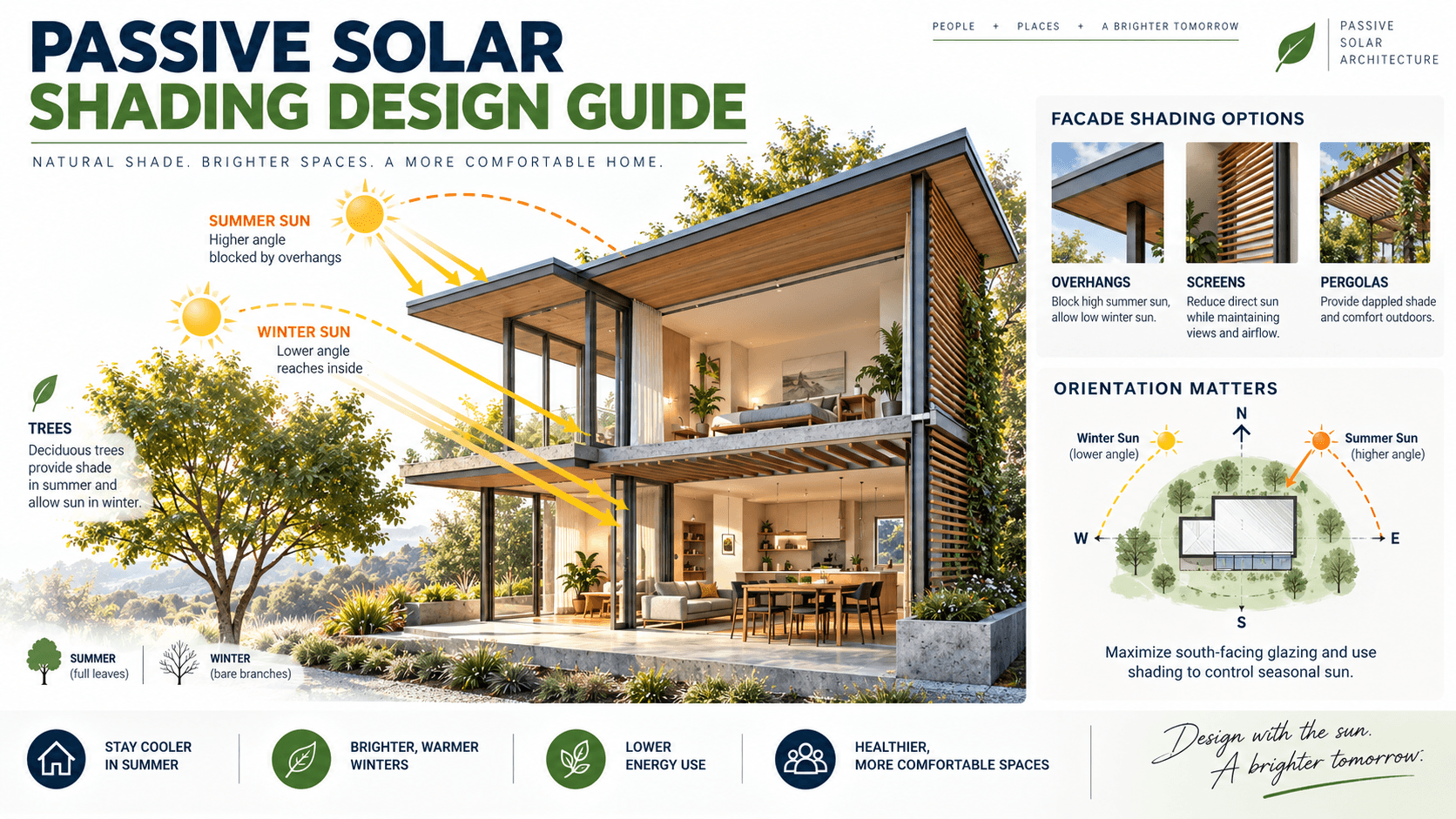
Passive solar house design is not about adding one “green” feature to a home. It is about designing the whole house so the site, sun, climate, windows, shading, thermal mass, insulation, ventilation, and daily living patterns work together.
For self-builders, this is important because many of the best passive solar decisions happen before construction starts. The position of the house, the shape of the floor plan, the location of the main rooms, the size of the windows, and the way summer sun is controlled are all early design choices. Once they are wrong, they can be expensive or impossible to fully correct.
The good news is that passive solar house design does not need to feel mysterious. You do not need to become an architect to understand the main priorities. You need to know what matters most, what questions to ask, and which design mistakes to avoid.
This guide explains the most important decisions in passive solar house design and how to think about them before you commit to a plan. For a broader overview, you can also read the main guide to passive solar house design.
Key Takeaways
- Passive solar house design starts with climate and site, not with the floor plan.
- Orientation matters, but it must be balanced with views, privacy, access, wind, shading, and local constraints.
- Windows are powerful design tools, but too much glass can cause overheating, glare, and heat loss.
- Thermal mass only helps when it is used correctly and matched with solar access, shading, insulation, and ventilation.
- Shading is essential, especially for summer comfort and east or west-facing windows.
- A passive solar house still needs good insulation, airtightness, ventilation, and professional project-specific design.
What Is Passive Solar House Design?
Passive solar house design is the process of designing a home to work with the sun and local climate through architectural decisions.
A passive solar house may use:
- climate-aware site planning,
- equator-facing glazing where useful,
- carefully sized windows,
- roof overhangs or exterior shading,
- thermal mass,
- insulation,
- airtightness,
- natural or mechanical ventilation,
- room layout based on sun and comfort,
- passive cooling strategies.
The goal is not to eliminate every heating or cooling system. The goal is to reduce unnecessary heating and cooling demand, improve comfort, and make the house respond more intelligently to its environment.
A passive solar house is also not the same as a house with solar panels. Solar panels generate electricity. Passive solar design uses the architecture of the house itself to manage heat, daylight, shade, and airflow.
If you are new to the concept, start with passive solar fundamentals before going deeper into design details.
What Matters Most in Passive Solar House Design?
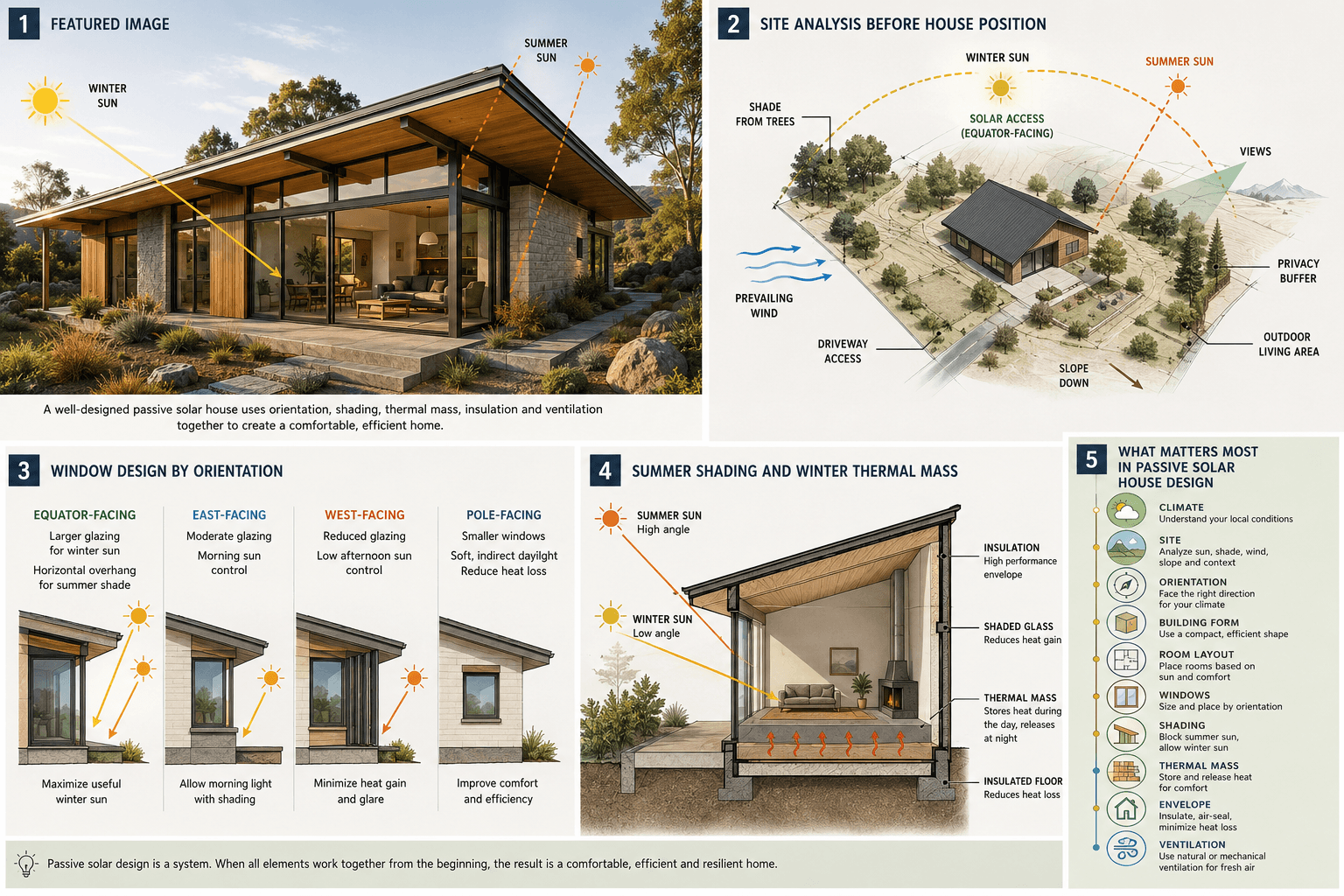
The most important thing to understand is that passive solar house design is a system. No single feature works well on its own.
A house can face the right direction and still overheat. It can have thermal mass and still feel uncomfortable. It can have large windows and still lose too much heat. It can have deep overhangs and still block useful winter sun if they are not designed for the site.
The main design priorities are:
- climate,
- site,
- orientation,
- building form,
- room layout,
- window placement,
- shading,
- thermal mass,
- envelope performance,
- ventilation and passive cooling.
Each priority affects the others. That is why passive solar design should be considered at the beginning of a project, not added as an afterthought.
For a deeper framework, see passive solar design principles.
Start With Climate Before the Floor Plan
The first question is not “What should the house look like?”
The first question is “What does this climate need?”
A house in a cold climate should not be designed the same way as a house in a hot-humid climate. A cold-climate home may need useful winter sun, strong insulation, airtightness, and carefully placed thermal mass. A hot-humid home may need deep shade, airflow, moisture control, and reduced solar heat gain.
Before choosing a house plan, ask:
- Is the climate mainly cold, temperate, hot-dry, hot-humid, or mixed?
- Is heating, cooling, or humidity control the main issue?
- Are summers dry or humid?
- Are nights cool enough for night ventilation?
- Is winter sun reliable or often blocked by clouds?
- Is overheating a bigger risk than heat loss?
- What do local building codes require?
The U.S. Department of Energy explains that passive solar design uses a building’s site, climate, and materials to reduce energy use, and that energy efficiency should come first: U.S. Department of Energy: Passive Solar Homes.
For a detailed comparison by region, read passive solar design by climate.
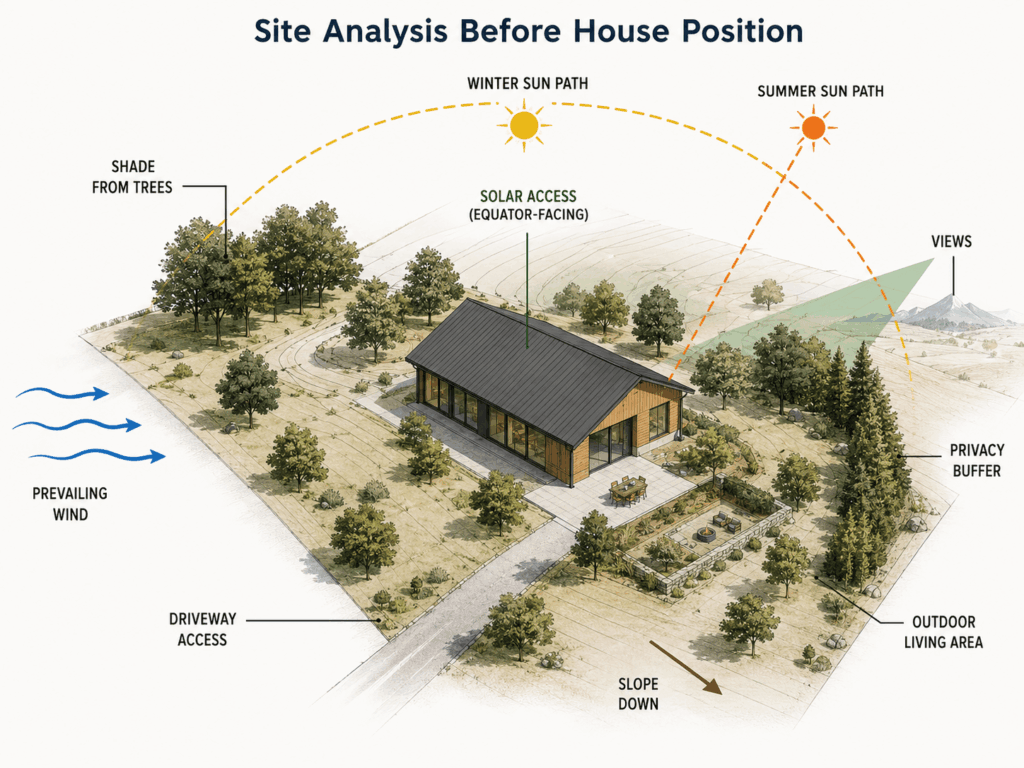
Analyze the Site Before You Choose the House Position
The site controls what kind of passive solar house is possible.
Even a well-designed house can perform poorly if it is placed badly on the land. A beautiful view, driveway location, slope, nearby trees, neighboring buildings, or local planning rule can all affect passive solar performance.
A basic passive solar site review should include:
- winter and summer sun path,
- solar access on the equator-facing side,
- shade from trees, hills, fences, and nearby buildings,
- slope and drainage,
- prevailing winds,
- views and privacy,
- road access and parking,
- noise, dust, wildfire smoke, or pollution sources,
- outdoor living areas,
- possible future development that could block sun.
For global accuracy, the term equator-facing is often better than simply saying south-facing. In the Northern Hemisphere, this usually means south-facing. In the Southern Hemisphere, it usually means north-facing.
Useful early tools include the solar angle calculator and the passive solar orientation calculator.
Orient the House for Sun, But Do Not Ignore Real Life
Orientation is one of the most important passive solar house design decisions.
In many climates, the main living spaces and useful solar glazing should face toward the equator. This can help collect winter sun, improve daylight, and make seasonal shading easier.
Good orientation can help:
- improve winter solar gain where heating is needed,
- make roof overhangs more effective,
- reduce difficult east and west solar exposure,
- improve daylight in main rooms,
- create a more comfortable room layout,
- reduce unnecessary heating demand.
But orientation is not the only goal. A house also has to respond to:
- views,
- privacy,
- street access,
- slope,
- wind,
- neighbors,
- outdoor spaces,
- local planning rules,
- construction budget,
- how the family actually lives.
A self-builder mistake is to force the house into a perfect solar orientation while ignoring the rest of the site. A better approach is to optimize orientation within the real constraints of the land.
For more detail, read passive solar orientation.
Choose a Building Form That Supports the Strategy
The shape of the house affects heat loss, daylight, construction cost, solar access, shading, and ventilation.
A compact house often reduces heat loss because it has less exterior surface area compared with its internal volume. This can be useful in cold climates. An elongated east-west form may create more equator-facing wall area for windows and daylight, but it can also increase envelope area and cost if not designed carefully.
| House Form | Potential Benefit | Possible Trade-Off |
|---|---|---|
| Compact form | Reduces heat loss and can simplify construction | May limit daylight or solar access if poorly planned |
| Elongated east-west form | Creates more equator-facing wall area | May increase envelope area and construction cost |
| Narrow plan | Supports daylight and cross ventilation | May be harder to fit on some lots |
| Courtyard form | Can create shade, privacy, and outdoor comfort | Requires careful sun and airflow analysis |
| Two-story form | Reduces footprint and may improve compactness | Needs careful stair, shading, and room layout planning |
The best form depends on climate, site, budget, lifestyle, construction system, and design priorities.
Plan the Rooms Around Sun and Comfort
Passive solar house design is not only about the exterior. The interior layout matters too.
Rooms should be placed according to when they are used, how much daylight they need, how much heat they generate, and how sensitive they are to overheating or heat loss.
Common room layout logic includes:
- Living rooms: often benefit from equator-facing daylight and winter sun in heating or mixed climates.
- Kitchens: need daylight but also produce internal heat, so overheating should be considered.
- Bedrooms: may work well with morning light, but should avoid too much evening heat in warm climates.
- Home offices: need daylight with glare control and stable temperatures.
- Bathrooms and storage rooms: can often sit on less favorable orientations.
- Garages and utility spaces: can sometimes buffer cold, hot, noisy, or less desirable facades.
The goal is to place the most important daily spaces where light, comfort, and views are strongest, while using secondary spaces to support the thermal strategy.
Before approving a plan, compare your layout with a passive solar design checklist.
Design Windows by Orientation, Not by Looks Alone
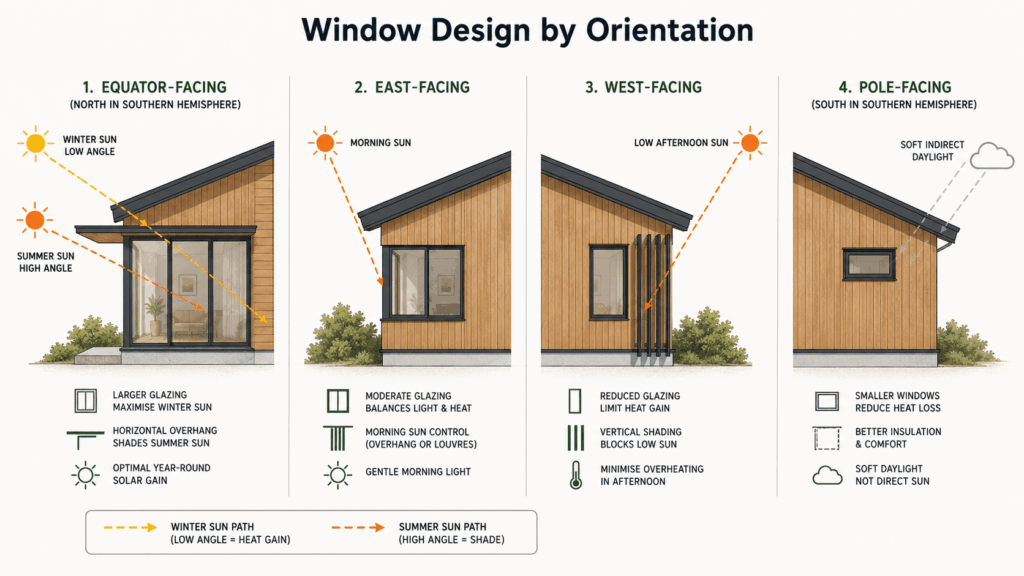
Windows are one of the most important parts of passive solar house design.
They bring daylight, views, ventilation, and solar heat. They can also cause heat loss, glare, overheating, and discomfort.
The question is not: “How much glass can we add?”
The better question is: “What size, type, and position of glazing makes sense for this climate and facade?”
| Window Orientation | Typical Behavior | Design Strategy |
|---|---|---|
| Equator-facing | Can provide useful winter sun in many heating and mixed climates | Use carefully sized glazing, shading, and thermal mass |
| East-facing | Receives morning sun | Useful for morning light, but control heat in warm climates |
| West-facing | Receives low-angle afternoon sun | Usually needs strong shading or reduced glazing |
| Pole-facing | Provides softer light with less direct solar gain | Useful for daylight, but watch heat loss in cold climates |
Window design should consider:
- window-to-wall ratio,
- U-value or U-factor,
- Solar Heat Gain Coefficient, or SHGC,
- visible transmittance,
- frame performance,
- airtight installation,
- exterior shading,
- interior glare control,
- room use and comfort.
If you are reviewing early drawings, use the window-to-wall ratio calculator and read more about passive solar windows.
Add Shading Before the House Overheats
Shading is not decoration. It is one of the most important passive solar house design strategies.
In many homes, the biggest risk is not too little sun. It is too much sun at the wrong time.
Effective shading blocks unwanted solar heat before it passes through the glass. Exterior shading is usually more effective than interior blinds because it stops heat before it enters the building.
Common shading strategies include:
- roof overhangs,
- exterior blinds,
- shutters,
- louvers,
- pergolas,
- balconies,
- deep window reveals,
- verandas,
- vertical fins,
- deciduous trees where suitable.
Equator-facing windows can often be shaded with horizontal overhangs. East and west windows usually need special attention because low-angle sun is harder to block with simple horizontal overhangs.
For early design checks, use the roof overhang calculator and read the guide to passive solar shading and overhangs.
Use Thermal Mass Carefully
Thermal mass can help a passive solar house store heat and reduce indoor temperature swings. Common thermal mass materials include concrete, brick, stone, tile, adobe, masonry, and rammed earth.
But thermal mass only works well when it is part of a balanced design.
Thermal mass is most useful when:
- it is exposed to indoor air,
- it receives useful winter sun where heating is needed,
- it is protected from unwanted summer sun,
- the amount of mass is balanced with window area,
- ventilation can remove stored heat when needed,
- the local climate supports heat storage.
Thermal mass is not the same as insulation. Insulation slows heat flow. Thermal mass stores and releases heat. A passive solar house may need both.
A common mistake is adding a concrete floor and assuming the house is now passive solar. If the floor does not receive useful sun, if the glazing is oversized, or if summer shading is missing, the mass may not improve comfort.
For a deeper explanation, read thermal mass and review material options in passive solar materials.
Strengthen the Building Envelope
A passive solar house still needs a strong building envelope.
The building envelope includes the walls, roof, floor, windows, doors, insulation, air barrier, vapor control layers, and construction joints.
If a house collects winter sun but loses heat quickly through weak insulation, leaky construction, poor windows, or thermal bridges, the benefit is reduced. In hot climates, a weak envelope can also allow unwanted heat to enter the house.
A strong passive solar envelope should include:
- climate-appropriate insulation,
- good airtightness,
- reduced thermal bridges,
- high-quality window installation,
- moisture-aware detailing,
- durable materials,
- reliable ventilation.
Good passive solar house design starts with demand reduction. The house should first reduce unnecessary heating and cooling loads, then use passive solar strategies to improve comfort.
Plan Ventilation and Passive Cooling
Every passive solar house needs a ventilation strategy.
Ventilation affects indoor air quality, moisture control, overheating risk, and comfort. It can be natural, mechanical, or hybrid.
Natural ventilation may include:
- cross ventilation,
- stack ventilation,
- night ventilation,
- operable windows,
- high and low openings,
- shaded outdoor air paths,
- courtyards or breezeways.
But natural ventilation is not always enough. Outdoor humidity, pollution, wildfire smoke, insects, security, noise, or extreme temperatures can limit how useful open windows are.
Passive cooling strategies may include:
- exterior shading,
- reduced east and west glazing,
- night flushing where nights are cool,
- roof heat control,
- shaded outdoor spaces,
- ventilated courtyards,
- careful use of thermal mass.
Passive solar house design should always include cooling, not only heating. For warmer climates or mixed climates, start with passive cooling before finalizing the plan.
Passive Solar House Design by Climate
The same passive solar house plan should not be copied from one region to another without analysis.
| Climate Type | Main Design Priority | Useful Strategies | Common Risk |
|---|---|---|---|
| Cold climate | Capture useful winter sun and reduce heat loss | Equator-facing glazing, insulation, airtightness, thermal mass, high-performance windows | Too much glass without enough envelope performance |
| Temperate climate | Balance winter gain, summer shading, daylight, and ventilation | Moderate glazing, overhangs, thermal mass, cross ventilation | Designing only for winter and ignoring summer comfort |
| Hot-dry climate | Block daytime heat and release heat at night where possible | Deep shade, courtyards, night ventilation, controlled thermal mass | Thermal mass storing heat without night cooling |
| Hot-humid climate | Reduce heat gain, improve airflow, and manage moisture | Large shade, cross ventilation, moisture-aware materials, limited heat storage | Heavy mass and unshaded glazing trapping heat |
| Mixed climate | Design for both heating and cooling seasons | Adjustable shading, balanced glazing, insulation, ventilation | A winter-focused house that overheats in summer |
This is why climate comes first. A passive solar house should be designed for the place where it will actually be built.
Illustrative Example: A Self-Builder Reviewing a House Plan
Imagine a self-builder planning a small home in a mixed climate.
The first draft has a large open-plan living area with big windows facing the view. The view is west-facing, so the room would receive strong afternoon sun in summer. The plan also includes a concrete floor, but there is no exterior shading.
At first, the house looks bright and attractive. But from a passive solar design perspective, there are several risks:
- too much west-facing glass,
- summer overheating,
- glare in the afternoon,
- thermal mass storing unwanted heat,
- no clear shading strategy,
- no plan for night ventilation.
A better approach might be to reduce the west-facing glazing, add exterior shading, place more controlled glazing toward the equator-facing side, protect the concrete floor from summer sun, and include cross ventilation where local conditions allow.
The lesson is simple: passive solar house design is not about adding more glass or more mass. It is about matching the design to climate, orientation, comfort, and control.
Common Passive Solar House Design Mistakes
1. Starting With the Floor Plan Instead of the Climate
A floor plan that ignores climate can create comfort problems later. Climate should guide orientation, window area, shading, ventilation, and thermal mass.
2. Using Too Much Glass
Large windows can be beautiful, but they are also weak points for heat loss and heat gain. More glass is not automatically better.
3. Ignoring Summer Comfort
A house designed only for winter sun may overheat in summer or shoulder seasons. Shading and cooling strategies should be included from the beginning.
4. Treating Orientation as the Only Passive Solar Decision
Orientation matters, but it cannot compensate for poor glazing, weak insulation, bad shading, or missing ventilation.
5. Placing Thermal Mass in the Wrong Location
Thermal mass should be exposed to useful heat and protected from unwanted heat. Hidden or badly placed mass may do very little.
6. Copying a Plan From Another Climate
A passive solar plan from a cold region may fail in a hot-humid or mixed climate. The design must be adapted to local conditions.
7. Forgetting East and West Sun
Low-angle morning and afternoon sun can be difficult to shade. West-facing glass is especially risky in many warm and mixed climates.
8. Relying Only on Rules of Thumb
Rules of thumb can help early thinking, but they are not final design specifications. A real project needs climate data, professional review, and local code compliance.
9. Confusing Passive Solar Design With Solar Panels
Solar panels generate electricity. Passive solar house design manages heat, light, shade, and comfort through architecture.
10. Adding Passive Solar Features Too Late
Passive solar decisions should happen early. Orientation, form, window placement, and room layout are hard to fix once the design is complete.
For a more complete review, use the passive solar design checklist.
Passive Solar House Design Checklist
Use this checklist before approving a concept plan.
- Has the local climate been identified?
- Are heating, cooling, and humidity priorities clear?
- Has the site been checked for sun, shade, wind, slope, and views?
- Is the house positioned for useful solar access?
- Are main rooms placed for comfort, daylight, and daily use?
- Is the building form appropriate for the climate and budget?
- Are windows sized and placed by orientation?
- Are east and west windows controlled?
- Are U-value, SHGC, and visible transmittance considered?
- Is exterior shading included?
- Is thermal mass used only where it supports comfort?
- Are insulation and airtightness part of the design?
- Is ventilation planned?
- Has overheating risk been checked?
- Are local codes and professional review included?
This checklist is not a substitute for architectural or engineering design, but it can help you ask better questions early.
Questions to Ask Your Architect or Designer
Before finalizing a passive solar house design, ask:
- What climate problem is this house mainly solving: heating, cooling, humidity, or seasonal balance?
- Why is the house positioned this way on the site?
- Which rooms receive the best daylight and winter sun?
- How much glazing is appropriate on each facade?
- How will east and west sun be controlled?
- What shading strategy prevents summer overheating?
- Where is thermal mass used, and why?
- How does the envelope reduce heat loss or unwanted heat gain?
- How will the house be ventilated in different seasons?
- Which assumptions should be checked with energy modeling or local climate data?
These questions can help move the conversation from appearance to performance.
FAQ
What is passive solar house design?
Passive solar house design is the process of designing a home to work with the sun and local climate through orientation, windows, shading, thermal mass, insulation, airtightness, ventilation, and building form.
What matters most in passive solar house design?
The most important factors are climate, site, orientation, window placement, shading, thermal mass, insulation, airtightness, ventilation, and how these elements work together.
Does a passive solar house need solar panels?
No. A passive solar house does not need solar panels to be passive solar. Solar panels generate electricity, while passive solar design uses the architecture of the house to manage heat and light.
Can any house plan become a passive solar house?
Not always. Some passive solar ideas can be added later, but the most important decisions, such as orientation, building form, room layout, and window placement, work best when planned from the beginning.
Is a passive solar house more expensive to build?
Not necessarily. Some passive solar decisions, such as orientation and room layout, are early design choices rather than expensive add-ons. Other elements, such as high-performance windows or additional shading, may affect the budget.
Can passive solar house design work in hot climates?
Yes, but the strategy changes. In hot climates, passive solar design often focuses more on shading, ventilation, reduced solar gain, and passive cooling than on collecting winter heat.
Does passive solar house design eliminate heating and cooling systems?
Usually, no. Passive solar design can reduce heating and cooling demand, but most homes still need appropriate mechanical systems for comfort, code compliance, and extreme conditions.
Conclusion
Passive solar house design works best when the major decisions are made early and treated as one connected system.
The most important lesson is that no single feature creates a good passive solar house. Orientation, windows, shading, thermal mass, insulation, airtightness, ventilation, building form, room layout, and climate all need to work together.
For self-builders, the best next step is to review your site and early design ideas before the plan becomes fixed. Look at where the sun comes from, where shade falls, which rooms need comfort most, and how the house will avoid overheating as well as heat loss.
Next step: Download the Passive Solar Design Checklist and use it before approving your floor plan, window layout, or early concept design.
For the complete foundation, continue with the main guide to passive solar house design.
Next step: check your own project
Try the ideas on your own project with the free passive solar design tools. It is free and runs in your browser.
Keep your results in one place
The free Passive Solar Design Checklist & Project Brief is a printable PDF with pages for your site’s sun angles, orientation, glazing per facade, shading and thermal mass, plus 12 questions to take to your architect or designer.