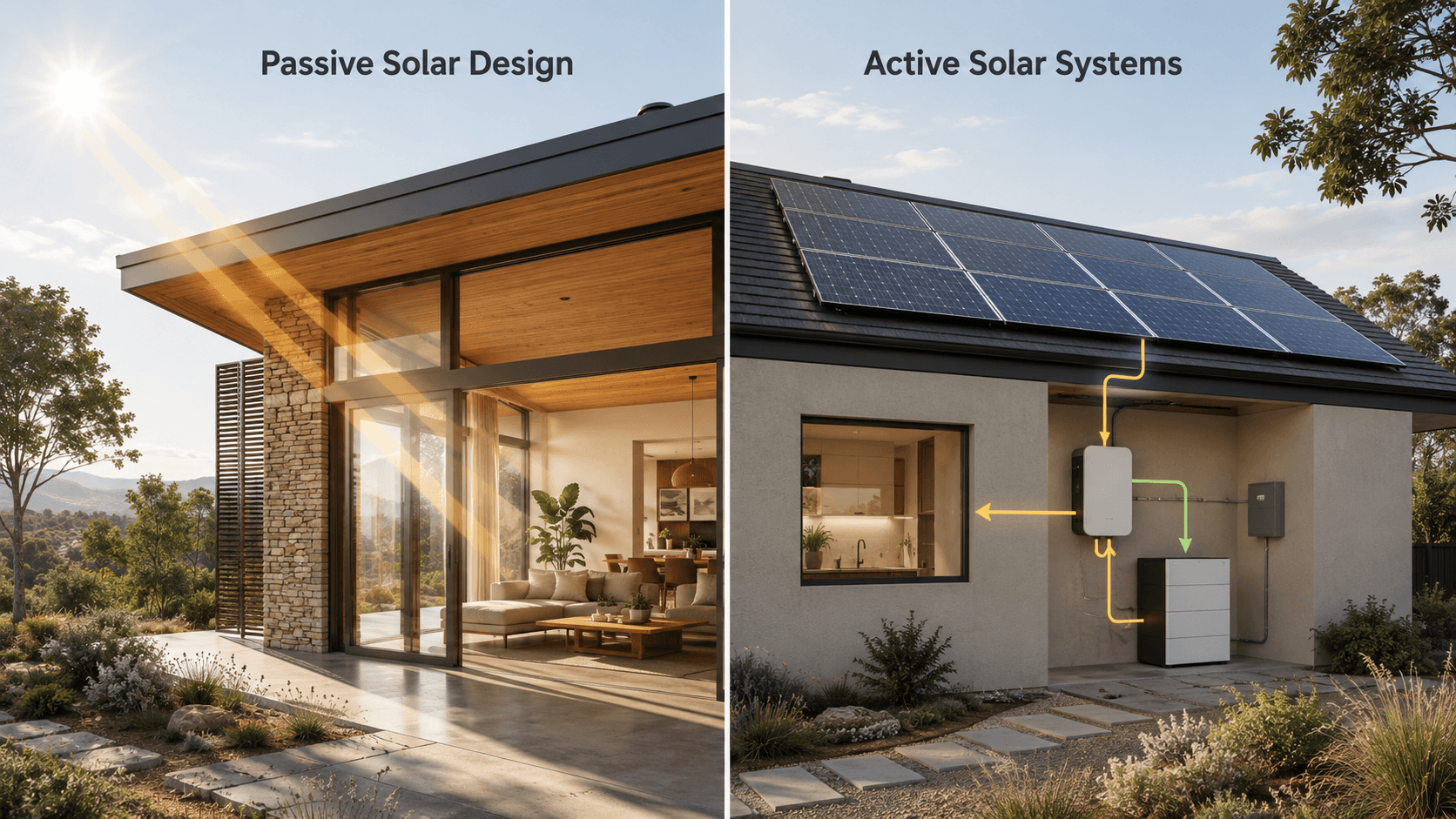
When people first hear the phrase “solar home,” they often think of solar panels on the roof. But solar energy can be used in two very different ways: through passive solar design and active solar systems.
Understanding passive solar vs active solar is important because these approaches solve different problems. Passive solar design uses the building itself to manage sunlight, heat, shade, and comfort. Active solar systems use equipment, such as photovoltaic panels, solar thermal collectors, pumps, fans, batteries, inverters, and controls, to collect, convert, or move solar energy.
A well-designed home can use both. But they should not be confused.
Passive solar design should usually be considered early, when the site, orientation, floor plan, windows, shading, and materials are still flexible. Active solar systems can often be added later, although they also work better when the roof, electrical system, and energy demand are planned carefully.
This guide explains the key differences between passive and active solar energy, when each approach makes sense, and how homeowners, self-builders, and designers can use both without creating confusion. If you are new to the broader concept, start with passive solar fundamentals and then use this comparison to understand how passive design differs from solar technology.
Key Takeaways
- Passive solar design uses architecture to manage sunlight, heat, daylight, shade, and comfort.
- Active solar systems use equipment to collect, convert, store, or move solar energy.
- Passive solar is mainly a design strategy, while active solar is usually a technology system.
- Passive solar decisions happen early, especially orientation, glazing, shading, layout, and thermal mass.
- Active solar can often be added later, but it still benefits from good roof orientation, low energy demand, and smart system sizing.
- The best homes often reduce energy demand first, then use active solar systems more efficiently.
What Is Passive Solar?
Passive solar design uses the building itself to work with the sun and climate.
Instead of relying on mechanical equipment to collect or distribute solar energy, passive solar design uses architectural choices such as:
- building orientation,
- equator-facing windows,
- window size and placement,
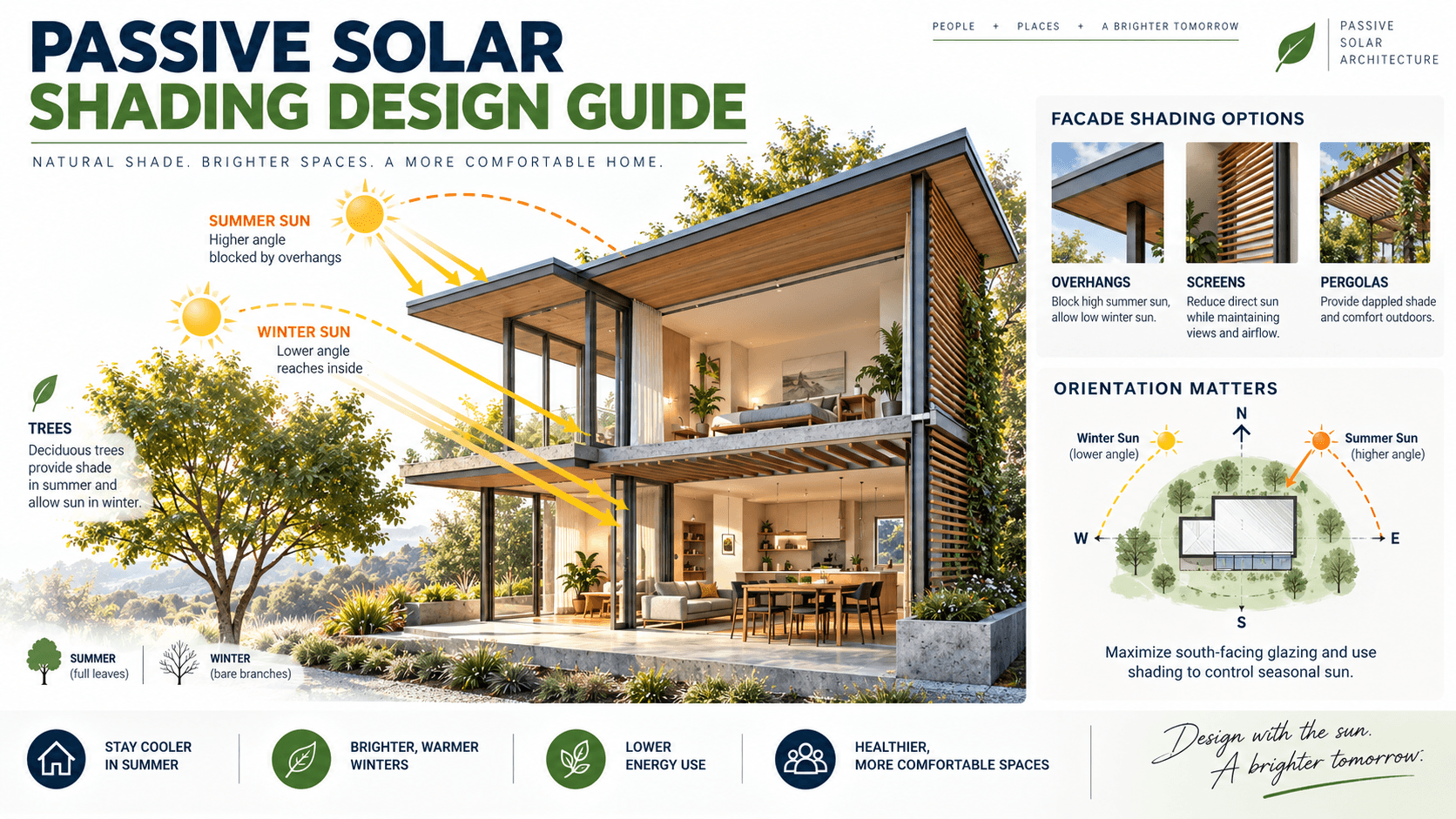
- shading and roof overhangs,
- thermal mass,
- insulation,
- airtightness,
- room layout,
- natural ventilation,
- passive cooling strategies.
The goal is to improve comfort and reduce unnecessary heating or cooling demand by making the building respond better to its environment.
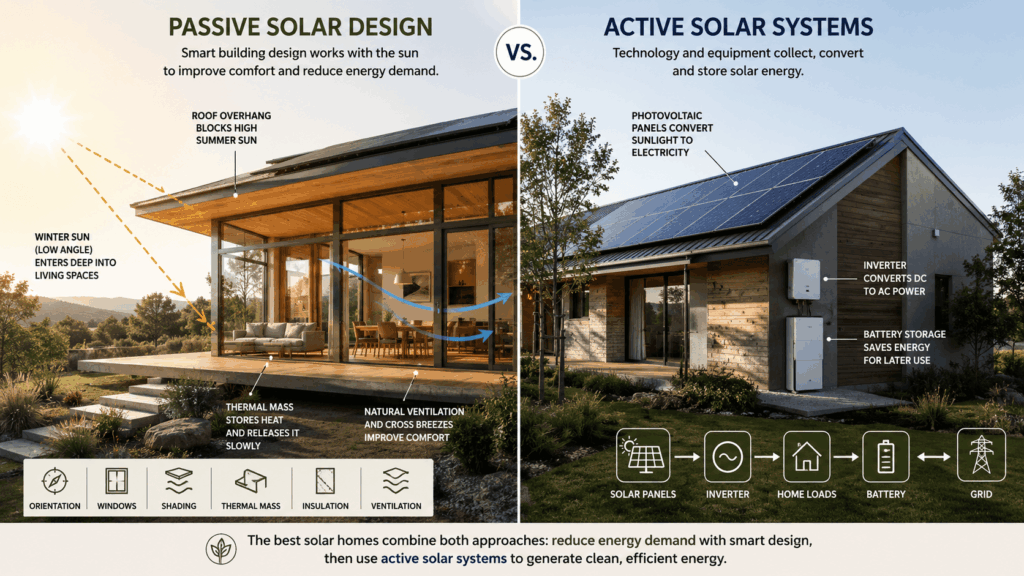
For example, in a cold or mixed climate, a passive solar home may allow useful winter sun into main living spaces. That sunlight may warm a concrete, tile, brick, or stone surface. The material stores some heat and releases it slowly as the room cools. In summer, roof overhangs or exterior shading help block unwanted sun before it overheats the interior.
Passive solar design can also be used in hot climates, but the goal may be different. Instead of collecting winter heat, the design may focus on reducing solar heat gain, improving shade, supporting airflow, and keeping indoor spaces cooler.
For a deeper explanation of the design framework, read passive solar design principles.
What Is Active Solar?
Active solar uses technology to collect, convert, move, or store solar energy.
The most common active solar system is a photovoltaic system, often called solar PV. Solar PV panels convert sunlight into electricity. That electricity can be used in the home, sent to the grid, or stored in a battery depending on the system design and local rules.
Active solar can also include solar thermal systems, which use solar collectors to heat water or another fluid. These systems may support domestic hot water, space heating, or pool heating, depending on the climate and design.
Common active solar components include:
- photovoltaic solar panels,
- solar thermal collectors,
- inverters,
- batteries,
- pumps,
- fans,
- controllers,
- sensors,
- wiring,
- mounting systems,
- heat exchangers,
- storage tanks.
Active solar systems are “active” because they usually require equipment, electrical components, moving parts, controls, or mechanical circulation.
That does not make active solar worse than passive solar. It simply means it works differently. Active solar is a technology system. Passive solar is a design strategy.
The U.S. Department of Energy provides a useful overview of solar energy technologies here: U.S. Department of Energy: Solar Energy Technologies Office.
Passive Solar vs Active Solar: The Core Difference
The simplest way to understand passive solar vs active solar is this:
Passive solar design reduces energy demand through architecture. Active solar systems produce or move energy through technology.
A passive solar home may need less heating or cooling because it is well oriented, shaded, insulated, ventilated, and designed around climate. An active solar system may then provide electricity or heat more efficiently because the home’s energy demand is lower.
| Feature | Passive Solar | Active Solar |
|---|---|---|
| Main approach | Building design | Technology system |
| Uses equipment? | Minimal or none for solar collection | Yes |
| Main purpose | Comfort, daylight, heating support, cooling control | Electricity generation or heat collection |
| Best planned when | Early design stage | Design stage or retrofit stage |
| Key elements | Orientation, glazing, shading, thermal mass, insulation, ventilation | Panels, collectors, batteries, inverters, pumps, controls |
| Main risk | Poor design can cause overheating, glare, or heat loss | Poor sizing, cost, maintenance, roof constraints, system complexity |
| Works without electricity? | Many passive strategies can | Most active systems depend on equipment and controls |
| Can be added later? | Some elements can, but major design choices are harder to change | Often yes, depending on roof, budget, wiring, and regulations |
The strongest result often comes from using both ideas in the right order: design the house to need less energy first, then size active systems around that lower demand.
How Passive Solar Works in a Home
Passive solar works by shaping the relationship between the sun, the building, and the interior environment.
In a heating-focused passive solar strategy, the building may:
- collect useful winter sun through equator-facing glazing,
- store some heat in thermal mass,
- retain warmth with insulation and airtightness,
- control excess solar gain with shading and ventilation.
For global accuracy, “equator-facing” is often more precise than “south-facing.” In the Northern Hemisphere, equator-facing usually means south-facing. In the Southern Hemisphere, it usually means north-facing.
Passive solar design is not only about heating. In warm climates, it may focus more on blocking solar heat, improving shade, and supporting passive cooling. In mixed climates, the challenge is balance: capturing useful winter sun without creating summer overheating.
Important passive solar design decisions include:
- where the house sits on the site,
- which direction the main rooms face,
- how much glass is placed on each facade,
- how roof overhangs are sized,
- whether thermal mass receives useful sun,
- how east and west windows are controlled,
- how ventilation removes heat when needed,
- whether insulation and airtightness support the strategy.
If you are planning a new home, use the passive solar design checklist before finalizing the floor plan or window layout.
How Active Solar Works in a Home
Active solar works by using equipment to capture solar energy and turn it into a usable form.
A solar PV system usually works like this:
- Solar panels receive sunlight.
- The panels produce direct current electricity.
- An inverter converts that electricity into usable household electricity.
- The electricity is used in the home, exported to the grid, or stored in a battery.
- Monitoring and controls help track performance.
A solar thermal system works differently:
- Solar collectors absorb heat from the sun.
- A fluid carries that heat through the system.
- A heat exchanger or storage tank holds the heat.
- The heat may be used for domestic hot water or another purpose.
Active solar systems can be powerful, but they also involve technical decisions such as:
- roof orientation,
- roof pitch,
- shading from trees or nearby buildings,
- available roof area,
- panel efficiency,
- inverter type,
- battery storage,
- system sizing,
- grid connection,
- maintenance,
- local incentives,
- code requirements,
- installer quality.
Active solar can reduce purchased energy, but it does not automatically make a home comfortable. A poorly insulated, overheated, or badly oriented house can still have comfort problems even if it has a large solar panel system.
That is why passive design and energy efficiency should not be skipped.
Passive Solar and Active Solar Compared by Homeowner Goal
The better choice depends on what the homeowner wants to improve.
| Homeowner Goal | Passive Solar Helps By | Active Solar Helps By |
|---|---|---|
| Better winter comfort | Using sun, mass, insulation, and layout to support warmth | Supplying electricity for heating systems if PV is installed |
| Lower electricity bills | Reducing heating, cooling, and lighting demand indirectly | Generating electricity directly |
| Lower heating demand | Capturing useful solar gain and reducing heat loss | Supporting electric heating or solar thermal systems |
| Lower cooling demand | Shading, ventilation, reduced heat gain, passive cooling | Supplying electricity for cooling equipment |
| Better daylight | Window placement and room layout | Not usually the main function |
| Backup power | Not the main purpose | Possible with batteries and appropriate system design |
| Retrofit potential | Limited for orientation and layout, useful for shading and insulation | Often possible if roof and electrical systems allow |
| Early design value | Very high | High, especially for roof planning and future readiness |
A common mistake is asking whether passive or active solar is “better.” The more useful question is: What problem are you trying to solve?
If the problem is poor comfort, overheating, glare, bad orientation, or heat loss, passive design may be the first priority. If the problem is electricity generation, active solar may be the better fit.
When Passive Solar Makes the Most Sense
Passive solar design makes the most sense when the building is still being planned.
It is especially valuable when:
- the site has useful solar access,
- the floor plan is not fixed yet,
- the owner wants better comfort and daylight,
- heating or cooling demand can be reduced through design,
- the climate supports useful solar strategies,
- the project can include shading and ventilation from the beginning,
- window sizes and specifications can still be adjusted.
Passive solar design is often most cost-effective when major decisions are made early. Orientation, room layout, window placement, roof overhangs, and thermal mass are much easier to coordinate before construction begins.
Some passive solar improvements can be added to existing homes, such as exterior shading, better windows, insulation, air sealing, or improved ventilation. But core decisions like building orientation and overall form are difficult to change later.
For homeowners and self-builders, passive solar design is not about making the house unusual. It is about making ordinary design decisions more intelligently.
For a broader design overview, read Passive Solar Design: A Beginner’s Guide.
When Active Solar Makes the Most Sense
Active solar makes the most sense when the goal is to generate electricity or collect solar heat through equipment.
It may be especially useful when:
- the home has a suitable roof or ground-mounted area,
- shading is limited,
- electricity costs are high,
- the household wants renewable electricity,
- the electrical system can support solar PV,
- the owner wants battery backup,
- local rules and incentives support solar installation,
- the home already has relatively low energy demand.
Active solar can be valuable in both new construction and retrofit projects. A solar PV system can often be added after the home is built, although it is easier when the roof, wiring, electrical panel, and equipment locations are planned in advance.
However, active solar should not be used as an excuse to ignore building performance.
A home with poor insulation, air leaks, oversized west-facing glass, and no shading may require more energy than necessary. Adding solar panels may offset some electricity use, but it does not solve the design problem.
A better sequence is:
- reduce energy demand,
- improve comfort,
- control overheating,
- design efficient systems,
- add active solar where it makes sense.
Can Passive and Active Solar Work Together?
Yes. In many projects, passive and active solar work best together.
A home might use passive solar design to reduce heating and cooling demand, then use active solar PV to generate electricity for remaining loads.
For example, a well-designed home might include:
- equator-facing living spaces for winter daylight,
- exterior shading for summer comfort,
- good insulation and airtightness,
- controlled window-to-wall ratios,
- thermal mass where useful,
- passive cooling strategies,
- a roof designed for future solar PV,
- efficient mechanical systems,
- battery storage if appropriate.
In this type of home, passive solar design reduces demand, while active solar helps supply energy.
This combination can be especially useful for homes aiming for lower operating costs, greater resilience, or future net-zero energy goals. But even then, the design should remain realistic. Solar panels do not remove the need for good architecture, and passive solar design does not remove the need for appropriate mechanical systems.
If your long-term goal is a high-performance home, begin with passive solar house design and then plan active systems around the building’s actual energy needs.
Design Implications for New Homes
For new homes, the passive solar vs active solar decision should not be treated as a competition. The two approaches affect different parts of the project.
Passive solar affects early architectural decisions:
- site planning,
- building orientation,
- room layout,
- glazing design,
- roof overhangs,
- shading,
- thermal mass,
- insulation,
- ventilation,
- passive cooling.
Active solar affects energy system planning:
- roof orientation and pitch,
- roof structure,
- panel layout,
- inverter location,
- battery location,
- electrical panel capacity,
- conduit routes,
- service access,
- future expansion,
- local interconnection rules.
A smart new home design considers both from the beginning.
For example, a roof can be shaped to support solar PV while the walls and windows are designed for passive comfort. A living room can face useful winter sun while the roof plane is also kept clear for panels. Shading can be designed so it protects windows without shading the PV array unnecessarily.
This is why passive and active solar should be coordinated, not chosen in isolation.
Design Implications for Existing Homes
Existing homes usually have fewer passive solar options because orientation, building form, and room layout are already fixed.
But that does not mean passive improvements are impossible.
Passive improvements for existing homes may include:
- adding exterior shading,
- planting climate-appropriate shade trees,
- upgrading windows,
- improving insulation,
- sealing air leaks,
- adding thermal mass surfaces where useful,
- improving ventilation,
- reducing west-facing heat gain,
- changing room use seasonally.
Active solar may be easier to add to an existing home if the roof has good solar exposure and the electrical system can support it.
However, a retrofit should still begin with basic questions:
- Is the home losing too much heat?
- Is it overheating in summer?
- Are windows causing glare or discomfort?
- Is the roof suitable for solar panels?
- Would insulation or shading provide better value first?
- Is the electrical system ready for PV or batteries?
- Are local permits, codes, and utility rules understood?
Before investing in active solar, many homeowners should first review the home’s envelope, shading, and energy demand. Generating energy is useful, but reducing waste is often the first step.
Common Misconceptions About Passive and Active Solar
Misconception 1: Solar Panels Make a House Passive Solar
Solar panels do not make a house passive solar. Solar panels generate electricity. Passive solar design manages heat, light, shade, and comfort through the building itself.
Misconception 2: Passive Solar Means No Heating System
Passive solar design can reduce heating demand, but most homes still need backup heating for cloudy days, cold nights, and extreme weather.
Misconception 3: Active Solar Fixes Poor Design
Active solar can generate energy, but it does not fix glare, overheating, poor ventilation, weak insulation, or bad window placement.
Misconception 4: Passive Solar Only Works in Cold Climates
Passive solar is not only about heating. In warm climates, passive solar principles may focus on shading, reduced heat gain, airflow, and passive cooling.
Misconception 5: More Glass Means Better Passive Solar
More glass can create more heat gain, but also more heat loss, glare, and overheating. Good passive solar design uses the right glass in the right place.
Misconception 6: Active Solar Is Always Better Because It Produces Energy
Producing energy is valuable, but reducing demand is also valuable. A smaller, more efficient energy load can make active solar systems more effective and easier to size.
Misconception 7: Passive Solar Is Old-Fashioned
Passive solar design is not outdated. It is a climate-responsive design approach that can work alongside modern insulation, high-performance glazing, efficient HVAC systems, and active solar technology.
Passive Solar vs Active Solar Checklist
Use this checklist when deciding how to prioritize passive and active solar strategies.
- Is the main goal comfort, lower energy demand, electricity generation, or resilience?
- Has the local climate been studied before choosing a strategy?
- Is the house still in the design stage, or is it an existing building?
- Can the building orientation still be changed?
- Are window placement and window sizes still flexible?
- Is overheating risk already addressed?
- Is the home well insulated and reasonably airtight?
- Is ventilation planned?
- Is the roof suitable for solar PV?
- Could roof-mounted panels be shaded by trees, chimneys, dormers, or nearby buildings?
- Is the electrical system ready for active solar?
- Would reducing energy demand first allow a smaller active solar system?
- Are local permits, codes, utility rules, and incentives understood?
- Has a qualified professional reviewed the project-specific assumptions?
For early passive design decisions, use the passive solar design checklist. For technical terms, refer to the passive solar glossary.
Questions to Ask Before Choosing a Solar Strategy
Before deciding between passive solar, active solar, or both, ask:
- What problem are we trying to solve first: comfort, heating demand, cooling demand, electricity use, or backup power?
- Is the house still early enough in design to improve orientation, glazing, shading, and room layout?
- Does the site have useful solar access for passive design, active solar, or both?
- Are there trees, buildings, slopes, chimneys, or roof elements that could cause shading?
- Would better insulation, air sealing, or shading reduce the system size needed?
- Is overheating already controlled before adding more solar gain?
- Is the roof designed for current or future solar PV?
- Are local energy codes, permits, utility rules, and incentives being considered?
- What maintenance will the active solar system require?
- Which assumptions should be checked by an architect, energy consultant, solar installer, or engineer?
These questions help prevent one of the most common mistakes: buying technology before understanding the building.
FAQ
What is the difference between passive solar and active solar?
Passive solar uses building design to manage sunlight, heat, shade, and comfort. Active solar uses equipment such as solar panels, collectors, pumps, inverters, batteries, and controls to collect or convert solar energy.
Is passive solar better than active solar?
Neither is automatically better. Passive solar is better for reducing demand and improving comfort through design. Active solar is better for generating electricity or collecting heat through equipment. Many homes can benefit from both.
Do solar panels count as passive solar?
No. Solar panels are active solar technology. Passive solar design uses orientation, windows, shading, thermal mass, insulation, and ventilation to manage heat and light naturally.
Can a home have both passive and active solar?
Yes. A home can use passive solar design to reduce heating and cooling demand, then use active solar panels or solar thermal systems to supply some of the remaining energy needs.
Which should come first, passive solar or active solar?
For new homes, passive solar and energy efficiency should usually be considered first because they affect long-term demand and comfort. Active solar can then be sized around a better-performing building.
Is active solar easier to add to an existing home?
Often, yes. Solar PV can sometimes be added to an existing roof if orientation, shading, structure, wiring, and local rules allow it. Major passive solar features, such as orientation and room layout, are harder to change later.
Does passive solar design work without electricity?
Many passive solar strategies can work without electricity because they rely on building design, sunlight, shading, mass, and natural heat movement. However, most homes still need mechanical systems for comfort, ventilation, and backup heating or cooling.
Conclusion
The difference between passive solar and active solar is simple but important.
Passive solar design uses the building itself to manage sunlight, heat, daylight, shade, and comfort. Active solar uses equipment to collect, convert, move, or store solar energy.
For most homes, the strongest approach is not choosing one and ignoring the other. It is reducing energy demand and improving comfort first, then using active solar systems where they make sense.
If you are designing a new home, passive solar decisions should begin early, before orientation, windows, shading, roof form, and room layout are fixed. If you are improving an existing home, start by understanding comfort problems and energy demand before investing in active solar technology.
Next step: Read the full guide to passive solar design principles to understand how passive strategies work together, or use the passive solar glossary if you want clear definitions before comparing design options.
Next step: check your own project
Try the ideas on your own project with the free passive solar design tools. It is free and runs in your browser.
Keep your results in one place
The free Passive Solar Design Checklist & Project Brief is a printable PDF with pages for your site’s sun angles, orientation, glazing per facade, shading and thermal mass, plus 12 questions to take to your architect or designer.