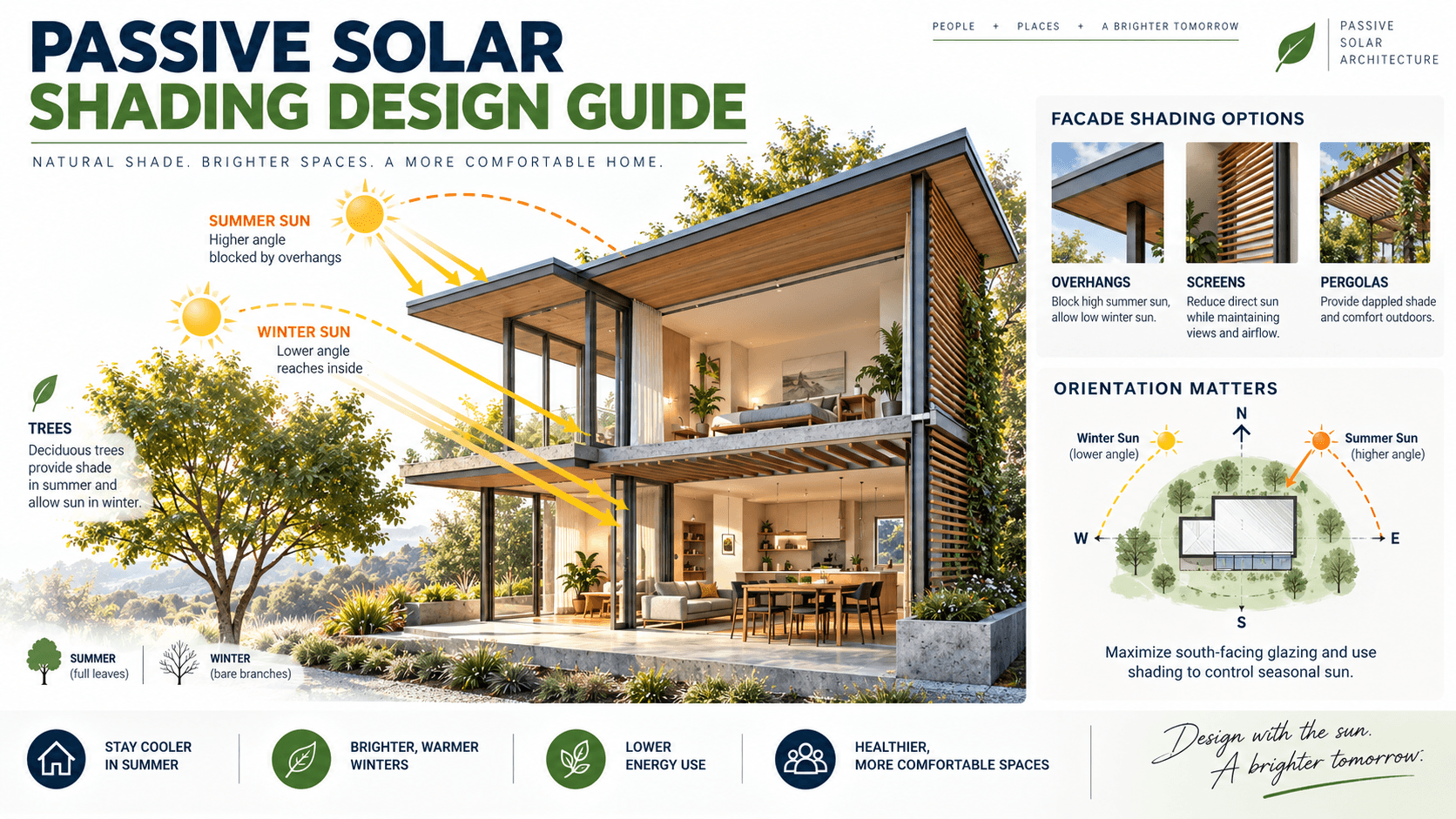
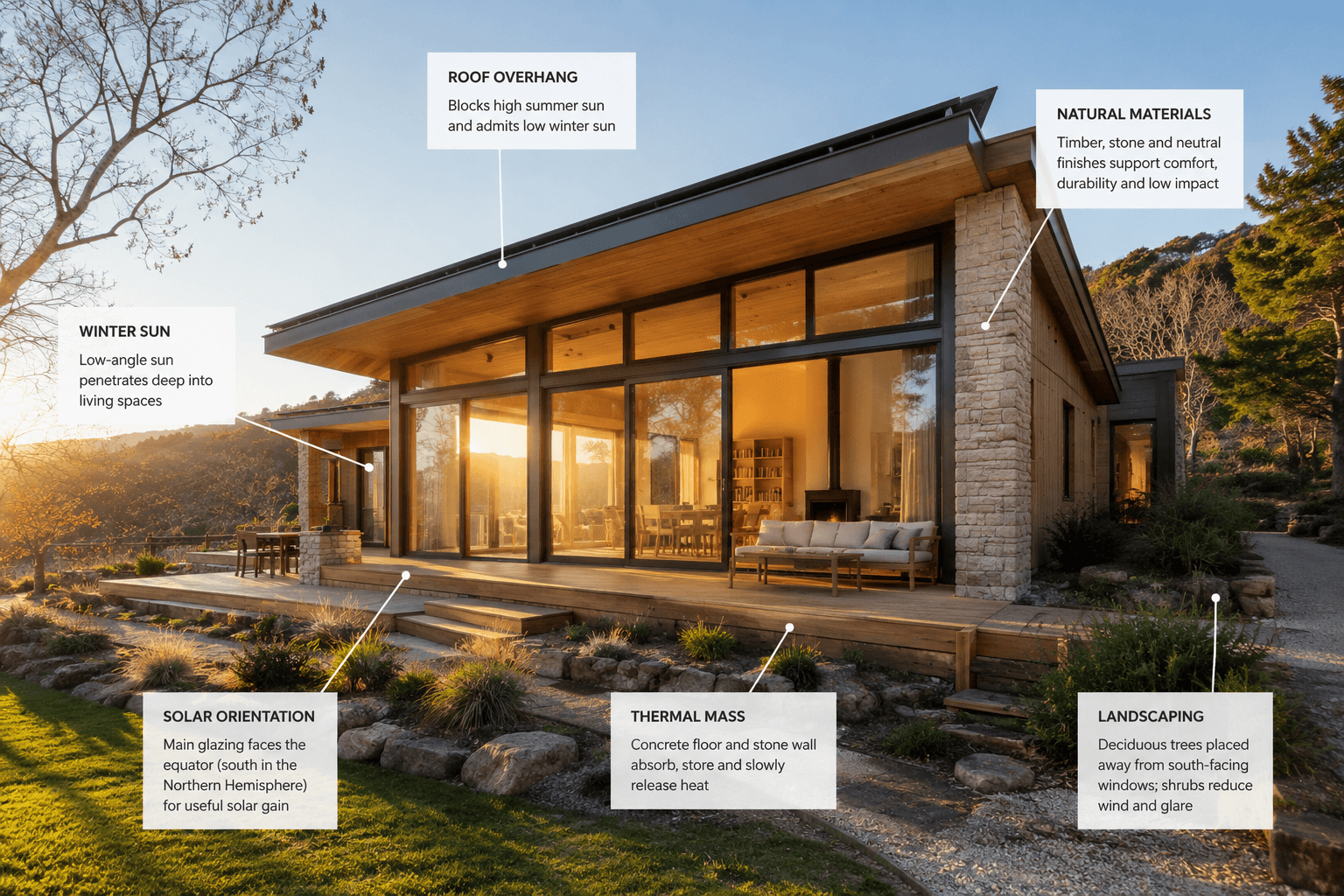
Solar orientation is one of the first decisions that shapes how well a passive solar home can work. Before window sizes, roof overhangs, thermal mass, or heating systems are discussed, the home needs to be placed and oriented in a way that makes sense for the sun, the site, and the climate.
In simple terms, solar orientation means positioning a building so it can use sunlight when it is helpful and avoid unwanted solar heat when it is not. In passive solar design, this affects winter comfort, summer overheating, daylight, room layout, shading, window performance, and energy demand.
But orientation is not just “face the house south.” That advice only works in some places, and it is too simple for real projects. A good passive solar orientation strategy considers hemisphere, latitude, seasonal sun angles, local climate, views, privacy, slope, trees, neighboring buildings, wind, and how people actually use the home.
This guide explains what matters most when orienting a passive solar home, how to check solar access, how orientation affects room layout, and which mistakes to avoid before your design becomes fixed. For the main pillar guide on this topic, you can also read passive solar orientation.
Try it on your own design: Passive Solar Orientation Calculator (free, about a minute).
Key Takeaways
- Solar orientation affects how a passive solar home receives sun, shade, daylight, and heat throughout the year.
- Equator-facing orientation is usually the most useful starting point for passive solar design, but it must be adapted to climate and site conditions.
- In the Northern Hemisphere, equator-facing usually means south-facing. In the Southern Hemisphere, it usually means north-facing.
- Good orientation is not enough on its own. Window size, shading, thermal mass, insulation, ventilation, and climate response must work together.
- East and west sun can be difficult to control, especially in warm and mixed climates.
- The best time to solve orientation is early, before the house position, floor plan, roof form, and window layout are finalized.
What Is Solar Orientation?
Solar orientation is the relationship between a building and the sun’s path across the sky.
For passive solar homes, orientation determines which parts of the house receive direct sunlight, when they receive it, and how intense that sunlight is during different seasons.
Good solar orientation helps answer questions such as:
- Which side of the home should receive the most winter sun?
- Where should main living spaces be located?
- Which windows are useful for solar gain?
- Which windows create overheating risk?
- Where should roof overhangs or exterior shading be placed?
- Can the site provide enough solar access in winter?
- Will the home need more passive heating, passive cooling, or both?
Solar orientation is not only about energy. It also affects daylight quality, glare, comfort, outdoor spaces, views, privacy, and how the home feels throughout the day.
If you are new to passive solar design as a whole, start with Passive Solar Design: A Beginner’s Guide before making orientation decisions.
Why Solar Orientation Matters in Passive Solar Homes
In passive solar design, the building itself helps manage heat and light. Solar orientation determines whether the building has the opportunity to do that well.
A well-oriented passive solar home can:
- collect useful winter sun where heating is needed,
- reduce unwanted summer heat gain,
- improve natural daylight,
- make roof overhangs more effective,
- reduce difficult east and west exposure,
- support comfortable room placement,
- improve the usefulness of thermal mass,
- reduce heating and cooling demand when combined with other strategies.
A poorly oriented home may have the opposite problems. It may miss useful winter sun, overheat in the afternoon, rely heavily on mechanical systems, or need expensive shading and glazing corrections later.
The important point is that orientation does not work alone. A house can face the right direction and still perform badly if the windows are oversized, thermal mass is missing, shading is wrong, or the building envelope is weak.
For the wider design framework, read passive solar design principles.
Start With Hemisphere, Not Habit
Many passive solar articles say that homes should face south. This is only true in the Northern Hemisphere.
For global design, the better term is equator-facing.
- In the Northern Hemisphere, equator-facing usually means south-facing.
- In the Southern Hemisphere, equator-facing usually means north-facing.
This matters because the sun’s path is different depending on which side of the equator the project is located. A design rule that works in Canada, the United States, or Europe cannot be copied directly to Australia, New Zealand, South Africa, or Argentina without adjusting the orientation logic.
Using “equator-facing” keeps the principle accurate across regions.
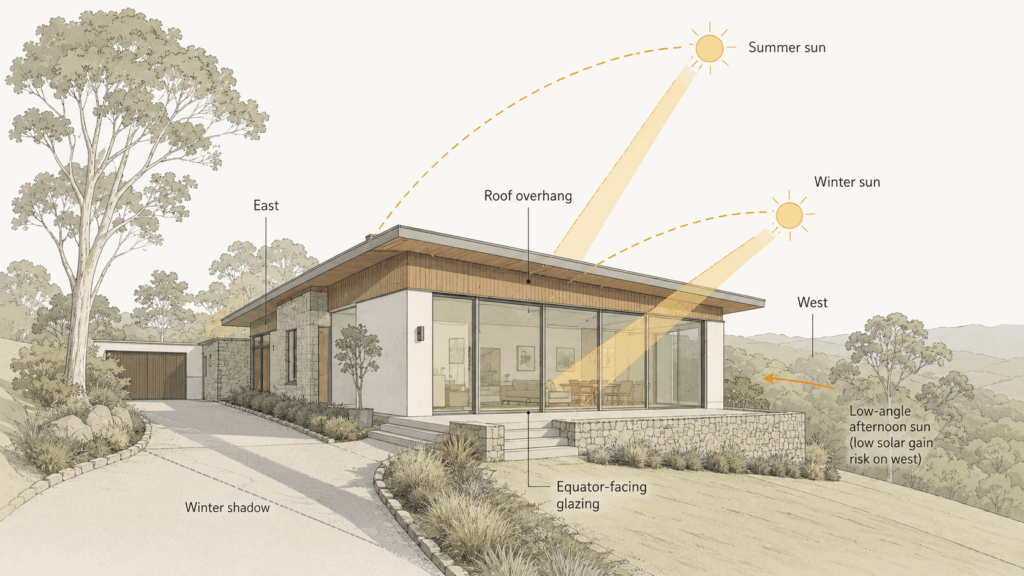
For passive solar homes, equator-facing walls and windows are often easier to manage because the sun is higher in summer and lower in winter. That seasonal difference makes it possible to design roof overhangs that admit useful low winter sun while blocking higher summer sun.
However, equator-facing is only a starting point. Local climate, site shading, slope, building form, and room layout still matter.
Understand the Sun Path Before Placing the House
A passive solar orientation strategy begins with the sun path.
The sun path describes where the sun rises, how high it travels, where it sets, and how that movement changes throughout the year.
In many regions:
- winter sun is lower in the sky,
- summer sun is higher in the sky,
- east sun is strongest in the morning,
- west sun is strongest in the afternoon,
- west-facing heat gain is often harder to control,
- seasonal shadows are longer in winter.
Before placing a passive solar home, the design team should understand:
- the winter sun path,
- the summer sun path,
- sunrise and sunset direction,
- noon sun angle,
- shadow patterns from nearby objects,
- solar access on the equator-facing side,
- areas of the site that are shaded during winter.
The goal is not to make the house receive maximum sun all year. The goal is to receive useful sun when it supports comfort and block sun when it creates overheating.
You can use the solar angle calculator to understand seasonal sun angles before deciding on window placement, roof overhangs, or shading depth.
Solar Access Comes Before Solar Orientation
A house can be oriented correctly and still fail to receive useful sun if the site is shaded.
Solar access means the building has access to sunlight when it is needed. In passive solar design, winter solar access is especially important in heating or mixed climates.
Common solar access obstacles include:
- tall trees,
- nearby buildings,
- hills or slopes,
- boundary walls,
- fences,
- garages,
- roof forms,
- neighboring future construction,
- dense urban surroundings.
Before deciding that a home is “well oriented,” check whether the important solar-facing areas are actually receiving sun.
A simple site analysis should ask:
- Is the equator-facing side open to winter sun?
- Are there trees or buildings blocking low winter sun?
- Will future tree growth create shade?
- Could a neighboring building block solar access later?
- Does the slope help or limit solar exposure?
- Are the best views in conflict with the best solar orientation?
- Is there a better house position on the site?
This is where many early mistakes happen. A plan may look good on paper, but if the solar-facing windows are shaded during winter, the passive solar strategy may not work as expected.
For early project checks, use the Passive Solar Orientation Calculator alongside your site observations.
How Orientation Affects Room Layout
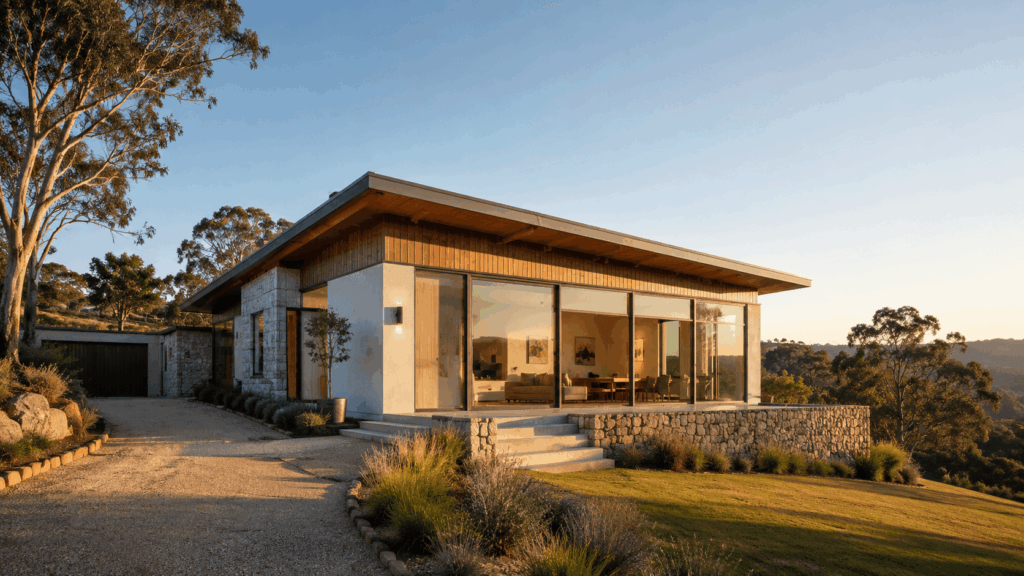
Solar orientation is not only about the outside of the house. It should shape the floor plan.
In a passive solar home, the most frequently used spaces should usually be placed where daylight and solar comfort are most useful. Secondary spaces can often be used as buffers on less favorable sides of the building.
A common layout strategy in heating or mixed climates is to place main daytime living spaces toward the equator-facing side. This may include:
- living room,
- dining area,
- kitchen,
- home office,
- family room,
- frequently used workspaces.
Spaces that need less direct sun can often be placed on cooler or less solar-favorable sides, such as:
- bathrooms,
- storage rooms,
- utility rooms,
- garages,
- closets,
- laundry rooms,
- circulation areas.
Bedrooms depend on climate and lifestyle. In some homes, morning sun may be pleasant. In warm climates, bedrooms may need protection from late afternoon heat so they remain comfortable at night.
The right layout depends on how the home is used. A retired couple, a family with children, and a remote worker may all need different solar priorities.
For broader planning, read passive solar house design before finalizing your floor plan.
Orientation by Facade: What Each Side Usually Means
Each side of a house behaves differently. Understanding this helps you place windows, rooms, shading, and thermal mass more intelligently.
| Facade Orientation | Typical Solar Behavior | Design Implication |
|---|---|---|
| Equator-facing | Often receives the most useful seasonal solar access | Good candidate for main living spaces, controlled glazing, shading, and thermal mass |
| East-facing | Receives morning sun | Useful for morning light, but may need control in warm climates |
| West-facing | Receives low-angle afternoon sun | Often high overheating and glare risk; usually needs strong shading or reduced glazing |
| Pole-facing | Receives less direct solar gain | Useful for softer daylight, service spaces, or controlled openings depending on climate |
This table is a starting point, not a final design rule. Cloud cover, latitude, climate, surrounding shade, and room use can change the best strategy.
The biggest caution is usually west-facing glass. Afternoon sun often arrives when outdoor temperatures are already high, so it can add heat at the worst time of day. Horizontal roof overhangs are often less effective for low-angle west sun, which may require vertical fins, exterior blinds, shutters, trees, or reduced glazing.
The Best Orientation Depends on Climate
Solar orientation should always respond to climate. A cold-climate passive solar home has different priorities than a hot-humid home.
| Climate Type | Orientation Priority | Main Risk | Design Focus |
|---|---|---|---|
| Cold climate | Maximize useful winter solar access where available | Heat loss through too much glass | Equator-facing glazing, insulation, airtightness, thermal mass |
| Temperate climate | Balance winter sun with summer shading | Mild overheating or underuse of solar gain | Moderate glazing, seasonal shading, flexible ventilation |
| Hot-dry climate | Control sun while using shade and night cooling | Thermal mass storing unwanted heat | Shading, limited solar gain, night ventilation where suitable |
| Hot-humid climate | Reduce heat gain and support airflow | Heat, humidity, glare | Shade, ventilation, reduced east/west exposure, moisture-aware design |
| Mixed climate | Balance heating and cooling seasons | Winter-focused design overheating in summer | Adjustable shading, careful glazing, climate-specific room layout |
In cold climates, orientation often supports winter heating. In hot climates, orientation may be more about avoiding heat gain and improving shade. In mixed climates, the goal is balance.
This is why a generic orientation rule can be misleading. Solar orientation should be checked against local climate data, seasonal comfort goals, and the actual site.
For more detail, continue with passive solar design by climate.
How Close to Perfect Does Orientation Need to Be?
A passive solar home does not always need to face the exact ideal direction.
In real projects, the perfect solar orientation may conflict with views, street access, slope, neighboring buildings, planning rules, or outdoor living areas. A good design does not ignore these constraints. It works with them.
Small deviations from ideal orientation can often be managed with:
- adjusted window sizes,
- better glazing specifications,
- exterior shading,
- room layout changes,
- thermal mass placement,
- improved insulation,
- passive cooling strategies,
- landscape design.
The question is not whether the home is mathematically perfect. The question is whether the orientation still supports the passive solar strategy.
A slightly imperfect orientation with good shading, balanced glazing, and a strong envelope may perform better than a perfectly oriented home with too much glass and no overheating control.
Use the passive solar design checklist to review the full set of design factors, not orientation alone.
Window Placement and Orientation Work Together
Solar orientation becomes most important when it is connected to window placement.
A wall can face the right direction, but if the windows are too large, too small, poorly specified, or badly shaded, the result may still be uncomfortable.
Window decisions should consider:
- orientation of each facade,
- window-to-wall ratio,
- Solar Heat Gain Coefficient, or SHGC,
- U-value or U-factor,
- visible light transmission,
- room use,
- glare risk,
- privacy,
- views,
- exterior shading,
- ventilation needs.
Equator-facing glazing may be useful for winter solar gain in many heating or mixed climates. West-facing glazing may need to be smaller or more carefully shaded. Pole-facing glazing may provide useful daylight with less direct solar heat, but in cold climates it can increase heat loss if oversized or poorly specified.
For early design checks, use the window-to-wall ratio calculator and read more about passive solar windows.
Orientation and Thermal Mass
Thermal mass stores and releases heat. But it only supports passive solar performance when it is placed where it can interact with useful heat.
Solar orientation affects whether sunlight can reach thermal mass at the right time of year.
For example, an exposed concrete or tile floor near equator-facing winter glazing may absorb useful solar heat during the day and release some of it later. But a heavy floor that never receives sun may not contribute much to passive solar heating. In a hot climate, unshaded mass may store unwanted heat and make the home less comfortable.
Thermal mass should be:
- located where useful sun or warm indoor air can reach it,
- protected from unwanted summer solar gain,
- balanced with window area,
- exposed to indoor air,
- appropriate for the local climate,
- supported by insulation and ventilation.
This is why orientation, glazing, shading, and thermal mass should be designed together.
For more detail, read thermal mass and passive solar materials.
Orientation and Roof Overhangs
Roof overhangs are often used to control sun on equator-facing windows.
They work because the sun is usually higher in summer and lower in winter. A well-designed overhang can help block high summer sun while allowing lower winter sun to enter.
However, overhang design depends on:
- latitude,
- wall orientation,
- window height,
- overhang depth,
- distance from glass,
- roof geometry,
- seasonal sun angles,
- climate goals.
A roof overhang that works in one location may not work in another. A deep overhang may block useful winter sun. A shallow overhang may allow too much summer sun. East and west windows are often harder to protect with horizontal overhangs alone because low-angle sun can enter under the shade.
Use the roof overhang calculator when testing early assumptions, and read more about passive solar shading and overhangs.
Practical Solar Orientation Workflow
Use this workflow before finalizing a passive solar home design.
Step 1: Identify the Hemisphere and Climate
First, confirm whether the project is in the Northern or Southern Hemisphere. Then identify the climate type: cold, temperate, hot-dry, hot-humid, or mixed.
This tells you whether orientation should focus mainly on heat gain, heat control, daylight, ventilation, or seasonal balance.
Step 2: Map the Sun Path
Study the sun path for the site. Look at winter and summer sun angles, sunrise and sunset directions, and seasonal shadow patterns.
Use the solar angle calculator to understand how the sun behaves at your location.
Step 3: Check Solar Access
Look for anything that blocks sun, especially during winter in heating-focused climates.
Check trees, buildings, walls, slopes, garages, and possible future development. If the equator-facing side is shaded during winter, the passive solar strategy may need to change.
Step 4: Place the House on the Site
Choose a house position that balances solar access with views, privacy, driveway access, slope, drainage, outdoor spaces, and local rules.
Do not orient the house for sun while ignoring the rest of the site.
Step 5: Arrange the Rooms
Place the rooms that benefit most from daylight and comfort on the best solar-facing sides. Use storage, utility, bathrooms, circulation, or garage spaces as buffers where appropriate.
Step 6: Design the Windows
Size and place windows by orientation. Avoid simply maximizing glass. Check SHGC, U-value, glare, privacy, shading, and ventilation.
Step 7: Add Shading and Overhangs
Design shading for the actual sun angles. Control summer sun, especially on equator-facing, east-facing, and west-facing windows.
Step 8: Review Thermal Mass and Ventilation
Make sure thermal mass receives useful heat when needed and does not store unwanted heat. Include ventilation and passive cooling where the climate requires it.
Step 9: Recheck the Whole Strategy
Orientation should be reviewed together with the full design. Use the Passive Solar Orientation Calculator and the passive solar design checklist before the design is fixed.
Example: A Site With Good Views but Difficult Solar Orientation
Imagine a self-builder planning a home on a sloped site.
The best view is to the west. The owner wants large living room windows facing the view. The site is in a mixed climate with warm summers and cool winters.
At first, a west-facing living room seems attractive. It offers views and afternoon light. But from a passive solar orientation perspective, there are risks:
- strong low-angle afternoon sun,
- summer overheating,
- glare in the main living space,
- difficult shading,
- thermal mass storing heat late in the day,
- higher cooling demand.
A better solution might not be to ignore the view. Instead, the design could:
- keep some west-facing glazing for the view,
- reduce the total west-facing glass area,
- use exterior vertical shading or adjustable screens,
- place the main solar-gain windows toward the equator-facing side,
- use roof overhangs for seasonal control,
- locate thermal mass where it receives winter sun but avoids summer overheating,
- create shaded outdoor spaces on the west side,
- use cross ventilation if the climate supports it.
The lesson is that orientation is not about choosing sun or views. It is about designing the house so comfort, daylight, views, and climate all work together.
Common Solar Orientation Mistakes
1. Assuming South-Facing Always Means Correct
South-facing is usually relevant in the Northern Hemisphere, but not everywhere. In the Southern Hemisphere, north-facing is usually the equator-facing direction. Use the equator as the reference point.
2. Ignoring the Local Climate
A heating-focused orientation strategy may create overheating in a hot or mixed climate. Climate should guide the orientation goal.
3. Orienting the House Correctly but Placing Rooms Poorly
The house may face the right way, but if storage rooms get the best sun while living spaces sit on the wrong side, the benefit is reduced.
4. Using Too Much Glass on the Solar Side
Good orientation does not justify unlimited glazing. Too much glass can cause heat loss, overheating, glare, and discomfort.
5. Forgetting East and West Sun
East and west sun can be difficult to shade, especially low-angle west sun. These facades need careful window sizing and shading.
6. Ignoring Existing or Future Shade
Trees, neighboring buildings, and future construction can block solar access. A good orientation plan must include shade analysis.
7. Treating Orientation as the Only Passive Solar Strategy
Orientation matters, but it must work with glazing, shading, thermal mass, insulation, airtightness, and ventilation.
8. Copying a Plan From Another Region
A house plan designed for one latitude, hemisphere, or climate may perform poorly somewhere else.
9. Forgetting Summer Comfort
A home designed only to capture winter sun may overheat in spring, summer, or fall. Shading and ventilation must be included early.
10. Waiting Too Long to Analyze Orientation
Orientation is hard to fix after the floor plan, driveway, roof form, and window layout are finalized. It should be reviewed at the beginning.
Solar Orientation Checklist for Passive Solar Homes
Use this checklist before approving a site plan or concept design.
- Has the project hemisphere been confirmed?
- Has the local climate type been identified?
- Is the design goal mainly heating, cooling, daylight, or seasonal balance?
- Has the sun path been reviewed for winter and summer?
- Has the site been checked for shade from trees, buildings, slopes, and fences?
- Is the equator-facing side available for useful solar access?
- Are main living spaces placed where sunlight supports comfort?
- Are bedrooms protected from unwanted heat where necessary?
- Are east and west windows carefully controlled?
- Is window area designed by orientation, not just views?
- Are roof overhangs or exterior shading matched to the sun angles?
- Is thermal mass located where it can receive useful heat?
- Is summer overheating risk considered?
- Are ventilation and passive cooling part of the plan?
- Has the orientation been reviewed with local climate data or a qualified professional?
This checklist is not a final design method, but it helps identify early problems before they become expensive.
Questions to Ask Your Architect or Designer
Before finalizing the orientation of a passive solar home, ask:
- What is the best solar orientation for this site and climate?
- Are we using equator-facing orientation correctly for this hemisphere?
- Which rooms receive the best winter sun?
- Which rooms are most at risk of overheating?
- How much east and west glazing is included, and why?
- What objects shade the site in winter and summer?
- Will future trees or neighboring buildings affect solar access?
- Are roof overhangs sized for this latitude and window height?
- How does the orientation support passive cooling?
- Which assumptions should be checked with the orientation calculator, solar angle calculator, or local climate data?
These questions help keep orientation connected to comfort, not just compass direction.
Suggested Diagram for This Article
Add a simple diagram after the section “Understand the Sun Path Before Placing the House.”
Suggested diagram prompt:
“Create a clean educational diagram showing a passive solar home on a site with the sun path in winter and summer. Show equator-facing glazing, longer winter shadows, higher summer sun, roof overhang shading, east and west facades, and nearby trees casting shade. Use a simple architectural style with clear labels.”
Suggested alt text:
“Solar orientation diagram for passive solar homes showing equator-facing glazing, winter sun, summer shading, and site shade analysis.”
FAQ
What is solar orientation in passive solar design?
Solar orientation is the way a building is positioned in relation to the sun’s path. In passive solar design, it affects solar gain, daylight, shading, overheating risk, room layout, and comfort.
What is the best orientation for a passive solar home?
The best orientation depends on hemisphere, climate, site conditions, and design goals. In many passive solar homes, the most useful glazing faces the equator: south in the Northern Hemisphere and north in the Southern Hemisphere.
Is south-facing always best for passive solar homes?
No. South-facing is usually the solar-facing direction in the Northern Hemisphere. In the Southern Hemisphere, north-facing is usually more appropriate. Climate and site shading also affect the best orientation.
How important is orientation compared with windows?
Orientation and windows work together. Good orientation creates the opportunity for useful sun, but window size, placement, glazing type, shading, and thermal mass determine whether that sun improves comfort or creates problems.
Can a passive solar home work if the orientation is not perfect?
Yes, in many cases. A slightly imperfect orientation can often be managed with better window placement, shading, insulation, thermal mass, and ventilation. The design should be checked as a whole system.
Why are west-facing windows a problem?
West-facing windows can receive strong low-angle afternoon sun, often when outdoor temperatures are already high. This can cause overheating and glare, especially in warm and mixed climates.
Should I orient my house for sun or views?
A good design tries to balance both. Views matter, but large windows facing the wrong direction can create comfort problems. The best solution may combine controlled view windows with better solar-facing glazing, shading, and room layout.
Conclusion
Solar orientation is one of the most important early decisions in passive solar home design. It shapes how the house receives winter sun, avoids summer overheating, supports daylight, organizes rooms, and connects to the site.
The key lesson is that orientation is not a single compass rule. A good passive solar orientation strategy considers hemisphere, latitude, climate, sun path, solar access, site constraints, room layout, window design, shading, thermal mass, and ventilation.
For homeowners, self-builders, and architects, the best time to solve orientation is before the floor plan and window layout are fixed. Once the house is designed, orientation problems become much harder to correct.
Next step: Use the Passive Solar Orientation Calculator to check your early design assumptions, then review the full passive solar design checklist before finalizing the site plan.
Next step: check your own project
Check how far your main facade is from ideal with the Passive Solar Orientation Calculator. It is free and runs in your browser.
Keep your results in one place
The free Passive Solar Design Checklist & Project Brief is a printable PDF with pages for your site’s sun angles, orientation, glazing per facade, shading and thermal mass, plus 12 questions to take to your architect or designer.