
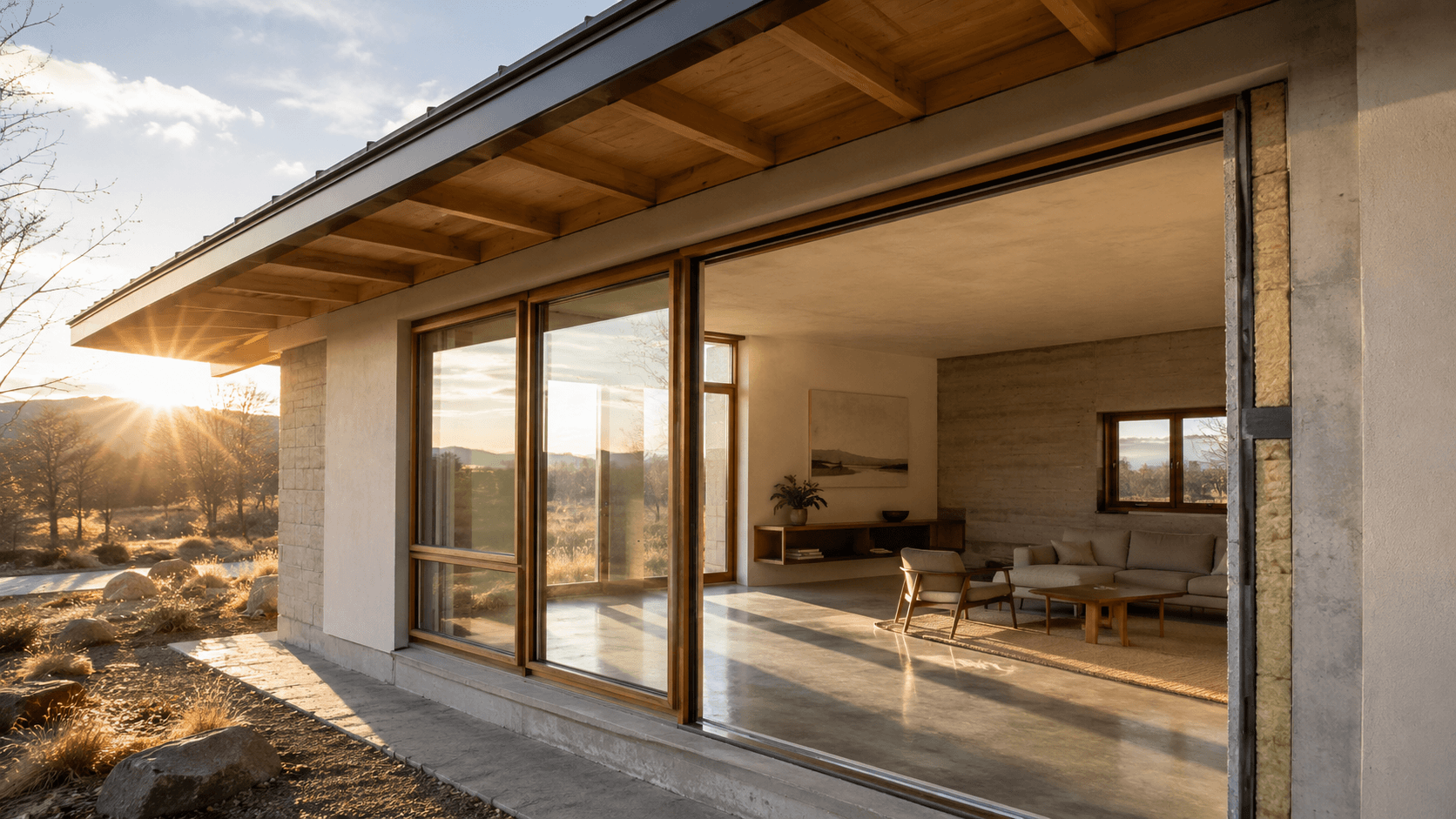
Thermal mass is one of the most important ideas in passive solar design, but it is also one of the most misunderstood.
Many people hear the phrase and imagine a concrete floor, a stone wall, or a thick masonry surface that somehow “stores free heat.” In reality, thermal mass only works well when it is part of a complete design strategy. It needs the right climate, the right amount of solar access, the right window design, the right shading, and the right insulation.
In passive solar design, thermal mass helps moderate indoor temperature swings by absorbing heat when the space is warm and releasing it later when the space cools. This can make a home feel more stable, especially in climates where there is useful winter sun or a strong difference between day and night temperatures.
But thermal mass is not always helpful. In the wrong climate, in the wrong location, or without proper shading, it can store unwanted heat and make overheating worse.
This guide explains what thermal mass does, how it works in passive solar homes, which materials are commonly used, when it helps, when it hurts, and how to avoid the most common mistakes. For the broader design framework, start with passive solar design principles and use this article as a focused guide to thermal storage.
Try it on your own design: Thermal Mass Calculator (free, about a minute).
Key Takeaways
- Thermal mass stores and releases heat, helping reduce indoor temperature swings when used correctly.
- Thermal mass is not insulation. Insulation slows heat flow; thermal mass absorbs and releases heat.
- Thermal mass needs a heat source, such as winter sun, warm indoor air, or controlled internal heat gains.
- Location matters. Mass works best when it is exposed to useful heat and indoor air, not hidden under insulating finishes.
- Climate matters. Thermal mass can help in cold, temperate, hot-dry, and mixed climates, but it must be used carefully in hot-humid climates.
- Shading is essential. Uncontrolled summer sun can turn thermal mass into a heat problem instead of a comfort solution.
What Is Thermal Mass?
Thermal mass is the ability of a material to absorb, store, and slowly release heat.
Dense, heavy materials usually have more useful thermal mass than lightweight materials. Common examples include concrete, brick, stone, tile, adobe, rammed earth, masonry, and some dense plasters.
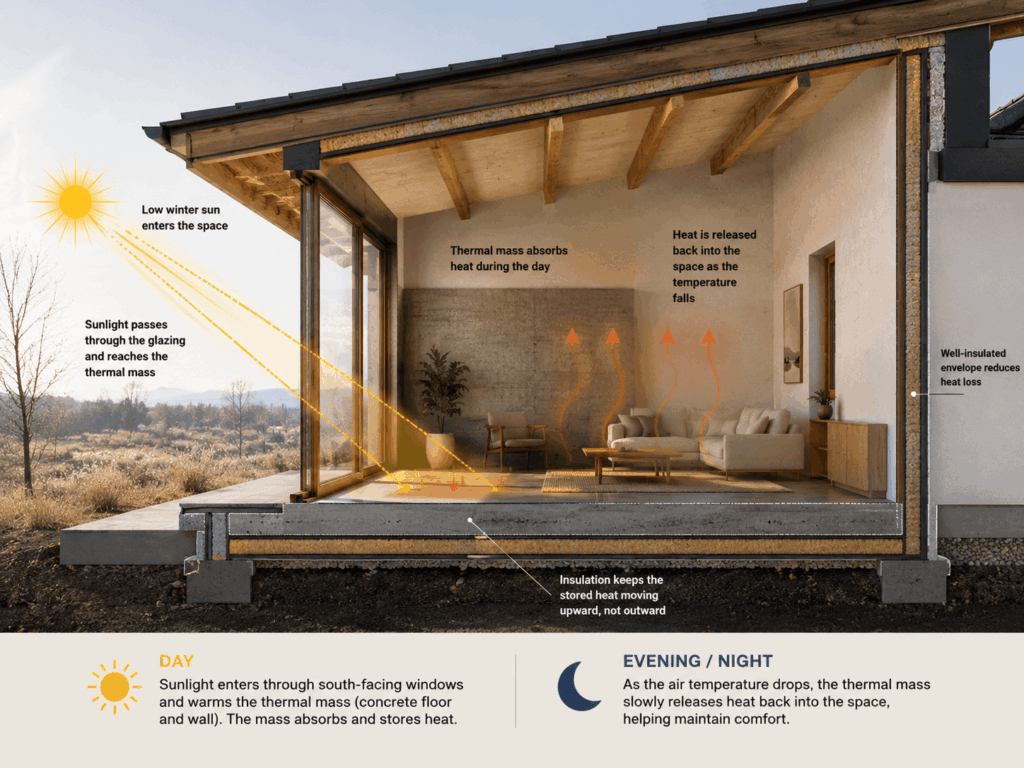
In a passive solar home, thermal mass can absorb heat from sunlight during the day and release some of that heat later as indoor temperatures drop. This can reduce temperature swings and make the home feel more comfortable.
A simple example is a sunny room with a tile or concrete floor. During the day, winter sun enters through equator-facing windows and warms the floor. The floor absorbs some of that heat instead of allowing the room temperature to rise too quickly. Later, when the sun is gone and the room begins to cool, the floor slowly releases heat back into the space.
That is the basic principle. But the details matter.
Thermal mass is useful only when it is connected to the rest of the design: windows, shading, orientation, insulation, ventilation, and climate. If you are new to the overall concept, read Passive Solar Design: A Beginner’s Guide before making material decisions.
Thermal Mass Is Not Insulation
One of the most common misunderstandings is confusing thermal mass with insulation.
They are not the same thing.
Insulation slows heat movement through the building envelope. It helps keep heat inside during cold weather and outside during hot weather.
Thermal mass absorbs, stores, and releases heat. It does not stop heat from moving the way insulation does.
A concrete wall may have thermal mass, but that does not automatically make it a good insulated wall. A poorly insulated masonry wall can still lose heat quickly to the outside. In many climates, thermal mass should be placed inside the insulated envelope so it can interact with indoor temperatures rather than losing heat directly outdoors.
| Feature | Insulation | Thermal Mass |
|---|---|---|
| Main function | Slows heat flow | Stores and releases heat |
| Typical materials | Mineral wool, cellulose, foam, wood fiber, fiberglass | Concrete, brick, stone, tile, adobe, rammed earth |
| Best location | Building envelope | Inside the insulated living space |
| Main comfort role | Reduces heat loss or heat gain | Smooths temperature swings |
| Main risk if misunderstood | Building loses or gains heat too quickly | Mass stores unwanted heat or feels cold |
A good passive solar home may need both. Insulation helps the home retain comfort. Thermal mass helps moderate the timing of heat.
How Thermal Mass Works in Passive Solar Design
Thermal mass works by delaying the movement of heat.
When sunlight or warm indoor air reaches a dense material, the material absorbs some of that heat. Because dense materials heat up and cool down more slowly than lightweight materials, they can reduce sudden temperature changes.
In passive solar design, this can create three useful effects.
Heat Absorption
During sunny winter periods, thermal mass can absorb heat that might otherwise make a room too warm too quickly.
This is especially useful in direct gain passive solar spaces, where sunlight enters the room directly through windows. Without enough thermal mass, the room may become hot during the day and cold again at night.
Heat Storage
After absorbing heat, the mass holds some of it for a period of time.
The exact timing depends on the material, thickness, surface exposure, temperature difference, solar gain, airflow, and construction details. Thermal mass is not an unlimited battery. It can only store and release heat within the physical limits of the material and design.
Heat Release
When the room cools, the stored heat can move back into the indoor air.
This release can support comfort during evening or nighttime hours, but it should not be exaggerated. Thermal mass can help reduce temperature swings, but it does not eliminate the need for heating systems in most homes.
For homes focused on passive heating, read passive solar heating explained for homes to see how thermal mass works with windows, insulation, and backup systems.
Where Thermal Mass Fits in the Passive Solar System
Thermal mass is only one part of passive solar design. It should not be treated as a standalone feature.
A successful passive solar strategy usually coordinates:
- solar orientation,
- window placement,
- glazing area,
- SHGC and U-value,
- shading,
- roof overhangs,
- thermal mass,
- insulation,
- airtightness,
- ventilation,
- passive cooling.
For example, equator-facing windows may admit useful winter sun. Thermal mass may absorb some of that heat. Insulation may help retain it. Shading may prevent the same windows from overheating the home in summer. Ventilation may help remove excess heat when outdoor conditions allow.
If one part of the system is missing, the thermal mass may not perform well.
A concrete floor without solar access may do little for passive solar heating. A masonry wall behind oversized unshaded glass may store too much heat. A thermal mass floor in a poorly insulated home may feel cold and uncomfortable.
This is why thermal mass should be designed together with passive solar windows, passive solar orientation, and passive solar shading and overhangs.
Common Thermal Mass Materials
Many materials can act as thermal mass, but they do not all behave the same way.
The best choice depends on climate, design goals, structure, budget, local availability, finishes, and construction method.
| Material | How It Is Commonly Used | Strengths | Design Cautions |
|---|---|---|---|
| Concrete | Floors, slabs, walls, topping slabs | High mass, durable, common in construction | Can feel cold if poorly insulated or poorly finished |
| Brick | Interior walls, masonry fireplaces, feature walls | Good heat storage, familiar material | Must be exposed to indoor air or sun to be useful |
| Stone | Floors, walls, interior features | High density, strong visual character | Can be expensive and slow to warm |
| Tile | Flooring over slab or mortar bed | Good surface for absorbing sun | Thin tile alone has limited mass without mass below |
| Adobe | Walls, floors, traditional construction | High mass, natural material | Climate and moisture detailing are critical |
| Rammed earth | Walls, internal mass elements | High mass, durable, natural appearance | Needs proper insulation strategy in many climates |
| Masonry block | Walls, internal partitions | Common and robust | Exterior mass must be insulated appropriately |
| Dense plaster | Wall finish over mass or masonry | Adds useful surface mass | Limited storage compared with heavy structural mass |
The most important point is exposure. Thermal mass hidden behind insulation, thick carpet, raised flooring, lightweight finishes, or furniture may not interact well with the room.
If you are comparing materials, continue with passive solar materials.
Where to Place Thermal Mass
Thermal mass placement is often more important than material choice.
A high-mass material in the wrong location may do very little. A modest amount of well-placed mass can be more useful than a large amount that never receives heat.
Place Mass Where Useful Sun Can Reach It
In direct gain passive solar design, thermal mass often works best where winter sun can reach it directly or indirectly.
Common locations include:
- exposed concrete floors near equator-facing windows,
- tile floors over a slab,
- masonry interior walls receiving winter sun,
- stone or brick surfaces in sunny living spaces,
- interior mass walls that receive warm air and radiant heat.
The goal is not to put mass everywhere. The goal is to place it where it can absorb useful heat when that heat is available.
Keep Mass Inside the Insulated Envelope
Thermal mass usually works best inside the conditioned space.
If mass is outside the insulation layer, it may store heat that is lost outdoors rather than helping indoor comfort. This is why uninsulated concrete or masonry walls can be problematic in cold climates.
In many high-performance homes, thermal mass is placed inside a well-insulated and airtight shell.
Keep the Surface Exposed
Thermal mass needs to exchange heat with the room.
Avoid covering useful thermal mass with:
- thick carpet,
- insulating underlay,
- raised timber floors,
- large rugs over key sunny areas,
- built-in cabinetry,
- heavy furniture,
- insulated wall linings.
A polished concrete floor, exposed brick wall, tile floor, or interior masonry surface may perform better than mass hidden behind finishes.
Avoid Uncontrolled Summer Solar Gain
Thermal mass can store unwanted heat too.
If summer sun reaches a concrete floor or masonry wall for hours, the material may absorb heat and release it later when the home should be cooling down. This can make overheating worse.
Good shading is essential. Use the roof overhang calculator to test early shading ideas for solar-facing windows.
Thermal Mass and Direct Gain Design
Thermal mass is most commonly discussed in direct gain passive solar design.
In direct gain, sunlight enters the living space directly through windows. The same room where people live is also the room where solar energy is collected.
This can work well because the strategy is simple. Sunlight warms the room, and exposed mass helps absorb some of the heat. But direct gain also needs careful control.
Without enough thermal mass, a direct gain room may overheat quickly on sunny days. Without shading, the same room may become uncomfortable in warmer seasons. Without good windows and insulation, the room may lose heat quickly at night.
A direct gain room should be checked for:
- window area,
- solar orientation,
- SHGC,
- U-value,
- thermal mass area,
- thermal mass exposure,
- roof overhangs,
- exterior shading,
- ventilation,
- nighttime heat loss,
- summer overheating.
Use the window-to-wall ratio calculator before assuming that a large sunny window needs only “more mass” to work well.
Thermal Mass by Climate
Thermal mass is climate-dependent. It can be very useful in some situations and less useful or even problematic in others.
| Climate Type | Thermal Mass Potential | Best Use | Main Risk |
|---|---|---|---|
| Cold climate | Useful when winter sun is available and the envelope is strong | Store daytime solar gain and moderate temperature swings | Mass feels cold or loses heat if poorly insulated |
| Temperate climate | Often useful with seasonal shading | Balance mild winter gain and daily temperature swings | Overheating in spring or autumn |
| Hot-dry climate | Can be useful with night cooling | Absorb heat during the day and release it when nights are cool | Heat buildup if nights stay warm or ventilation is poor |
| Hot-humid climate | Must be used carefully | Limited mass, shaded mass, or mass used only where appropriate | Stored heat and humidity-related discomfort |
| Mixed climate | Useful but requires control | Combine moderate mass with adjustable shading and ventilation | Winter-focused mass strategy causing summer overheating |
For a broader climate comparison, read passive solar design by climate.
Cold Climates
In cold climates, thermal mass can help store useful solar heat when winter sun is available.
However, the building envelope must be strong. If the home is poorly insulated or leaky, the stored heat may be lost too quickly. Thermal mass should usually be inside the insulated envelope and paired with high-performance windows and airtight construction.
Cold-climate thermal mass works best when:
- winter sun reaches the mass,
- glazing is not oversized,
- insulation is strong,
- air leakage is controlled,
- nighttime heat loss is considered,
- backup heating is included.
Temperate Climates
Temperate climates often benefit from moderate thermal mass, especially when seasonal temperature swings are not extreme.
The main challenge is balance. Thermal mass may help on cool sunny days, but it can also contribute to overheating during mild spring and autumn weather if shading is poor.
Temperate-climate design should pay special attention to roof overhangs, operable windows, and ventilation.
Hot-Dry Climates
Thermal mass can be useful in hot-dry climates when days are hot and nights are cool.
In this situation, mass may absorb heat during the day and release it at night, especially if the home can be ventilated with cooler night air. This strategy depends heavily on the local diurnal temperature range.
If nights are not cool, or if the mass is exposed to too much daytime sun, it can store unwanted heat and make the home uncomfortable.
For cooling-focused design, read passive cooling.
Hot-Humid Climates
Thermal mass must be used carefully in hot-humid climates.
Because nights may remain warm and humid, stored heat may not be released effectively. Heavy mass can sometimes hold warmth and make indoor comfort worse, especially if the home depends on air conditioning or dehumidification.
In hot-humid regions, priority often goes to shade, ventilation, moisture control, lightweight construction in some contexts, and reduced solar heat gain.
Thermal mass is not forbidden, but it should not be copied from cold-climate passive solar examples.
Mixed Climates
Mixed climates require thermal mass strategies that work across seasons.
A design that stores useful winter heat may also need to avoid summer overheating. This often means moderate mass, good shading, operable windows, passive cooling strategies, and careful window sizing.
Adjustable shading can be especially helpful in mixed climates because it allows the house to respond to different seasons.
How Much Thermal Mass Do You Need?
There is no universal answer.
The right amount of thermal mass depends on:
- climate,
- solar access,
- window area,
- glazing performance,
- shading,
- room size,
- insulation,
- airtightness,
- ventilation,
- building use,
- comfort expectations,
- material type,
- exposed surface area,
- thickness and construction details.
Rules of thumb can be useful for early thinking, but they should not be treated as final specifications. Too little mass may allow temperature swings. Too much mass may make a space slow to warm, expensive to build, or uncomfortable if it stores unwanted heat.
A better question is not “How much thermal mass is best?” but:
How much exposed thermal mass is appropriate for this climate, this room, this glazing area, and this shading strategy?
For early checks, use the thermal mass calculator and review the result with a qualified designer or energy consultant.
Thermal Mass, Windows, and Shading Must Be Designed Together
Thermal mass cannot fix poor window design.
If a room has too much glass, especially unshaded glass, adding mass may only delay the overheating rather than prevent it. The room may still become too hot, and the mass may release heat later when occupants want the space to cool.
A good design coordinates three things:
- Windows admit useful light and heat.
- Thermal mass absorbs and moderates that heat.
- Shading blocks unwanted sun before it enters.
If any of these are wrong, comfort problems can appear.
For example:
- Too much glass + too little mass = rapid overheating and temperature swings.
- Too much glass + too much unshaded mass = delayed overheating.
- Good mass + poor insulation = stored heat is lost too quickly.
- Good windows + hidden mass = limited heat storage.
- Good mass + no ventilation = heat cannot be released when needed.
This is why passive solar design is a system, not a collection of isolated features.
Thermal Mass and Floor Design
Floors are often used as thermal mass because they receive sunlight and have a large surface area.
Common floor-based thermal mass strategies include:
- exposed concrete slab,
- polished concrete,
- tile over concrete,
- stone flooring,
- masonry or earthen floors in suitable contexts.
Floor mass can work well in direct gain spaces, but it requires careful detailing.
Important floor questions include:
- Is the slab insulated properly?
- Can winter sun reach the surface?
- Is the surface covered by carpets or rugs?
- Is the finish comfortable for occupants?
- Is summer sun blocked?
- Does the floor create glare?
- Is the material appropriate for the climate and lifestyle?
A concrete floor is not automatically a passive solar floor. It must be part of a design that includes solar access, shading, insulation, and ventilation.
Thermal Mass and Wall Design
Walls can also provide useful thermal mass, especially when they are inside the insulated envelope.
Interior thermal mass walls may include:
- brick feature walls,
- masonry partitions,
- rammed earth walls,
- adobe walls,
- stone walls,
- concrete walls,
- dense plaster over masonry.
Walls can be useful because they may receive direct sunlight, absorb warm indoor air, and release heat into occupied spaces. They may also provide architectural character.
However, exterior mass walls must be handled carefully. In many climates, an uninsulated exterior masonry wall can lose heat to the outside. The question is not only whether the wall is heavy, but where the insulation layer is and how the wall interacts with indoor comfort.
If the mass is intended to support indoor comfort, it usually needs to be thermally connected to the interior, not isolated behind insulation or exposed to outdoor temperature swings.
Example: When Thermal Mass Works Well
Imagine a compact home in a cool temperate climate.
The living room faces the equator and has carefully sized windows. Winter sun reaches a polished concrete floor for several hours during the day. The floor is inside a well-insulated envelope, the windows are high performance, and roof overhangs block most high summer sun.
In this case, thermal mass can help by:
- absorbing useful winter solar heat,
- reducing daytime overheating,
- releasing some warmth later,
- improving temperature stability,
- working with daylight and room use.
The system works because the parts are coordinated: orientation, windows, mass, shading, insulation, and ventilation.
Now imagine the same concrete floor in a hot-humid climate with large unshaded west-facing windows. The floor may absorb afternoon heat and release it into the evening, making the home less comfortable.
The lesson is simple: thermal mass is not automatically good or bad. It depends on climate, placement, solar exposure, shading, and the whole building design.

Common Thermal Mass Mistakes
1. Thinking Thermal Mass Is Insulation
Thermal mass stores heat. Insulation slows heat movement. A heavy wall or slab may still lose heat if it is not insulated correctly.
2. Adding Mass Without Solar Access
Thermal mass needs access to useful heat. A heavy material that never receives sun or warm indoor air may not contribute much to passive solar performance.
3. Covering Thermal Mass With Insulating Finishes
Thick carpet, rugs, raised floors, and built-in furniture can reduce the ability of mass to absorb and release heat.
4. Ignoring Summer Overheating
Mass can store unwanted heat. Without shading and ventilation, it can make overheating worse.
5. Using Too Much Glass and Expecting Mass to Fix It
Thermal mass can moderate heat gain, but it cannot fully compensate for oversized, poorly shaded windows.
6. Copying Cold-Climate Strategies Into Hot-Humid Climates
Heavy mass that helps in a cold or hot-dry climate may be uncomfortable in a hot-humid climate if it stores heat that cannot be released.
7. Placing Mass Outside the Insulated Envelope
Mass outside the thermal boundary may store heat that is lost outdoors rather than supporting indoor comfort.
8. Using Too Much Mass Without a Clear Purpose
More mass is not always better. Excess mass can be expensive, slow to respond, and ineffective if not matched to the design.
9. Forgetting Ventilation
Mass needs a way to release heat when the home should cool down. Ventilation and passive cooling are especially important in warm or mixed climates.
10. Treating Thermal Mass as a Product Instead of a Strategy
Thermal mass is not something you simply add. It must be designed into the building as part of a climate-responsive system.
Thermal Mass Design Checklist
Use this checklist before including thermal mass in a passive solar home.
- Has the local climate been identified?
- Is the goal heating support, cooling support, temperature stability, or seasonal balance?
- Does the home have useful solar access?
- Can winter sun reach the proposed thermal mass?
- Is the mass inside the insulated envelope?
- Is the surface exposed to indoor air?
- Is the mass free from thick carpet, insulating finishes, or major obstructions?
- Is the amount of mass matched to the glazing area?
- Are windows sized and specified appropriately?
- Is summer sun blocked before it reaches the mass?
- Are roof overhangs or exterior shading included?
- Is ventilation planned for heat release?
- Is overheating risk checked for spring, summer, and autumn?
- Is insulation strong enough to retain useful heat?
- Has a qualified professional reviewed the mass strategy?
This checklist is not a final design method, but it can help identify whether the thermal mass is likely to support comfort or create problems.
Questions to Ask Your Architect or Designer
Before approving thermal mass in a passive solar design, ask:
- What comfort problem is the thermal mass intended to solve?
- Is the thermal mass being used for heating support, cooling support, or temperature stability?
- Can winter sun reach the mass?
- Is the mass inside the insulated envelope?
- How much glazing is being balanced with the mass?
- How will summer sun be kept off the mass?
- What happens during cloudy winter days?
- What happens during hot summer evenings?
- Is the mass exposed, or will finishes reduce its performance?
- Does this climate actually benefit from this type of thermal mass?
- How will ventilation remove stored heat when needed?
- Should the design be checked with the thermal mass calculator or energy modeling?
These questions help prevent thermal mass from becoming a vague design feature instead of a useful comfort strategy.
FAQ
What is thermal mass in passive solar design?
Thermal mass is material that absorbs, stores, and slowly releases heat. In passive solar design, it can help moderate indoor temperature swings when placed where useful solar heat can reach it.
What are the best thermal mass materials?
Common thermal mass materials include concrete, brick, stone, tile, adobe, rammed earth, masonry, and dense plaster. The best material depends on climate, design goals, structure, cost, and placement.
Is concrete good thermal mass?
Concrete can be an effective thermal mass material when it is exposed to indoor air, placed inside the insulated envelope, and protected from unwanted summer sun. It is not automatically useful if poorly located or covered.
Does thermal mass replace insulation?
No. Thermal mass and insulation do different jobs. Insulation slows heat flow through the building envelope. Thermal mass stores and releases heat. Most passive solar homes need both.
Can thermal mass cause overheating?
Yes. If thermal mass absorbs unwanted summer sun or heat that cannot be released, it can make overheating worse. Shading and ventilation are essential.
Is thermal mass useful in hot climates?
It depends on the type of hot climate. Thermal mass may help in hot-dry climates with cool nights, especially with night ventilation. In hot-humid climates, it must be used carefully because stored heat may not be released effectively.
How much thermal mass do I need?
There is no universal amount. It depends on climate, window area, solar access, shading, insulation, ventilation, material type, and room use. Use early tools such as the thermal mass calculator and confirm assumptions with a qualified professional.
Conclusion
Thermal mass in passive solar design is powerful when it is used correctly, but it is not a magic solution.
The key is balance. Thermal mass needs useful heat to absorb, enough exposed surface area to interact with the room, insulation to help retain comfort, shading to prevent unwanted summer gain, and ventilation to release heat when needed.
For homeowners, self-builders, and architects, the most important question is not whether a material is heavy. The better question is whether that material is in the right place, in the right climate, with the right window and shading strategy.
Next step: Use the thermal mass calculator to test early assumptions, then review passive solar windows and passive solar shading and overhangs before finalizing the design.
Next step: check your own project
Estimate how much heat your floor or wall can store with the Thermal Mass Calculator. It is free and runs in your browser.
Keep your results in one place
The free Passive Solar Design Checklist & Project Brief is a printable PDF with pages for your site’s sun angles, orientation, glazing per facade, shading and thermal mass, plus 12 questions to take to your architect or designer.