
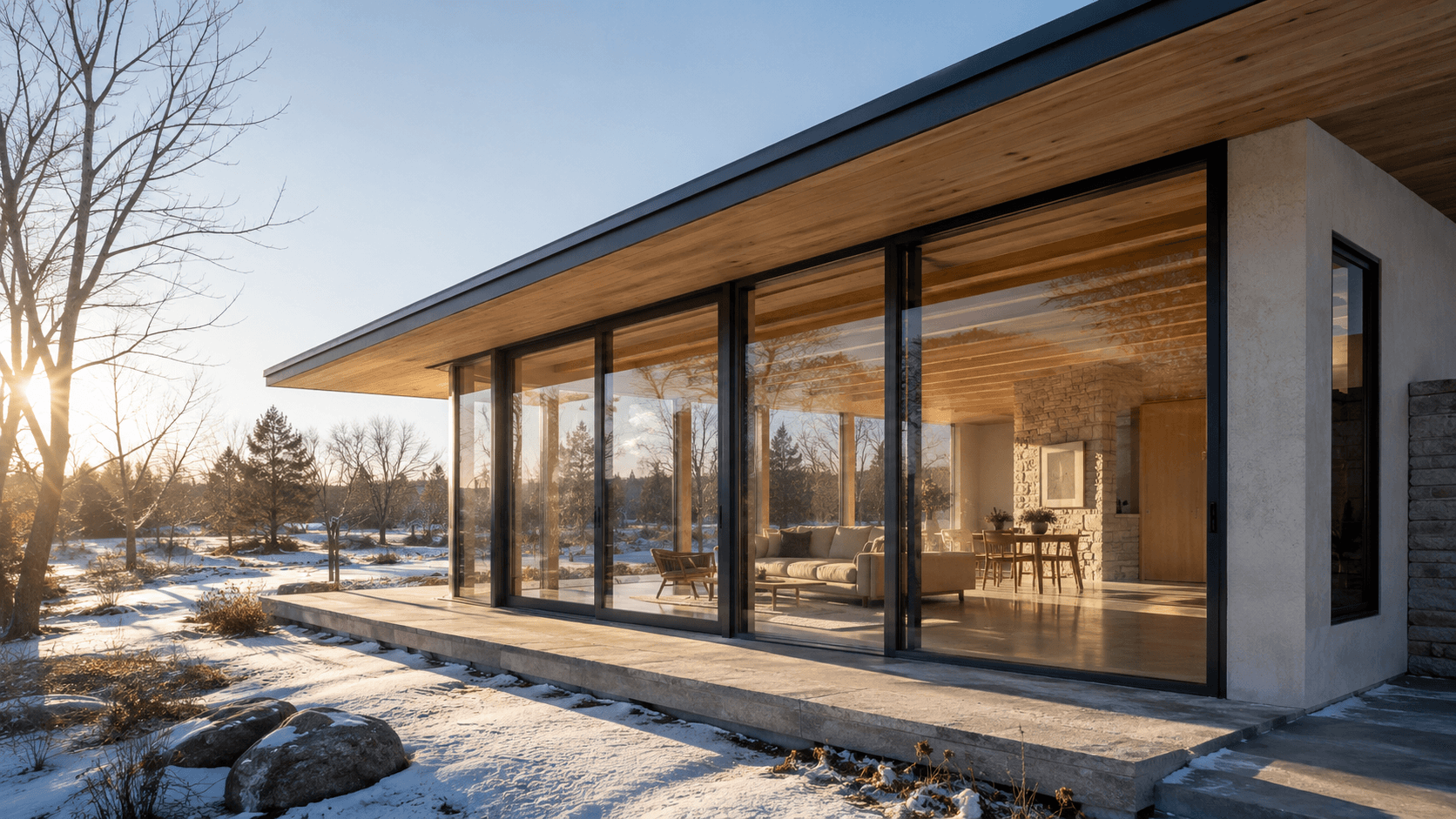
Passive solar heating is one of the most practical ideas in climate-responsive home design. Instead of relying only on a furnace, heat pump, boiler, or wood stove, a home can be designed to capture useful sunlight, hold that warmth for longer, and reduce unnecessary heat loss.
But passive solar heating is often misunderstood.
It does not mean a house will heat itself for free all winter. It does not mean adding solar panels. It does not mean removing the need for a heating system. Passive solar heating is a design strategy that helps a home use winter sun more intelligently, especially when it is supported by good orientation, glazing, thermal mass, insulation, airtightness, and ventilation.
For homeowners and self-builders, the value of passive solar heating is not only lower energy use. It can also mean better daylight, more stable indoor temperatures, and a home that feels more connected to the seasons.
This guide explains how passive solar heating works, when it makes sense, what design variables matter most, and which mistakes to avoid. For a broader foundation, start with passive solar design principles and then use this article to understand the heating side of the strategy.
Key Takeaways
- Passive solar heating uses sunlight as a heat source, but the building design controls how that heat is collected, stored, retained, and released.
- Windows are the collector, but they must be placed, sized, shaded, and specified carefully.
- Thermal mass can store heat, but only when it is exposed to useful solar gain and matched to the glazing strategy.
- Insulation and airtightness are essential, because captured solar heat is not useful if the home loses it too quickly.
- Passive solar heating works best in climates with useful winter sun, but it must still be designed for summer comfort.
- Most passive solar homes still need backup heating, especially during cloudy periods, cold nights, and extreme weather.
What Is Passive Solar Heating?
Passive solar heating is a way of using the sun’s warmth to help heat a building through design rather than through mechanical solar equipment.
In a passive solar home, sunlight enters through carefully placed glazing, warms interior surfaces, and may be stored in materials such as concrete, brick, stone, tile, or masonry. The building envelope then helps keep that warmth inside for as long as practical.
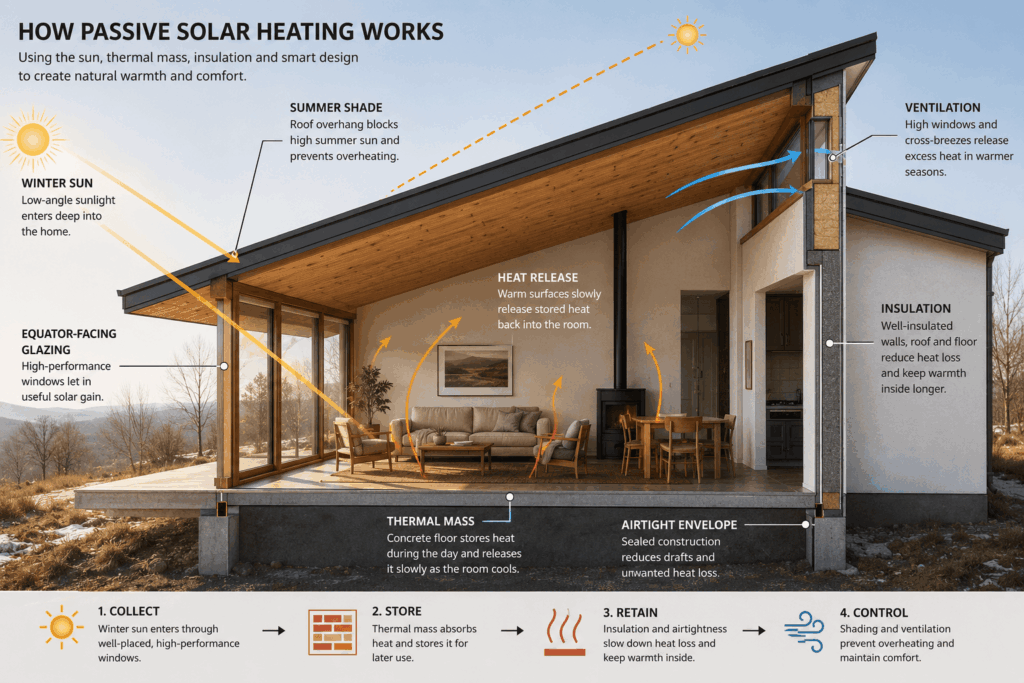
A simple passive solar heating sequence looks like this:
- Winter sun enters through equator-facing windows.
- Sunlight warms interior surfaces and thermal mass.
- The warmed materials slowly release heat back into the room.
- Insulation and airtightness reduce heat loss.
- Shading and ventilation prevent the same strategy from causing overheating in warmer seasons.
For global accuracy, “equator-facing” is often the best term. In the Northern Hemisphere, this usually means south-facing. In the Southern Hemisphere, this usually means north-facing.
Passive solar heating is one part of a larger design approach. If you are new to the topic, read passive solar fundamentals before making design decisions.
Passive Solar Heating Is Not the Same as Solar Panels
Passive solar heating is often confused with solar panels, but they are different systems.
Passive solar heating uses the architecture of the house to collect, store, and manage heat from sunlight.
Photovoltaic solar panels convert sunlight into electricity.
A house can use both. For example, a well-designed passive solar home may reduce heating demand, while solar panels may help supply electricity for appliances, lighting, or a heat pump. But solar panels do not automatically make a home passively heated, and a passive solar home does not need solar panels to use passive solar heating principles.
This distinction matters because passive solar heating should be considered during design. It affects orientation, window placement, room layout, shading, thermal mass, and envelope performance. Solar panels can often be added later, but the best passive solar heating decisions are usually made early.
For a beginner-friendly overview of the full design approach, see Passive Solar Design: A Beginner’s Guide.
Passive Solar Heating Is Not the Same as Passive House
Passive solar heating is also different from Passive House.
Passive solar heating is a design strategy that uses solar gain, windows, thermal mass, shading, and envelope performance to support indoor comfort.
Passive House is a high-performance building standard focused on very low energy demand, airtightness, continuous insulation, high-performance windows, thermal bridge reduction, and mechanical ventilation with heat or energy recovery.
The two approaches can overlap, but they are not identical. A Passive House may use passive solar heating principles, but certification depends on specific performance criteria. A passive solar home may use winter sun effectively without being certified as a Passive House.
For homeowners, the simple distinction is this: passive solar heating is a design approach, while Passive House is a performance standard.
How Passive Solar Heating Works in a Home
Passive solar heating works through four connected functions:
| Function | What It Means | Main Design Elements |
|---|---|---|
| Collect | Let useful winter sun enter the home | Equator-facing glazing, solar access, window performance |
| Store | Hold some of that heat for later | Thermal mass such as concrete, brick, stone, tile, or masonry |
| Retain | Slow down heat loss | Insulation, airtightness, high-performance windows |
| Control | Prevent overheating or unwanted gain | Roof overhangs, exterior shading, ventilation, passive cooling |
The most important word is connected. A home that collects heat but cannot store or retain it may still feel cold at night. A home with good thermal mass but poor solar access may not gain much heat. A home with large windows but no shading may overheat on sunny days.
Passive solar heating is not just about getting sunlight inside. It is about managing the timing, amount, and movement of heat.
The Three Main Types of Passive Solar Heating
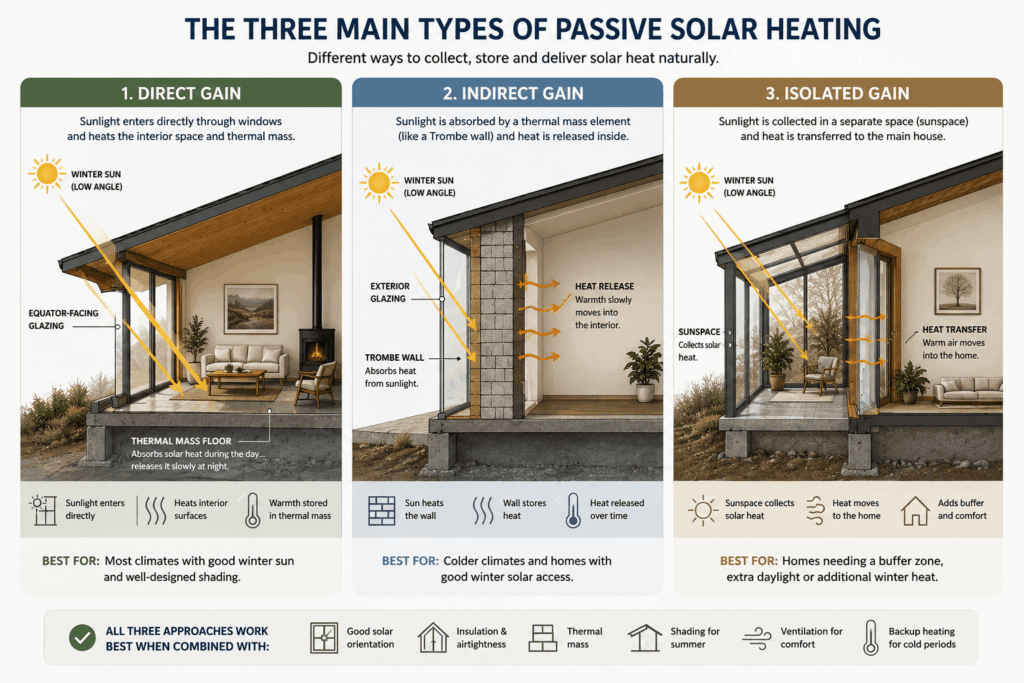
Passive solar heating strategies are often grouped into three main types: direct gain, indirect gain, and isolated gain.
These are useful concepts because they explain where the sun enters, where heat is stored, and how warmth reaches the living space.
For a more complete technical comparison, see passive solar systems.
Direct Gain Passive Solar Heating
Direct gain is the simplest and most common passive solar heating strategy.
In a direct gain home, sunlight enters directly through windows and warms the interior space. The heat may be absorbed by floors, walls, furniture, or dedicated thermal mass.
A typical direct gain strategy may include:
- equator-facing windows,
- exposed concrete, tile, brick, or stone floors,
- good insulation,
- airtight construction,
- exterior shading for summer,
- careful window sizing,
- ventilation for overheating control.
Direct gain can work well because it is simple and easy to understand. The same sunlight that warms the room can also improve daylight and visual comfort.
However, direct gain can also create problems if it is not controlled. Too much glass can cause glare, overheating, nighttime heat loss, and uncomfortable temperature swings. Direct gain works best when glazing, thermal mass, shading, and envelope performance are designed together.
Indirect Gain Passive Solar Heating
Indirect gain separates the solar collection area from the living space with a thermal storage element.
A classic example is a Trombe wall. In this strategy, sunlight passes through exterior glazing and heats a dense wall behind it. The wall stores heat and slowly releases it into the interior.
Indirect gain systems can reduce some of the temperature swings associated with direct gain, but they are more complex. They require careful detailing, climate analysis, ventilation strategy, and overheating control.
Examples of indirect gain elements may include:
- Trombe walls,
- water walls,
- masonry heat storage walls,
- sun-facing thermal storage walls.
Indirect gain is often more architectural and technical than direct gain. It may be appropriate for some projects, but it should not be copied from a diagram without professional review.
Isolated Gain Passive Solar Heating
Isolated gain collects solar heat in a space that is separate from the main living area.
A sunspace is the most common example. The sunspace captures solar heat, and some of that heat may be transferred to the house through doors, windows, vents, or shared walls.
A sunspace can be useful when carefully designed, but it can also overheat badly or lose heat quickly if treated like a normal room.
A sunspace for passive solar heating should be designed differently from a standard glass room or conservatory. It needs climate-specific shading, ventilation, insulation strategy, and a clear purpose.
Isolated gain systems can be attractive because they provide an intermediate space between indoors and outdoors. But they require honest design thinking: is the sunspace meant to be a living room, a heat collector, a plant room, or a seasonal buffer? Trying to make it do everything often leads to poor performance.
Direct, Indirect, and Isolated Gain Compared
| Passive Solar Heating Type | How It Works | Best For | Main Risk |
|---|---|---|---|
| Direct gain | Sunlight enters living spaces directly | Simple homes, daylight-rich spaces, early passive solar design | Glare, overheating, heat loss through too much glass |
| Indirect gain | Sun heats a storage element before reaching the room | Projects needing slower heat release or architectural thermal storage | Complexity, poor detailing, summer overheating |
| Isolated gain | Solar heat is collected in a separate space such as a sunspace | Transitional spaces, seasonal heat collection, buffer zones | Overheating, heat loss, unclear room purpose |
For most beginners and self-builders, direct gain is the easiest strategy to understand and integrate. Indirect and isolated gain systems can be valuable, but they need more careful design.
What Makes Passive Solar Heating Work Best?
Passive solar heating works best when several conditions are present.
It is not enough to have a sunny window. The whole home needs to support the heating strategy.
Useful Winter Solar Access
Passive solar heating needs access to useful winter sun.
Trees, hills, nearby buildings, fences, roof shapes, and future development can all reduce solar access. This is especially important in winter, when the sun is lower in the sky and shadows are longer.
Before relying on passive solar heating, check:
- where winter sun comes from,
- whether the equator-facing side is shaded,
- how long the home receives sun during winter days,
- whether future buildings or trees could block sunlight,
- whether the main rooms can be placed where solar gain is useful.
If you are still choosing a site or planning a layout, read passive solar orientation before finalizing the house position.
Correct Window Placement and Glazing
Windows are the main solar collectors in most passive solar heating strategies.
But windows are also weak points in the envelope. They usually lose more heat than insulated walls and can create glare or overheating if they are too large or poorly placed.
Important glazing factors include:
- orientation,
- window area,
- window-to-wall ratio,
- U-value or U-factor,
- Solar Heat Gain Coefficient, or SHGC,
- frame performance,
- airtight installation,
- exterior shading,
- interior comfort near glass.
In heating-focused climates, equator-facing windows may use glazing that allows useful solar gain, while still limiting heat loss. In warmer climates, lower solar heat gain and stronger shading may be more important.
There is no single best window specification for every passive solar home. The right choice depends on climate, orientation, room use, energy goals, and budget.
For more detail, read passive solar windows and use the window-to-wall ratio calculator for early design checks.
Enough Thermal Mass to Smooth Temperature Swings
Thermal mass helps store heat and release it slowly.
In passive solar heating, thermal mass can reduce the problem of a sunny room becoming too hot during the day and too cold at night. It acts like a heat buffer.
Common thermal mass materials include:
- concrete,
- brick,
- stone,
- tile,
- adobe,
- rammed earth,
- masonry,
- dense plaster.
Thermal mass is most useful when it is:
- exposed to sunlight or warm indoor air,
- not covered by insulating finishes,
- located in rooms that receive useful solar gain,
- matched to the amount of glazing,
- protected from unwanted summer sun,
- supported by good insulation and airtightness.
Thermal mass is not a substitute for insulation. Insulation slows heat loss. Thermal mass stores heat. A passive solar home usually needs both.
For a deeper explanation, read thermal mass and review material options in passive solar materials.
A Strong Building Envelope
Passive solar heating is much less useful if the home loses heat too quickly.
A strong building envelope helps retain the heat collected during the day. This includes:
- roof insulation,
- wall insulation,
- floor insulation,
- airtightness,
- high-performance windows,
- well-sealed doors,
- reduced thermal bridges,
- careful construction detailing.
A common beginner mistake is focusing on solar gain before reducing heat loss. In many homes, better insulation, airtightness, and windows may be more important than simply increasing the amount of glass.
A well-designed passive solar heating strategy should always start with energy efficiency. The U.S. Department of Energy notes that successful passive solar homes need properly oriented windows and thermal mass, but they also depend on good design and energy-efficient construction: U.S. Department of Energy: Passive Solar Homes.
Seasonal Shading and Overheating Control
Passive solar heating is usually designed for winter, but the house must be comfortable all year.
The same windows that collect winter sun can cause overheating in spring, summer, and fall if they are not shaded correctly.
Shading strategies may include:
- roof overhangs,
- exterior blinds,
- shutters,
- pergolas,
- louvers,
- deep window reveals,
- balconies,
- deciduous trees where appropriate,
- vertical fins for low-angle sun.
Equator-facing windows are often easier to shade with horizontal overhangs because winter and summer sun angles are different. East and west windows are harder to control because the sun is lower in the sky.
For early checks, use the roof overhang calculator and read more about passive solar shading and overhangs.
Climate Considerations for Passive Solar Heating
Passive solar heating is not equally useful in every climate.
In some climates, winter solar gain can be a major comfort benefit. In others, avoiding heat gain is more important than collecting it. The strategy should always be climate-specific.
| Climate Type | Passive Solar Heating Potential | Main Design Priority | Main Risk |
|---|---|---|---|
| Cold climate | Often useful when winter sun is available | Capture sun, store heat, reduce heat loss | Too much glazing without enough insulation |
| Temperate climate | Useful, but seasonal balance matters | Combine winter gain with summer shading | Overheating during mild seasons |
| Hot-dry climate | Limited heating use, but useful in cool nights or winters | Shading, controlled gain, night cooling | Thermal mass storing unwanted heat |
| Hot-humid climate | Usually less heating-focused | Reduce heat gain, improve shade and airflow | Designing for heat collection when cooling is the real priority |
| Mixed climate | Useful with careful control | Flexible shading and balanced glazing | Winter-focused design causing summer discomfort |
In cold climates, passive solar heating can support comfort when combined with strong insulation and airtightness. In mixed climates, it must be carefully balanced with cooling. In hot-humid climates, the priority may be passive cooling rather than passive heating.
For a wider comparison, read passive solar design by climate.
Example: A Simple Passive Solar Heating Strategy
Imagine a small home in a cold but sunny winter climate.
The owners want the living area to feel brighter and warmer during winter days. The site has good solar access on the equator-facing side, and the main living spaces can be placed there.
A basic passive solar heating strategy might include:
- a compact building form to reduce heat loss,
- equator-facing living room windows,
- limited east and west glazing,
- high-performance windows,
- exposed tile or concrete floor in the sunny living area,
- roof overhangs sized for seasonal sun angles,
- strong roof and wall insulation,
- good airtightness,
- planned ventilation,
- backup heating for cloudy periods and cold nights.
In this example, the passive solar heating strategy is not just the sunny windows. It is the combination of solar access, glazing, thermal mass, insulation, airtightness, shading, and backup systems.
The likely benefit is better winter daylight and more stable daytime comfort. But the design still needs professional review, local climate data, and overheating checks.
For early project planning, compare this type of strategy with the passive solar design checklist.
Common Passive Solar Heating Mistakes
1. Thinking Passive Solar Heating Means Free Heat
Passive solar heating can reduce heating demand, but it does not guarantee free heating. Weather, climate, insulation, glazing, thermal mass, construction quality, and user behavior all affect results.
2. Adding Too Much Glass
More glass can mean more solar gain, but it can also mean more nighttime heat loss, glare, and overheating. Window area should be calculated and checked, not guessed.
3. Forgetting That Windows Lose Heat
Even good windows usually insulate less than walls. A heating strategy that depends on oversized glass may lose more heat than it gains during cloudy periods or at night.
4. Using Thermal Mass Without Sunlight
Thermal mass needs access to useful heat. A heavy floor or wall that never receives solar gain may not contribute much to passive solar heating.
5. Ignoring Summer Shading
A winter heating strategy can become a summer overheating problem. Shading should be designed from the beginning, not added after discomfort appears.
6. Copying a Passive Solar Heating Design From Another Climate
A design that works in a cold, sunny region may perform poorly in a cloudy, humid, or hot climate. Local climate data matters.
7. Treating Backup Heating as a Failure
Backup heating is normal. Passive solar heating can reduce demand, but most homes still need a reliable heating system for comfort, safety, and code compliance.
8. Ignoring Air Leakage
Air leaks can remove heat quickly and create drafts. Airtightness is a key part of making passive solar heating useful.
9. Designing for Sunny Days Only
A good home must also work on cloudy days, cold nights, and extreme weather. Passive solar heating should support the home, not be the only strategy.
10. Confusing Passive Solar Heating With Passive House
Passive solar heating is a design strategy. Passive House is a performance standard. They can overlap, but they are not the same thing.
Passive Solar Heating Checklist for Homeowners
Use this checklist before relying on passive solar heating in a home design.
- Is the local winter climate sunny enough to support useful solar gain?
- Does the site have good solar access on the equator-facing side?
- Are main living spaces placed where winter sun can improve comfort?
- Is the window area sized carefully by orientation?
- Are U-value and SHGC considered for each window type?
- Is thermal mass located where it can absorb useful heat?
- Is the home well insulated?
- Is airtightness part of the construction strategy?
- Is ventilation planned for indoor air quality and moisture control?
- Are roof overhangs or exterior shading designed for summer?
- Are east and west windows controlled?
- Is backup heating included?
- Has overheating risk been checked?
- Has the design been reviewed against local climate data and building codes?
This checklist is not a final design method, but it can help you ask better questions early.
Questions to Ask Your Architect or Designer
Before approving a passive solar heating strategy, ask:
- How much winter sun does this site actually receive?
- Which rooms are intended to receive passive solar heat?
- How much equator-facing glazing is appropriate for this climate?
- What SHGC and U-value are recommended for the windows?
- Where is thermal mass located, and how will it receive heat?
- How will the design avoid overheating in spring, summer, and fall?
- How will heat loss be reduced at night and during cloudy weather?
- What backup heating system is still required?
- Has the strategy been checked against local climate data?
- Which assumptions should be verified through energy modeling?
These questions help turn passive solar heating from a vague idea into a design conversation.
FAQ
What is passive solar heating?
Passive solar heating is a design strategy that uses sunlight, windows, thermal mass, insulation, airtightness, and shading to help warm a home naturally.
Does passive solar heating replace a heating system?
Usually, no. Passive solar heating can reduce heating demand, but most homes still need backup heating for cloudy weather, cold nights, extreme temperatures, and code requirements.
What is the best orientation for passive solar heating?
For global design, useful heating windows usually face the equator. In the Northern Hemisphere, this often means south-facing. In the Southern Hemisphere, this often means north-facing.
What materials store passive solar heat?
Common thermal mass materials include concrete, brick, stone, tile, adobe, rammed earth, masonry, and dense plaster. They work best when exposed to useful solar gain.
Is passive solar heating useful in hot climates?
In hot climates, passive solar heating may be less important than shading and cooling. Some hot-dry climates may still benefit from controlled heat storage during cool nights or cooler seasons, but the design must avoid overheating.
Is passive solar heating expensive?
Some passive solar heating decisions, such as orientation and room layout, are early design choices rather than expensive add-ons. Other elements, such as high-performance windows, thermal mass, or exterior shading, may affect the budget.
Can passive solar heating be added to an existing home?
Some improvements can be added, such as better insulation, window upgrades, exterior shading, thermal mass surfaces, or room-use changes. However, orientation and basic building form are much easier to optimize in new construction.
Conclusion
Passive solar heating is not a single feature. It is a coordinated home design strategy that uses winter sun, glazing, thermal mass, insulation, airtightness, shading, and ventilation to support comfort.
The most important lesson is balance. A passive solar heating strategy should collect useful heat, store it where appropriate, retain it through a strong envelope, and control it so the home does not overheat in warmer seasons.
For homeowners and self-builders, the best time to think about passive solar heating is early, before the house position, floor plan, window layout, and roof overhangs are fixed.
Next step: Download the Passive Solar Design Checklist and use it to review whether your early home design supports passive solar heating without creating overheating risks.
For a deeper explanation of the different ways passive solar heat can be collected and distributed, continue with passive solar systems.
Next step: check your own project
Try the ideas on your own project with the free passive solar design tools. It is free and runs in your browser.
Keep your results in one place
The free Passive Solar Design Checklist & Project Brief is a printable PDF with pages for your site’s sun angles, orientation, glazing per facade, shading and thermal mass, plus 12 questions to take to your architect or designer.