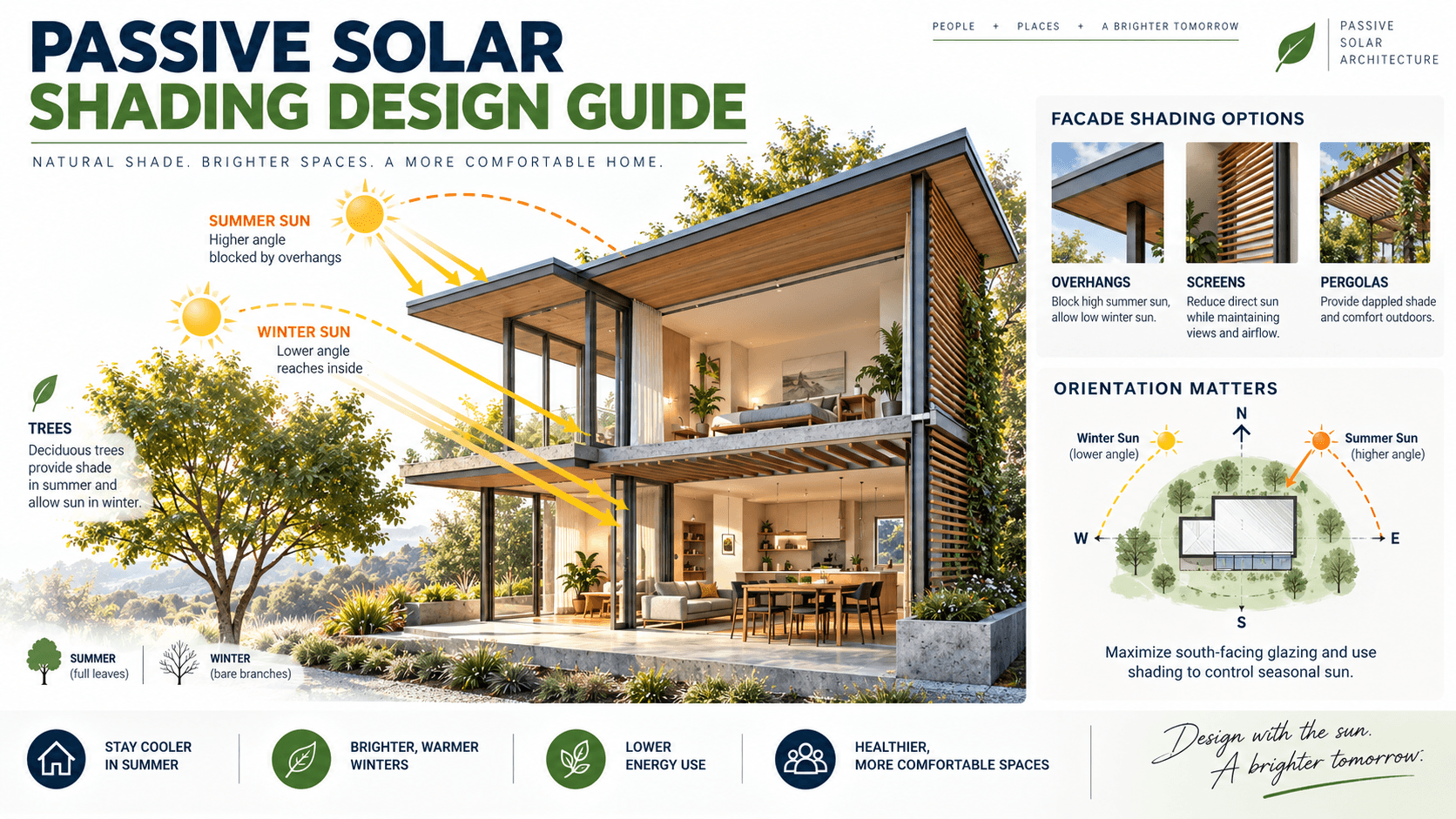
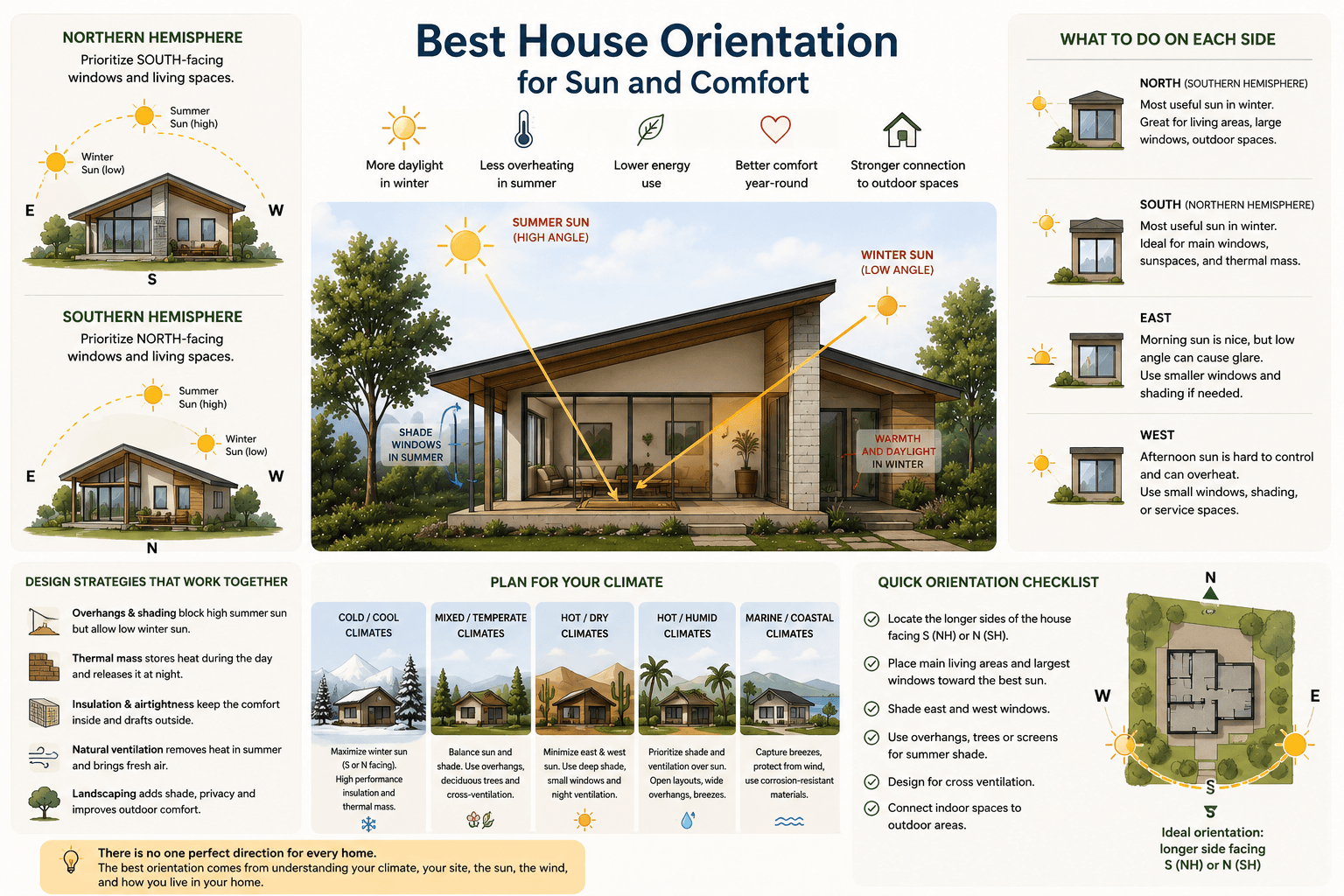
The best house orientation for sun and comfort is usually one that places the main living areas and the largest useful windows toward the equator. In the Northern Hemisphere, this usually means facing south. In the Southern Hemisphere, it usually means facing north.
But good orientation is not just about sunlight. A comfortable house also needs shade in summer, protection from overheating, good daylight, usable outdoor spaces, natural ventilation, insulation, and a layout that matches how people live during the day.
In passive solar design, orientation is one of the earliest and most important decisions because it affects almost every other design choice: window placement, roof overhangs, thermal mass, room layout, heat loss, glare, cooling demand, and indoor comfort.
This guide explains how to orient a house for sun and comfort in a practical, climate-aware way.
Try it on your own design: Passive Solar Orientation Calculator (free, about a minute).
Key Takeaways
- The best orientation depends on climate, latitude, site conditions, and how the house is used.
- For passive solar design, the most important windows usually face the equator: south in the Northern Hemisphere and north in the Southern Hemisphere.
- East and west windows are harder to control because low morning and afternoon sun can cause glare and overheating.
- A long east-west building form often helps place more rooms and windows on the solar side.
- Orientation works best when combined with shading, insulation, airtightness, thermal mass, and ventilation.
- There is no universal “perfect direction” for every home. A cold climate house and a hot-humid climate house may need very different priorities.
What Does House Orientation Mean?
House orientation means the direction a building faces on its site. It includes the direction of the front facade, but for energy and comfort, the more important question is this:
Where are the main windows, living spaces, outdoor areas, and shaded surfaces located in relation to the sun and wind?
A house may have a front door facing the street, but the main living spaces may face the garden, courtyard, mountains, sea, or best solar direction. For passive solar design, the orientation of the windows and rooms matters more than the symbolic direction of the entrance.
For a deeper introduction, see Passive Solar Orientation and Passive Solar House Design.
The Simple Rule: Face the Main Solar Windows Toward the Equator
For a global audience, the most accurate rule is:
- Northern Hemisphere: prioritize south-facing glazing.
- Southern Hemisphere: prioritize north-facing glazing.
- Near the equator or in hot climates: solar access may be less important than shading, ventilation, and avoiding overheating.
This is why “south-facing windows” is not always the correct global advice. In Australia, South Africa, Argentina, and New Zealand, the useful winter sun usually comes from the north. In Europe, North America, and most of Asia, it usually comes from the south.
A better phrase is equator-facing glazing.
Why Orientation Matters for Comfort
Orientation affects comfort in several ways. It influences how much winter sun enters the home, how easily summer sun can be blocked, how bright the rooms feel, and how much mechanical heating or cooling may be needed.
1. Solar Heat Gain
In colder seasons, sunlight can help warm interior spaces when it enters through well-placed windows. This is especially useful when the sun reaches thermal mass such as concrete, brick, stone, tile, or other dense materials that can absorb and slowly release heat.
However, solar heat gain must be controlled. Too much glass without enough shading or thermal mass can make a house uncomfortable, especially in sunny or mixed climates.
2. Daylight
Good orientation improves natural light without relying on oversized windows. Equator-facing windows often provide more predictable daylight than east or west windows, which can create low-angle glare.
North-facing windows in the Northern Hemisphere, or south-facing windows in the Southern Hemisphere, usually provide softer indirect light. These can be useful for studios, workspaces, staircases, and rooms where glare control is important.
3. Summer Overheating
A house can be sunny but uncomfortable if it is not shaded correctly. East and west sun is especially difficult because it is low in the sky. Roof overhangs are often less effective for low-angle sun, so vertical fins, shutters, external blinds, trees, screens, or carefully placed service spaces may be needed.
To learn more, see Passive Solar Shading & Overhangs and the Roof Overhang Calculator.
4. Natural Ventilation
Orientation should also respond to wind. In hot and humid climates, capturing breezes may be more important than maximizing solar gain. In cold or windy climates, the design may need to reduce exposure to winter winds while still allowing controlled ventilation.
This is why house orientation should always begin with site and climate analysis, not a fixed rule copied from another region.
Best Orientation by Climate Type
The best house orientation changes by climate. The table below gives a practical starting point.
| Climate Type | Orientation Priority | Main Design Goal | Common Risk |
|---|---|---|---|
| Cold climate | Maximize winter sun on the equator-facing side | Use solar gain to support heating and daylight | Heat loss through oversized or poorly insulated glazing |
| Temperate climate | Balance winter sun with summer shade | Improve comfort across seasons | Overheating during shoulder seasons |
| Hot-dry climate | Limit harsh sun, use shade, courtyards, and thermal mass carefully | Reduce daytime heat and support night cooling | Too much exposed glass or poorly managed thermal mass |
| Hot-humid climate | Prioritize shade, airflow, and reduced solar exposure | Improve ventilation and reduce cooling load | Copying cold-climate passive solar rules |
| Mixed climate | Design for both heating and cooling periods | Control seasonal trade-offs | Good winter performance but poor summer comfort |
For climate-specific guidance, visit Passive Solar Design by Climate.
The Best Building Shape for Solar Orientation
A common passive solar strategy is to stretch the house along an east-west axis. This means the longer facades face the solar side and the opposite side, while the shorter facades face east and west.
This form can make it easier to:
- place more rooms on the sunny side;
- reduce difficult east and west glazing;
- use roof overhangs more effectively;
- bring daylight deeper into living spaces;
- organize rooms by temperature and use.
However, this is not always possible. Urban lots, views, slopes, neighbors, planning rules, and street access may limit the ideal orientation. A good design adapts the passive solar strategy to the real site instead of forcing a perfect diagram onto an imperfect plot.
Room Layout: Where Should Each Room Go?
Orientation is not only about the exterior. It also affects the internal plan. Rooms used during the day usually benefit most from sunlight and daylight, while storage, bathrooms, garages, utility rooms, and circulation spaces can often act as buffers.
Best Rooms for the Sunny Side
- Living room
- Dining area
- Kitchen or breakfast area
- Home office used during the day
- Children’s play area
- Sunroom, if carefully designed and shaded
Best Rooms for the Cooler or Buffer Side
- Storage rooms
- Bathrooms
- Laundry
- Garage
- Pantry
- Stairs and corridors
- Bedrooms in climates where cooler sleeping conditions are preferred
This is not a strict rule. In hot climates, bedrooms may need protection from afternoon heat. In cold climates, morning sun in bedrooms may be pleasant. The best layout depends on lifestyle, climate, and the daily use of each room.
Orientation Comfort Matrix
Use this simple matrix as an early design guide.
| Direction | Typical Benefit | Typical Problem | Best Use |
|---|---|---|---|
| Equator-facing side | Useful winter sun, easier seasonal shading | Can overheat if glazing is too large or unshaded | Main living spaces, controlled passive solar windows |
| East | Morning light | Low-angle sun and glare | Bedrooms, breakfast areas, limited glazing |
| West | Evening light and views | Afternoon overheating risk | Carefully shaded spaces, service areas, limited glass |
| Pole-facing side | Soft daylight, lower direct solar gain | Less winter heat gain | Workspaces, utility rooms, circulation, smaller windows |
How Much Can a House Deviate from the Ideal Orientation?
Many sites cannot face the house perfectly toward the equator. That does not mean passive solar design is impossible.
Small deviations can often be managed with better window placement, adjusted overhangs, side shading, room layout, and stronger building envelope design. Larger deviations may require a more careful strategy, especially if the house relies heavily on solar heat gain.
Instead of asking only “Is this house perfectly oriented?”, ask:
- Where does the winter sun actually reach?
- Which rooms need the most daylight and warmth?
- Can the roof, windows, and shading be adjusted?
- Are east and west windows limited or protected?
- Is there enough insulation and airtightness to reduce heat loss?
- Is there enough thermal mass for the amount of solar gain?
- Will the house remain comfortable in summer?
If you are planning a project, the Passive Solar Orientation Calculator can help you think through early orientation decisions.
House Orientation and Windows
Windows are often the most sensitive part of orientation. They provide light, views, ventilation, and solar heat gain, but they can also cause heat loss, glare, and overheating.
In passive solar design, window strategy should consider:
- window direction;
- glazing area;
- glass performance;
- solar heat gain coefficient;
- U-value;
- shading;
- thermal mass;
- room function;
- local climate.
Large windows are not automatically better. A passive solar house needs the right amount of glazing in the right place, with the right shading and interior materials.
For more detail, see Passive Solar Windows, Passive Solar Window Placement, and the Window-to-Wall Ratio Calculator.
Thermal Mass: The Missing Part of Orientation
Orientation and windows bring sunlight into the house. Thermal mass helps manage what happens next.
Without enough useful thermal mass, a sunny room may heat up quickly and then cool down quickly. With well-placed thermal mass, solar heat can be absorbed during sunny periods and released later as temperatures drop.
Useful thermal mass must usually be:
- inside the insulated building envelope;
- exposed to interior air or direct/indirect sun;
- matched to the amount of glazing;
- protected from unwanted summer heat gain;
- appropriate for the climate.
Thermal mass is not always beneficial in the same way. In some hot and humid climates, heavy mass without night cooling can hold unwanted heat. In cold climates, mass can support comfort when combined with good insulation and solar access.
Learn more in Thermal Mass and the Thermal Mass Calculator.
Shading: The Difference Between Sunny and Comfortable
A well-oriented house should not simply collect sun. It should collect useful sun when needed and block unwanted sun when it causes discomfort.
Good shading may include:
- roof overhangs;
- balconies;
- external blinds;
- sliding screens;
- vertical fins;
- pergolas;
- deciduous trees;
- covered outdoor rooms;
- neighboring buildings or landscape elements.
Fixed horizontal overhangs often work best on the equator-facing side because the summer sun is higher and the winter sun is lower. East and west windows usually need different shading because the sun is lower in the sky.
This is one reason a house with too much west-facing glass can be difficult to keep comfortable, even if it has good insulation.
Practical Step-by-Step Process
Step 1: Identify Your Hemisphere and Solar Direction
First, determine the equator-facing direction for your site. In the Northern Hemisphere, this is generally south. In the Southern Hemisphere, it is generally north.
Step 2: Study the Site
Look at slope, views, trees, neighboring buildings, road access, noise, privacy, and local planning restrictions. The best solar orientation must still work as a real home on a real site.
Step 3: Check the Climate
Decide whether the main challenge is heating, cooling, humidity, glare, wind, or a mix of several conditions. This will shape the orientation strategy.
Step 4: Place the Main Living Spaces
Put the rooms used most during the day where they can benefit from daylight, controlled solar gain, and views. Avoid giving the best solar side only to corridors or rarely used rooms.
Step 5: Control East and West Glazing
Use smaller windows, external shading, landscape, or service spaces to reduce overheating from low-angle sun.
Step 6: Match Windows With Thermal Mass
If the design uses passive solar heating, make sure the amount of glass is balanced with enough useful thermal mass and good insulation.
Step 7: Design Shading Early
Do not leave shading until the end. Overhangs, pergolas, balconies, shutters, and screens should be part of the architectural concept from the beginning.
Step 8: Test the Design
Use sun path diagrams, simple calculators, climate data, and professional energy modeling where needed. Early testing can reveal overheating, glare, or winter shading problems before construction.
For a broader design process, see the Passive Solar Design Checklist and Passive Solar Calculations.
Application Example: A Temperate Climate Home
Imagine a small home in a temperate climate with cool winters and warm summers. The site has a street on the west, a garden on the equator-facing side, and some neighboring shade in the morning.
A practical orientation strategy might include:
- placing the living room and dining area toward the equator-facing garden;
- using moderate glazing rather than a fully glazed facade;
- adding a roof overhang sized for seasonal sun control;
- using a concrete slab or tiled floor as interior thermal mass;
- limiting west-facing glass near the street;
- placing storage, stairs, or bathrooms on the less favorable side;
- adding operable windows for cross-ventilation;
- checking summer comfort before finalizing the window sizes.
This type of design does not depend on one perfect rule. It works because orientation, glazing, shading, layout, ventilation, and thermal mass support each other.
Common House Orientation Mistakes
Mistake 1: Thinking the Front Door Direction Is the Main Issue
The direction of the entrance may matter for access, culture, street presence, or views, but it is not the same as passive solar orientation. The location of windows and living spaces is usually more important for comfort.
Mistake 2: Using Too Much Glass
Large sunny windows can look attractive but may cause overheating, glare, or heat loss if they are not designed carefully.
Mistake 3: Ignoring East and West Sun
East and west sun is often more difficult to shade than equator-facing sun. West-facing glass is especially risky in many warm and mixed climates.
Mistake 4: Copying Cold-Climate Advice in Hot Climates
In hot climates, the goal may be to avoid direct sun, create shade, and support air movement. Passive solar design is not only about heating.
Mistake 5: Forgetting Thermal Mass
If solar gain enters the house but there is no useful thermal mass, temperatures may swing too much. Thermal mass should be planned together with windows and insulation.
Mistake 6: Designing Shading Too Late
Shading is not decoration. It is part of the comfort system of the house. It should be designed together with orientation and window placement.
Best House Orientation Checklist
| Question | Why It Matters |
|---|---|
| Which direction is equator-facing on this site? | Defines the main solar opportunity. |
| What is the main climate challenge? | Heating, cooling, humidity, and wind require different strategies. |
| Where should the main living spaces go? | Room layout determines who benefits from sun and daylight. |
| Are east and west windows controlled? | Low-angle sun can cause glare and overheating. |
| Is shading designed for each facade? | Different orientations need different shading solutions. |
| Is there enough thermal mass for solar gain? | Mass helps stabilize indoor temperatures. |
| Is the building envelope strong enough? | Orientation cannot compensate for poor insulation or air leakage. |
| Has the design been tested with sun and climate data? | Testing reduces the risk of comfort problems. |
Passive Solar Orientation Is Not the Same as Solar Panels
House orientation for passive solar comfort is not the same as roof orientation for photovoltaic panels.
Passive solar orientation focuses on how the building itself uses sun, shade, thermal mass, windows, and layout to improve comfort. Solar panels are active systems that generate electricity. A home can have solar panels without being passively designed, and a passive solar home can work without solar panels.
For a clear introduction to the concept, read What Is Passive Solar Architecture?.
Passive Solar Orientation Is Also Not Passive House Certification
Passive solar design and Passive House are related but not identical.
Passive solar design focuses on climate-responsive use of sun, shade, form, windows, and thermal mass. Passive House is a performance-based building standard with specific requirements for energy demand, airtightness, thermal bridge control, ventilation, and comfort.
A Passive House can use passive solar design, but not every passive solar home is a certified Passive House.
Conclusion: The Best Orientation Is Climate-Aware
The best house orientation for sun and comfort is not a single compass direction that works everywhere. It is a climate-aware design strategy.
In many locations, the main solar windows should face the equator: south in the Northern Hemisphere and north in the Southern Hemisphere. But orientation must also respond to overheating risk, wind, views, site limits, room layout, shading, insulation, glazing, and thermal mass.
A comfortable house does not just face the sun. It uses the sun carefully, blocks it when needed, and creates rooms that feel good throughout the day and across the seasons.
For your next step, explore Passive Solar Design Principles, Passive Solar Orientation, and the Passive Solar Orientation Calculator.
FAQ
What is the best house orientation for sunlight?
For passive solar design, the best orientation usually places the main windows toward the equator. This means south-facing windows in the Northern Hemisphere and north-facing windows in the Southern Hemisphere.
Is a south-facing house always best?
No. South-facing is usually useful in the Northern Hemisphere, but it is not a universal rule. In the Southern Hemisphere, north-facing is usually better for winter sun. In hot climates, shade and ventilation may be more important than solar gain.
Which direction should living rooms face?
Living rooms often work best on the sunny, equator-facing side of the house because they are used during the day and can benefit from daylight and controlled solar warmth.
Are west-facing windows bad?
West-facing windows are not always bad, but they can cause overheating and glare because afternoon sun is low and strong. They usually need careful shading or reduced glass area.
Can a passive solar house be slightly off orientation?
Yes. Many passive solar homes are not perfectly aligned. The design can often compensate with adjusted window placement, shading, insulation, thermal mass, and room layout.
Does orientation matter if I have solar panels?
Yes. Solar panels generate electricity, but passive solar orientation affects indoor comfort, daylight, heating, cooling, and window performance. They are related but different design issues.
What if my site faces the wrong direction?
You can still improve comfort with careful window placement, skylights, clerestory windows, shading, insulation, landscape design, and room layout. A site analysis is the best first step.
How do I check the sun path for my site?
You can use sun path diagrams, solar angle tools, climate data, and passive solar calculators. For early planning, start with the Solar Angle Calculator.
Next step: check your own project
Check how far your main facade is from ideal with the Passive Solar Orientation Calculator. It is free and runs in your browser.
Keep your results in one place
The free Passive Solar Design Checklist & Project Brief is a printable PDF with pages for your site’s sun angles, orientation, glazing per facade, shading and thermal mass, plus 12 questions to take to your architect or designer.