The solar heat gain coefficient (SHGC) tells you how much of the sun’s heat that strikes a window ends up inside the building. It is one of the two most important numbers on a window label, alongside the U-factor, and in a passive solar home it often matters more than people expect.
Our Passive Solar Windows guide introduces SHGC alongside other glazing properties. This article focuses on SHGC alone: what it measures, what typical values look like, how it differs from the g-value and shading coefficient, and how to choose a sensible value for each façade.
Key points
- SHGC is a number from 0 to 1. An SHGC of 0.40 means about 40 % of incident solar heat enters the building.
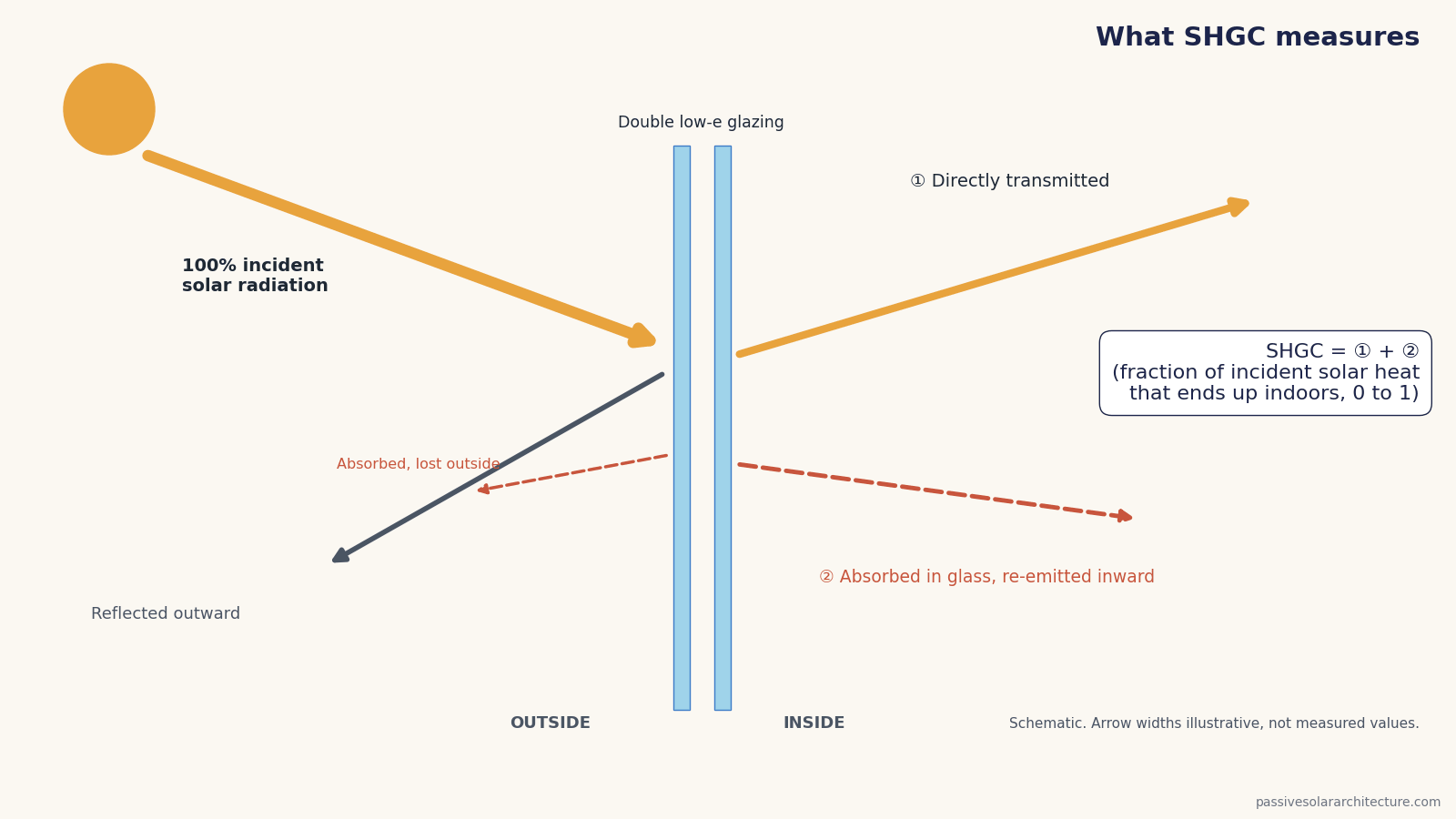
- It includes sunlight transmitted directly and heat absorbed by the glass and then released inward.
- Neither “higher” nor “lower” is always better: you usually want higher SHGC on equator-facing windows in heating climates and lower SHGC on east and west windows and in hot climates.
- SHGC (solar gain) and U-factor (heat loss) are separate properties; good windows are selected on both.
- Exterior shading changes the effective SHGC of the whole opening more than any glass coating can.
What does the solar heat gain coefficient measure?
When solar radiation hits glazing, part of it is reflected, part is transmitted straight through, and part is absorbed by the glass. Some of the absorbed heat is released to the outside and some to the inside. SHGC is the sum of two parts:
- the solar radiation transmitted directly into the room, and
- the share of absorbed heat that is re-emitted inward.
The result is expressed as a fraction between 0 and 1, with no units. In North America, the NFRC energy performance label reports SHGC for the whole window, including the frame. Because the frame is opaque, whole-window SHGC is lower than the centre-of-glass value quoted in many glass datasheets.
How to calculate solar heat gain through a window
For early design, the solar heat entering through a window can be estimated with one simple equation:
Q = A × SHGC × I
- Q is the solar heat gain (W, or kWh over a period),
- A is the window area (m²),
- I is the solar irradiance on the window plane (W/m², or kWh/m² over a period).
Example: a west window on a summer afternoon. Suppose a 2 m² (22 ft²) west-facing window receives 650 W/m² (about 206 Btu/h·ft²) of late-afternoon sun. With SHGC 0.60, the gain is 2 × 0.60 × 650 = 780 W, roughly the output of a small electric heater. With SHGC 0.30, it is 390 W. Over a three-hour afternoon, that is the difference between about 2.3 kWh and 1.2 kWh of heat in one room.
Example: an equator-facing window on a winter day. The chart below applies the same equation to a 2 m² (22 ft²) window that receives 3.5 kWh/m² (about 1.1 kBtu/ft²) over a clear winter day.
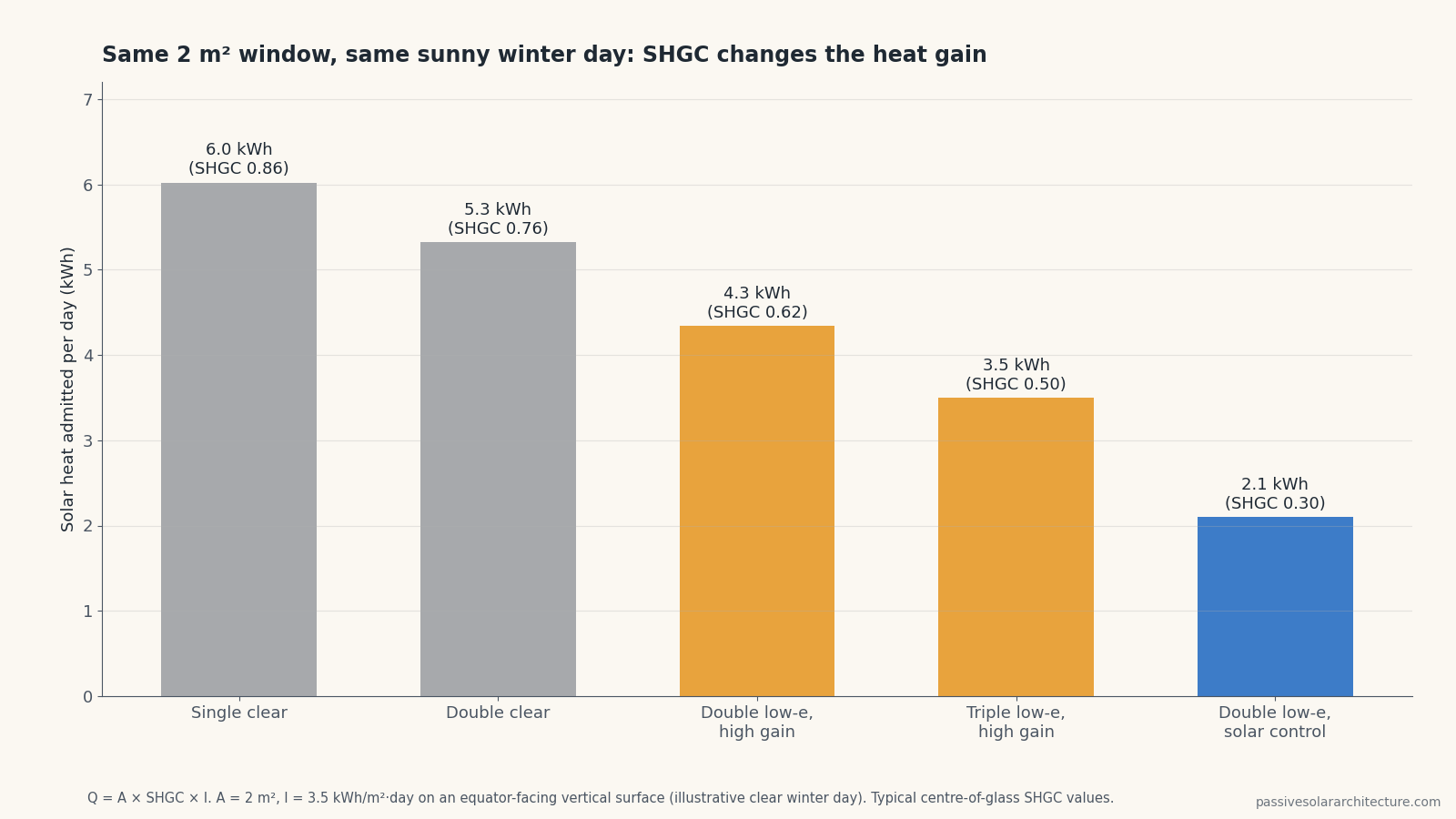
In winter, a higher SHGC is useful free heat. In summer, the same property becomes a cooling load unless the window is shaded. That is why SHGC must be chosen together with orientation and shading.
Typical SHGC values by glass type
The values below are indicative centre-of-glass ranges for common insulating glass units. Whole-window ratings are lower because of the frame, and products vary widely, so always use the manufacturer’s certified data for a real project.
| Glazing type | Typical SHGC | Typical U-value (W/m²K) | Visible transmittance | Typical role |
|---|---|---|---|---|
| Single clear | ≈ 0.86 | ≈ 5.8 | ≈ 0.90 | Legacy; high gain and high loss |
| Double clear | ≈ 0.76 | ≈ 2.7–2.9 | ≈ 0.81 | Older standard double glazing |
| Double low-e, high solar gain | 0.55–0.70 | 1.4–1.9 | 0.70–0.78 | Equator-facing glass in heating climates |
| Double low-e, solar control (spectrally selective) | 0.25–0.40 | 1.1–1.6 | 0.55–0.70 | East/west glass, cooling climates |
| Triple low-e, high solar gain | 0.45–0.55 | 0.5–0.8 | 0.60–0.72 | Very cold climates, passive solar south glass |
| Triple low-e, solar control | 0.25–0.35 | 0.5–0.8 | 0.50–0.65 | Cold climates with overheating-prone façades |
| Tinted or reflective | 0.20–0.50 | varies | often below 0.50 | Commercial glare/solar control; dims daylight |
The position of a low-e coating within the unit matters: coatings closer to the outside generally reduce SHGC more than the same coating further in. Ask the supplier for the SHGC of the exact unit, not just the coating name.
Is a higher or lower SHGC better?
It depends on what you want the window to do. NFRC summarises the trade-off simply: a low SHGC helps keep a home cool in summer, while a higher SHGC can help keep it warm in winter. In passive solar design, the choice is made window by window:
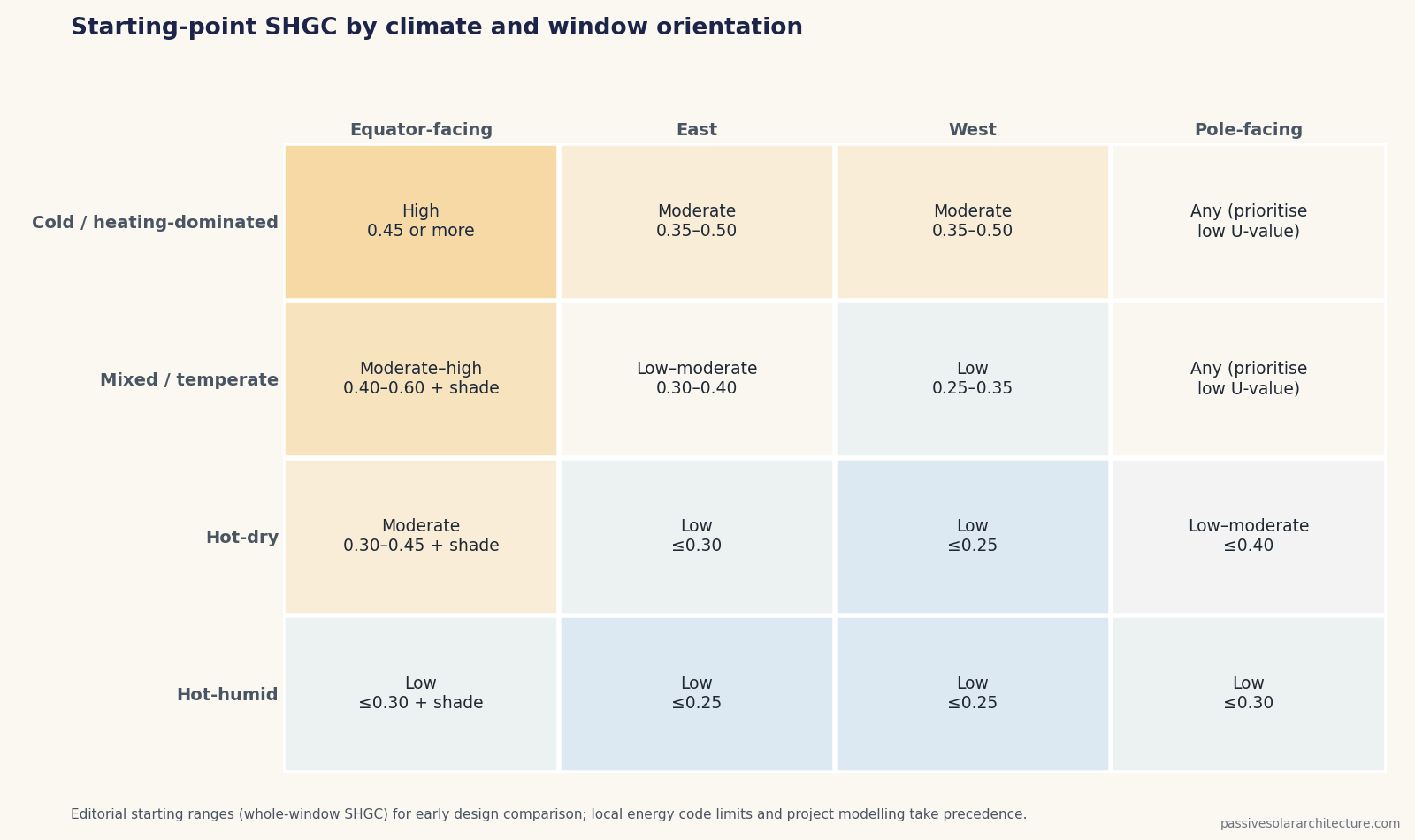
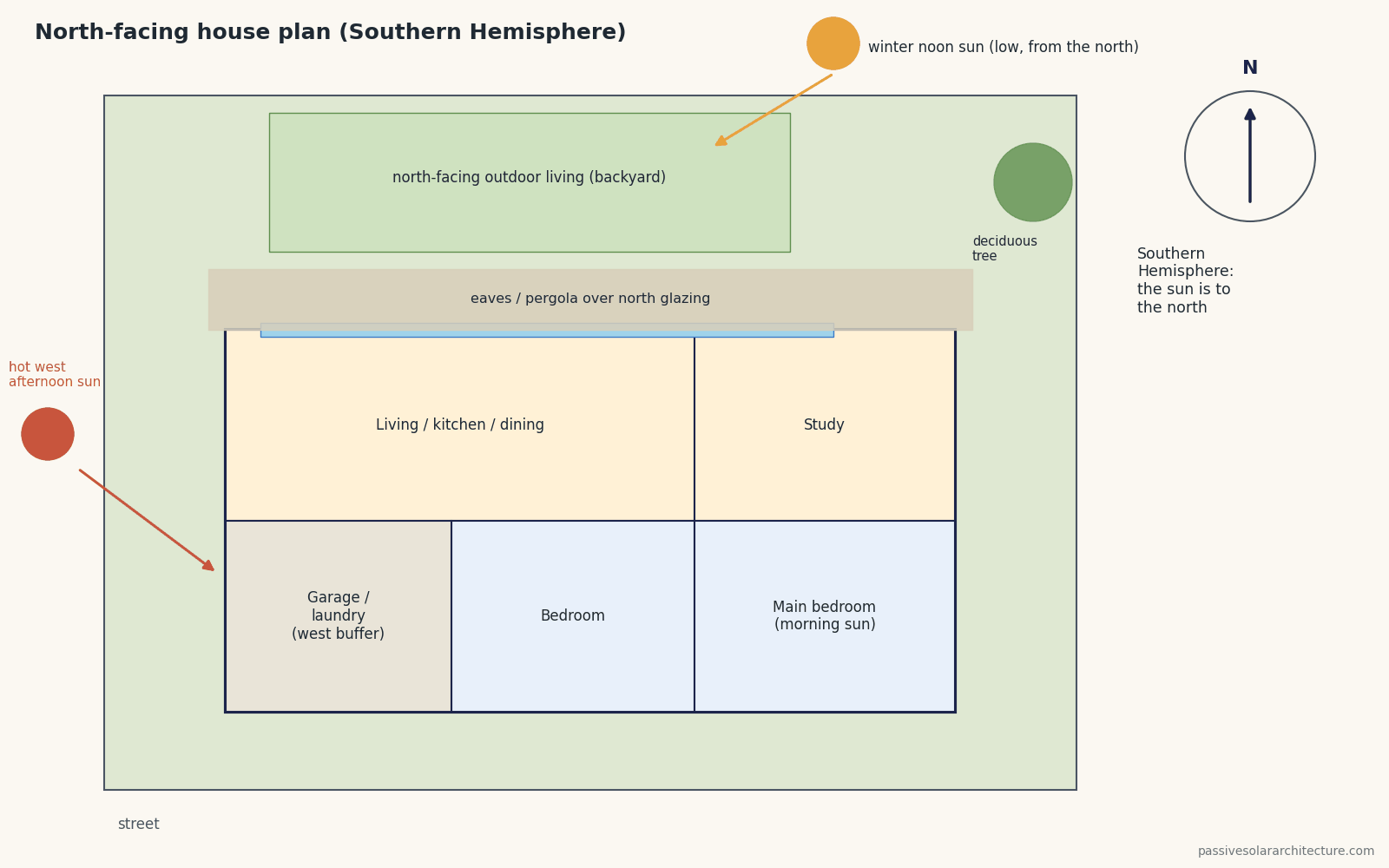
- Equator-facing windows in heating-dominated climates: choose a high SHGC and control summer sun with an overhang. These windows are your solar collectors.
- East and west windows: choose a lower SHGC in most climates. Low-angle morning and afternoon sun is difficult to shade with overhangs, as our shading guide explains.
- Pole-facing windows: they receive little direct sun in mid-latitudes, so prioritise a low U-value and good daylight.
- Hot climates: choose a low SHGC almost everywhere and combine it with exterior shading.
Energy codes and labelling programmes often set limits. In warm climate zones, prescriptive codes such as the US IECC cap SHGC, while cold zones may set no maximum. ENERGY STAR window criteria also vary by climate zone. Always check the edition adopted where you build.
SHGC vs U-factor
These two numbers answer different questions:
| SHGC | U-factor / U-value | |
|---|---|---|
| Question it answers | How much solar heat gets in? | How fast heat flows through because of the indoor–outdoor temperature difference? |
| Scale | 0 to 1, no units | W/m²K (or Btu/h·ft²·°F) |
| Better is… | Depends on climate and orientation | Lower is better in almost all climates |
| Main design lever | Coating type, tint, shading | Number of panes, low-e, gas fill, spacers, frame |
A good passive solar window combines a low U-value with an SHGC appropriate for its orientation. Triple glazing, for example, lowers U-value substantially but also reduces SHGC, so in a heating climate it is worth selecting a high-solar-gain triple unit for equator-facing glass.
SHGC vs g-value vs shading coefficient
Different regions and older documents use related terms:
- g-value (solar factor, total solar energy transmittance) is used in Europe under EN 410. It describes the same physical quantity as SHGC, usually for the centre of glass. A g-value of 0.50 is broadly comparable with a centre-of-glass SHGC of 0.50, although test conditions differ slightly.
- Shading coefficient (SC) is an older measure comparing a glass to 3 mm (⅛ in) clear glass. It converts approximately as SHGC ≈ 0.87 × SC, so SC 0.50 corresponds to SHGC of about 0.43. SHGC has largely replaced SC.
- Visible transmittance (VT) is the share of visible light admitted. The ratio VT/SHGC, called the light-to-solar-gain ratio, shows whether a glass admits daylight while blocking heat; values of about 1.25 or more are generally described as spectrally selective.
Shading changes the effective SHGC
SHGC on a label describes the window alone. What matters in the room is the solar gain of the whole opening, including shading devices. Exterior shading intercepts sunlight before it reaches the glass. Interior blinds reflect some light back out, but much of the heat has already passed through the glass.
- An overhang on an equator-facing window can give near-full sun in winter and substantial shade in summer, effectively a seasonal SHGC.
- Exterior blinds, shutters and screens can reduce summer gains far more than switching to a lower-SHGC glass, while keeping winter gains high when they are open.
- Deep reveals and side fins help on east and west windows where sun angles are low.
Size overhangs with the Roof Overhang Calculator, and check spring and autumn exposure with our shoulder-season shading check.
How to choose SHGC for a passive solar home: step by step
- Identify the climate type and whether heating or cooling dominates. Our Site & Climate Analysis guide explains how.
- List windows by orientation. Group equator-facing, east, west and pole-facing glazing.
- Check window area first. An oversized window cannot be rescued by glass choice alone. Use the Window-to-Wall Ratio Calculator and our window sizing guide.
- Assign a starting SHGC for each group using the matrix above.
- Design exterior shading for each façade before reducing SHGC further.
- Check the thermal mass available to absorb winter gains on equator-facing rooms; see Thermal Mass in Passive Solar Design.
- Verify certified whole-window values and local code limits, then test the design in an energy model for important decisions.
Using different glass on different façades is common and usually inexpensive to specify. Make sure the window schedule and orders identify each unit’s coating, so the right glass ends up on the right façade.
SHGC and passive solar systems
SHGC also matters for glazing that is not a normal window. The glass in front of a Trombe wall should normally have a high SHGC, because its purpose is to admit solar heat to the storage wall. The glazing of a sunspace or passive solar greenhouse needs a balance between winter collection and summer overheating, which is usually managed with ventilation and shading rather than low-SHGC glass.
Frequently asked questions
What is a good solar heat gain coefficient for windows?
There is no universal value. As a starting point, about 0.45 or more suits equator-facing windows in cold climates, and 0.25–0.35 suits east and west windows and most glazing in hot climates. Local code limits take precedence.
Is SHGC 0.25 good?
For west windows or hot climates, yes: it blocks about three-quarters of incident solar heat. On equator-facing windows in a cold climate, it throws away useful winter heat.
Does a lower SHGC make a room darker?
Not necessarily. Spectrally selective low-e coatings reduce solar heat more than visible light. Tinted and reflective glass, however, usually reduces both. Compare the visible transmittance (VT) as well as SHGC.
Is SHGC the same as the g-value?
They describe the same physical concept. SHGC on an NFRC label is a whole-window value; a European g-value is usually for the glass alone, so the two numbers for the same product are not always identical.
Can window film change SHGC?
Yes. Solar control films (affiliate link) lower SHGC, often reducing visible light too. Check the glass manufacturer’s guidance first, because films can increase thermal stress in some insulating glass units.
Continue learning
- Passive Solar Window Design by Climate
- Passive Solar Window Placement
- House Orientation for Energy Efficiency
- Passive Solar Glossary
Published and editorially checked: 14 October 2026. Values are indicative ranges for early design comparison; use certified product data and the energy code adopted for your project. Featured image, charts and diagrams: AI-generated original schematics, checked by our editorial team; they are not to scale and not a design calculation.
Recommended tools
This section contains affiliate links. As an Amazon Associate we earn from qualifying purchases, at no extra cost to you. We only list items that relate to this page; we have not tested specific products.
- Solar control window films: reduce solar heat gain on existing glass; check the glass maker's guidance first. Browse on Amazon
- Solar power (irradiance) meters: measure how much sunlight actually reaches a window or wall, in W/m². Browse on Amazon
Next step: check your own project
Try the ideas on your own project with the free passive solar design tools. It is free and runs in your browser.
Keep your results in one place
The free Passive Solar Design Checklist & Project Brief is a printable PDF with pages for your site’s sun angles, orientation, glazing per facade, shading and thermal mass, plus 12 questions to take to your architect or designer.